In this article
You’ve tried them all.
The bullet journal that lasted 4 days. The Notion dashboard that took 6 hours to build and never got opened again. The $12/month productivity app that sent you guilt-tripping notifications. The sticky notes that became wallpaper.
None of them worked. And here’s the thing: it’s not your fault. (If you want to skip straight to what does work, here’s my complete guide to ADHD tools for adults.)
The Problem Isn’t You. It’s the Hidden Assumption.
Every mainstream productivity system — every planner, every app, every method with a bestselling book behind it — is built on one quiet, unexamined assumption:
You will show up with roughly the same executive function every day.
That’s it. That’s the whole flaw. Pull on that thread and the entire genre unravels.
Think about what a typical system actually demands of you. Review your tasks each morning. Prioritize them rationally. Estimate how long things will take. Update statuses as you go. Do a weekly review. Maintain the system even on the days the system is the last thing you care about.
Every one of those steps is an executive function task. Planning, prioritizing, time estimation, task switching, self-monitoring — the exact cognitive functions that ADHD disrupts. A productivity system that requires consistent executive function to operate is asking ADHD brains to spend the one resource they don’t reliably have, just to keep the lights on.
It’s like a bank that charges you a fee for being broke.
For a neurotypical brain, “spend 10 minutes maintaining your system” is a trivially cheap subscription. For an ADHD brain, some days it’s cheap and some days it costs everything you have — and the system has no idea which day it is. It just keeps billing.
The Three Specific Lies
Inside that big assumption, mainstream systems make three specific bets that lose against ADHD wiring:
1. “You can prioritize rationally.” You can’t — not the way the system means it. The ADHD brain prioritizes by interest, urgency, and novelty, not importance. You know the report matters more than reorganizing your bookmarks. Knowing has never once been the problem. Any system built on “just rank your tasks by importance and work the list” is built on a motivational engine you don’t have.
2. “You’ll maintain the system.” Maintenance is where every system goes to die. The bullet journal needs daily migration. Notion needs gardening. The app needs you to triage the 40 stale tasks silently judging you. Maintenance is sustained, low-stimulation, repetitive effort — the precise category of work ADHD brains struggle with most. Any system that requires upkeep to stay useful is dead on arrival; the only question is the date on the certificate.
3. “Structure equals productivity.” For ADHD brains, rigid structure triggers avoidance. An hour-by-hour time-blocked calendar doesn’t feel like support — it feels like a cage, and your brain starts planning the jailbreak immediately. The more elaborate the structure, the more there is to rebel against, and the more spectacular the eventual collapse.
This is why a blank brain dump page with no categories beats a color-coded Notion database with 47 properties. Not because it’s more powerful. Because it asks less of the part of your brain that’s already overdrawn.
The Real Killer: Systems That Can’t Survive a Bad Day
Here’s the part almost nobody designs for.
You will miss a day. With ADHD, you’ll miss three. Not because you’re lazy — because executive function fluctuates, and some days the gas tank is just empty.
Watch what a traditional system does when that happens. The planner shows a graveyard of blank pages. The habit app shows a broken streak. The task list shows yesterday’s failures stacked on top of today’s obligations, like the system has been keeping receipts.
For a neurotypical user, that’s a nudge. For an ADHD brain — which has usually absorbed decades of “not living up to potential” messaging — it’s shame. And shame doesn’t motivate ADHD brains. It triggers avoidance. The app gets deleted. The planner goes in the drawer. Not because the system stopped working, but because opening it started to hurt.
So here’s the design test that actually matters, the one no feature list ever mentions:
What does it cost to come back after you disappear?
If returning after a bad week means migrating tasks, confronting a wall of overdue flags, or “catching up” before you can start — the system has a re-entry fee. And any system with a re-entry fee will eventually price you out.
Forgiveness isn’t a nice-to-have feature for ADHD brains. It’s the entire load-bearing wall. A forgiving system has a blank page waiting with no commentary. No streak to mourn. No backlog staring at you. Yesterday doesn’t exist unless you decide it does. You start where you are, today, every time — and starting costs nothing.
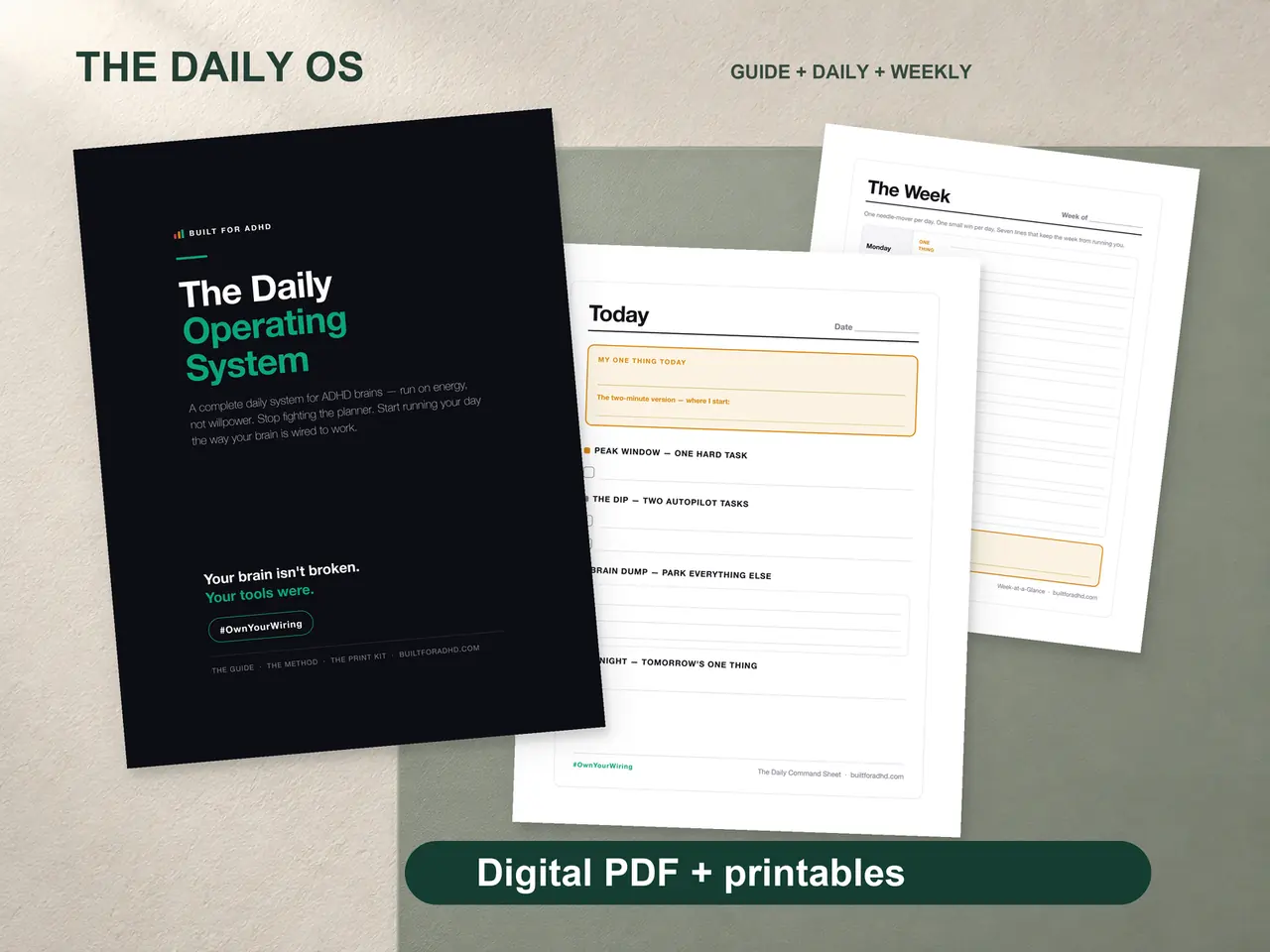
This is one reason printable systems quietly outperform apps for a lot of ADHD adults. A PDF doesn’t send notifications. It doesn’t track your absence. It can’t guilt-trip you, because paper has no memory of your bad week. Skipped four days? Print a fresh page. The Daily OS is built around exactly this: every day starts blank, on purpose, because the restart is the system.
What Actually Works: 3 Principles
After testing dozens of approaches — on ourselves, because we actually have ADHD — three principles survive contact with a distracted brain:
1. Dump First, Organize Later
Your brain has 47 tabs open. The first step isn’t to organize them — it’s to get them out. Write every thought, task, worry, and half-formed idea into one massive, unstructured space. No categories. No priorities. Just capture.
Capture has to be friction-free, because the moment your brain has to make a filing decision (“Is this Work or Personal? What tag? What priority?”), it bails. This is the entire philosophy behind the Daily OS brain dump pages — blank space, you write, that’s it — and it’s why a dedicated brain dump page beats every “intelligent” capture tool you’ve abandoned.
2. Sort by Energy, Not Importance
“What’s your #1 priority?” is a trap question for ADHD brains. We don’t work that way.
Instead, sort by how you feel: What do I have energy for RIGHT NOW? That’s your “Do Today” list. Everything else goes into “This Week,” “Someday,” or “Delete” — and you’d be amazed how much qualifies for Delete. Energy-based sorting works because it’s the one question your brain can always answer instantly, even on the bad days. No executive function required. (More on this in energy-based task management.)
3. Make Completion Feel Good
Neurotypical productivity systems treat task completion as its own reward. For ADHD brains, checking a box isn’t enough dopamine. You need visible proof that you accomplished something.
That’s why every system we build includes a Done List — a page where you write down what you finished, by hand, and watch the evidence pile up. Not an animation, not a notification. A growing record in your own handwriting that says you are, in fact, someone who does things. Your brain needs the hit, and paper delivers it without an app deciding when you’ve earned it.
The Bottom Line
Every system you’ve abandoned assumed you’d bring consistent executive function to the table, then punished you when you couldn’t. That’s not a personal failure. That’s a design failure — theirs, not yours.
The fix isn’t more discipline, a better app, or finally becoming “a planner person.” The fix is a system that assumes the bad days are coming and makes restarting free.
Stop blaming yourself for failing at systems that were never designed for your brain. Start using tools that match your wiring. (The complete guide to ADHD tools for adults shows exactly what wiring-matched tools look like.)
Your brain isn’t broken. Your tools are.