In this article
The report is due tomorrow. Your laptop is open. The document is ready. You know exactly what you need to write.
And you cannot start.
You’ve been sitting here for 45 minutes. You’ve checked your phone 12 times. You’ve rearranged your desk. You’ve googled “how to focus with ADHD.” You’ve opened the document, stared at the blank page, closed it, and opened Twitter instead.
This isn’t laziness. This isn’t a lack of motivation. This is ADHD task paralysis — and it’s one of the most frustrating symptoms of ADHD because everyone around you (including you) thinks you’re just not trying.
You are trying. Your brain is blocked. There’s a difference.
What Task Paralysis Actually Is
Task paralysis is a failure of executive function initiation. Your brain’s “start” button doesn’t fire.
In neurotypical brains, the process looks like: recognize task → evaluate task → initiate action. It’s almost automatic. “I need to write the report” leads directly to fingers on keyboard.
In ADHD brains, the process stalls at step 3. You recognize the task. You evaluate it (often over-evaluate it, imagining every possible difficulty). But the signal to initiate action doesn’t arrive. Your prefrontal cortex, which manages executive function, doesn’t generate enough activation to start.
The result: you’re stuck in a loop of wanting to do the thing, knowing how to do the thing, and being physically unable to begin the thing.
This is neurological, not motivational. Telling yourself to “just start” is like telling someone with a broken leg to “just walk.”
Why Big Tasks Trigger Paralysis
Not every task causes paralysis. You can probably scroll your phone for hours. You can probably deep-dive into a random Wikipedia rabbit hole. You can probably hyperfocus on something that interests you.
Paralysis hits hardest with tasks that are:
- Big and ambiguous — “Write the report” vs. “Type one sentence”
- Boring — low novelty, low stimulation
- Not urgent yet — the deadline pressure hasn’t hit
- Emotionally loaded — you’re afraid of doing it wrong
- Multi-step — your brain sees all the steps at once and freezes
The common thread: the task feels too large for your brain to conceptualize the first physical action. “Write the report” is an outcome, not an action. Your brain doesn’t know what to do with an outcome. It needs an action — a specific, physical, small movement.
The Tiny First Step Method
The method is exactly what it sounds like: you identify the absolute smallest physical action that begins the task. Not the task itself — the first micro-movement.
Task: Write the report Tiny first step: Open the document
Task: Clean the kitchen Tiny first step: Pick up one dish
Task: Exercise Tiny first step: Put on shoes
Task: Do taxes Tiny first step: Open the IRS website
Task: Respond to emails Tiny first step: Open inbox and click the first email
The tiny first step must be:
- Physically specific. Not “start working” but “open the document” or “type the first word.”
- Completable in under 2 minutes. If it takes longer, it’s too big. Break it down further.
- So small it feels stupid. If it doesn’t feel embarrassingly easy, it’s too big.
Why This Works Neurologically
The tiny first step works because it tricks the brain’s initiation barrier. Your prefrontal cortex can’t generate enough activation to “write a 3,000-word report.” But it CAN generate enough to “open a document.” That’s a trivially small action — low risk, low effort, low ambiguity.
Once you’ve taken the first step, something shifts. Motion creates momentum. The document is now open. You’re looking at it. You might type a word. Then a sentence. Then a paragraph.
This is Newton’s law of ADHD: a brain at rest stays at rest. A brain in motion tends to stay in motion. The first step overcomes static friction.
You don’t need to commit to finishing. You don’t even need to commit to working for 5 minutes. You just need to take the tiny first step. If you stop after that, fine. But most of the time, you won’t. Because the hardest part was always starting.
Building It Into a System
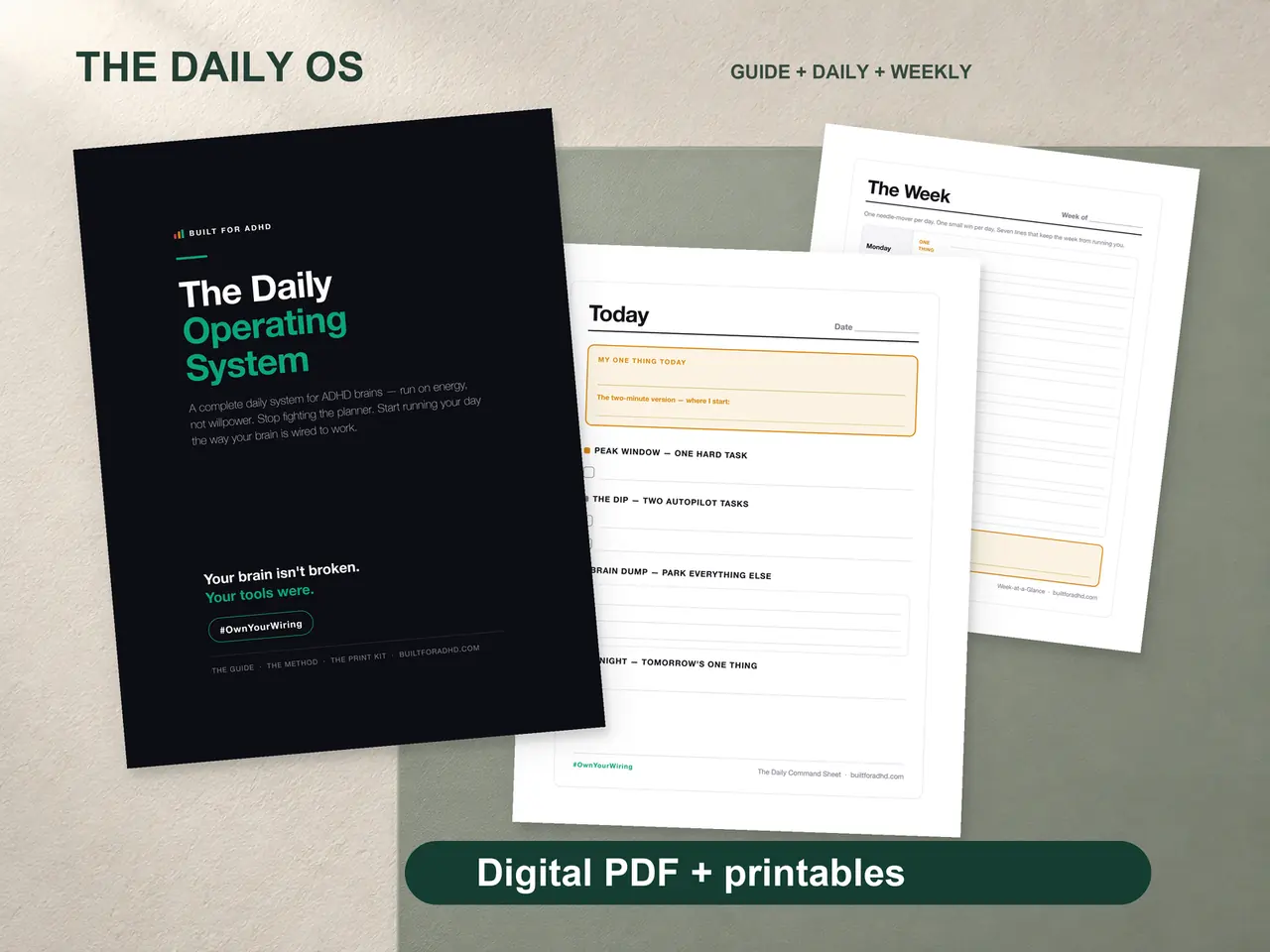
The Daily OS makes tiny first steps the default. When you sort tasks into the “Do Today” bucket, you make an Action Card for each task. Every card includes:
- The task — what you’re doing
- The tiny first step — the micro-action to begin
- Time estimate — how long the whole task takes (5 / 15 / 25 / 45 min)
- A reward — what you get when you finish
You don’t have to identify the tiny first step yourself. The system prompts you to define it when creating the task, and then surfaces it when you need it.
This matters because in the moment of paralysis, your executive function is already impaired. Asking a paralyzed brain to also break down the task is asking it to use the exact function that’s failing. The system does the breaking-down in advance, during a moment when you have the capacity.
The “Just Open It” Technique
If you don’t have a system yet, here’s the simplest version of the tiny first step method:
Whatever you’re avoiding, just open it.
- Avoiding a document? Open the document. That’s it.
- Avoiding email? Open your inbox. Don’t respond — just open it.
- Avoiding a project? Open the folder it lives in.
- Avoiding a conversation? Type the person’s name in a new message. Don’t write anything yet.
“Just open it” works because it’s a tiny first step that applies to almost anything. And the act of opening — seeing the thing you’ve been avoiding — often breaks the spell. The task is usually smaller than the monster your brain has been building.
When Tiny Steps Aren’t Enough
Sometimes the paralysis is deep. The tiny first step doesn’t work because even “open the document” feels impossible. When this happens:
Change the environment. Move to a different room. Go to a coffee shop. Sit on the floor. Physical environment changes can reset your brain’s state enough to unstick the paralysis.
Body double. Work next to another person. They don’t need to help or even know what you’re doing. The presence of another human doing work creates enough social activation to bypass the initiation failure.
Reduce the stakes. Tell yourself: “I’m going to do this badly.” Give yourself explicit permission to produce garbage. The paralysis often isn’t about the task — it’s about the imagined standard. Lowering the bar lets you start.
Use a timer. Set a 5-minute timer and commit to only 5 minutes. When it goes off, you can stop. Most of the time you’ll keep going, but knowing you CAN stop reduces the activation energy.
Paralysis Isn’t Permanent
ADHD task paralysis comes and goes. Some days, starting is easy. Some days, it’s a fight. The pattern is normal — it’s part of the condition, not a reflection of your character.
Having a system — a brain dump to capture what’s overwhelming you, sorted tasks with tiny first steps pre-defined, and visible rewards when you finish — doesn’t eliminate paralysis. But it makes the paralysis shorter. Instead of 45 minutes frozen in your chair, it’s 5 minutes frozen followed by “okay, my tiny first step is to open this document.” (That system is part of a bigger set of ADHD tools that actually work — all built around lowering activation energy.)
Your brain isn’t lazy. It’s stuck. The tiny first step is the smallest possible crowbar to unstick it.