In this article
Let’s be honest about your relationship with money.
You check your bank account like it’s a horror movie. You have no idea where $400 went last month. There are at least two subscriptions you’re paying for that you haven’t used since 2024. And the phrase “make a budget” triggers the same fight-or-flight response as “we need to talk.”
This isn’t because you’re bad with money. It’s because every budgeting system you’ve tried was designed for brains that work differently than yours. (Everything below is part of my ADHD money management guide.)
Why Traditional Budgets Fail ADHD Brains
The category problem
Traditional budgets ask you to assign every transaction to a category. Groceries. Gas. Entertainment. Dining out.
But what about the $47 Amazon order that was half impulse, half necessity? What about the Uber Eats you ordered because executive dysfunction made cooking impossible? What about the $12 duplicate purchase of something you already own but forgot about?
ADHD spending doesn’t fit neatly into categories. And the moment a system makes you think hard about where something goes, you stop using it.
The consistency problem
Budgeting apps like YNAB work great — if you reconcile your accounts weekly, review your spending monthly, and adjust your categories quarterly.
That’s three different maintenance tasks, all requiring the kind of boring, sustained effort that ADHD brains actively resist. You’ll do it passionately for two weeks. Then you’ll forget. Then you’ll feel guilty. Then you’ll delete the app.
The shame problem
Most budgets are designed to show you how much you overspent. Red numbers. Exceeded limits. Angry pie charts.
For ADHD brains, shame isn’t motivating — it’s paralyzing. The moment your budget makes you feel bad, you stop looking at it. And a budget you don’t look at is worse than no budget at all.
The ADHD Tax: The Hidden Cost Nobody Talks About
Before we fix your budget, let’s name the elephant in the room: the ADHD tax. (We wrote a full breakdown of the ADHD tax with real examples — this is the short version.)
The ADHD tax is the real money you lose specifically because of ADHD symptoms:
- Impulse purchases — the $200 gadget you “needed” at midnight
- Late fees — because you forgot to pay the bill, not because you couldn’t afford it
- Duplicate purchases — buying something you already own because you forgot
- Unused subscriptions — that gym membership, that streaming service, that app
- Convenience spending — Uber Eats because cooking felt impossible today
- Hyperfocus purchases — the $500 hobby kit for the hobby you dropped in three days
Every ADHD adult pays this tax. And no mainstream budgeting app accounts for it because they don’t know it exists.
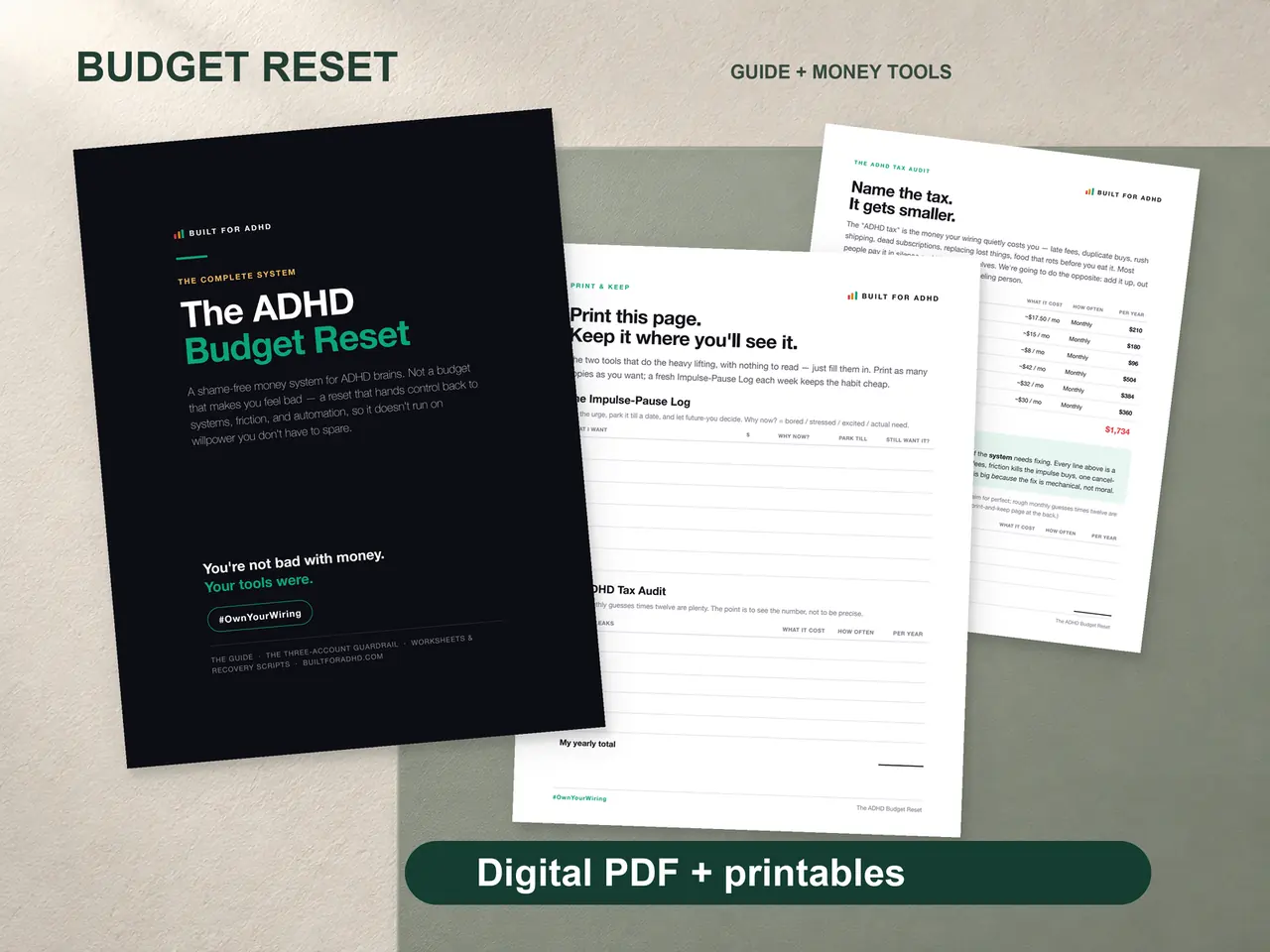
The Budget Reset has a dedicated ADHD Tax category. Not to shame you — to make it visible. Because you can’t fix what you can’t see.
A Budgeting System That Actually Works With ADHD
Here’s the approach that sticks:
Step 1: Dump, don’t categorize
Spent money? Open the Money Dump page. Write three things: what you bought, how much, and whether it came in or went out.
That’s it. No categories. No tags. No thinking about whether Starbucks is “dining” or “entertainment.” Just log it and move on. Takes 10 seconds.
The buckets do the sorting for you. Coffee goes under Wants. Electric bill, Needs. That random Amazon purchase at 2am? ADHD Tax — it has its own space. You decide where something goes, but the page makes it obvious.
Step 2: Look at the summary (once a week)
The Monthly View page shows you everything at a glance:
- Total income vs. total spending
- Where your money actually goes
- Your ADHD Tax total — the number you’ve been avoiding
- Month-over-month trends — are you getting better or worse?
You don’t need to analyze this. Just look at it. Awareness alone changes behavior.
Step 3: Track what you didn’t buy
This is the secret weapon. The Impulse Log tracks items you almost bought but didn’t. Every time you close a shopping tab or walk away from an impulse purchase, write down the item and the price.
The tracker keeps a running total of money saved. Watch that number grow. $50 saved. $100 saved. $250 saved. That’s real money your ADHD brain almost spent but didn’t — and seeing it accumulate is a dopamine hit that reinforces the behavior.
Step 4: Audit your subscriptions (once)
The Subscription Tracker gives you a page for every recurring charge: amount, frequency, annual cost, and one critical column — “Do I actually use this?”
Most ADHD adults are paying $50-$200/month in subscriptions they’ve forgotten about. One 20-minute audit can save you over $1,000/year. The page makes it a checkbox exercise, not a research project.
The Mindset Shift
Traditional budgets say: “Here’s how much you’re allowed to spend.”
The ADHD approach says: “Here’s where your money actually goes. Now you can decide if that’s what you want.”
No limits. No restrictions. No shame. Just visibility.
Because ADHD adults don’t overspend due to lack of willpower. They overspend because the spending is invisible. The moment you see the ADHD tax as a real number — not a vague guilt — you naturally start reducing it.
Start Today (Literally)
You don’t need to set up categories. You don’t need to import transaction history. You don’t need a “fresh start on Monday.”
Download the Budget Reset. Open it. Write down what you spent today. That’s your whole first session.
The system builds itself from there. No maintenance. No weekly reviews. Just dump your spending and check the summary when you feel like it.
And if money is only one of the fires, the rest of our printable ADHD tools run on the same dump-it-and-see-it principle.
Your bank account doesn’t have to be a horror movie. It just needs subtitles.