You made a chore chart. It was beautiful. Color-coded, laminated, stuck to the fridge with magnets. Everyone was excited about it on Sunday. By Tuesday, it was invisible — just another piece of paper on the fridge that nobody, including you, was looking at.
This has happened more than once. Maybe more than five times. And every time it fails, the narrative in your head gets louder: why can’t we just do this simple thing that every other family seems to handle?
Because you’re not every other family. You’re an ADHD family, and that chart was designed for a different kind of brain.
Why Traditional Chore Charts Become Wallpaper
A standard chore chart assumes three things: that everyone will remember to check it, that the listed tasks are clear enough to start without help, and that motivation will remain consistent day after day.
For ADHD brains — yours and your kids’ — none of those assumptions hold. Checking the chart requires self-initiation, which is an executive function deficit. Starting tasks requires understanding the first step, not just the task name. And motivation with ADHD isn’t consistent — it’s interest-driven and energy-dependent.
So the chart goes up, enthusiasm fades, and within a week it’s a guilt decoration.
The Three Principles That Actually Work
An ADHD-friendly chore system needs three things: visibility, simplicity, and attachment to existing routines.
Visibility means the chore reminder happens at the moment of the routine, not on a chart across the room. If the chore is “put dishes in dishwasher after dinner,” the reminder lives at the dinner table, not on the fridge.
Simplicity means fewer chores, described in concrete terms. Not “clean your room” — that’s a project, not a chore. “Put dirty clothes in hamper” is a chore. One action, one location, done.
Attachment means connecting the chore to something that already happens. After breakfast, wipe the table. After getting dressed, make the bed. The existing routine becomes the trigger, so your kid’s brain doesn’t need to generate the impulse from scratch.
How Many Chores Is Realistic?
For an ADHD kid, start with one. Seriously. One consistent chore that happens every day at the same time, attached to the same routine. When that’s automatic — when it happens without prompting for two solid weeks — add a second.
The temptation is to assign five chores because the house needs it and you need help. Resist that temptation. Five chores means five things to remember, five things to nag about, and five chances for the system to collapse. One chore done consistently teaches the habit. The list grows from there.
For yourself, apply the same principle. Pick the chores that matter most and let the rest go, at least for now. A clean-enough house with a functional family is better than a spotless house with everyone in a fight.
The Weekly Overview Helps You See the Whole Picture
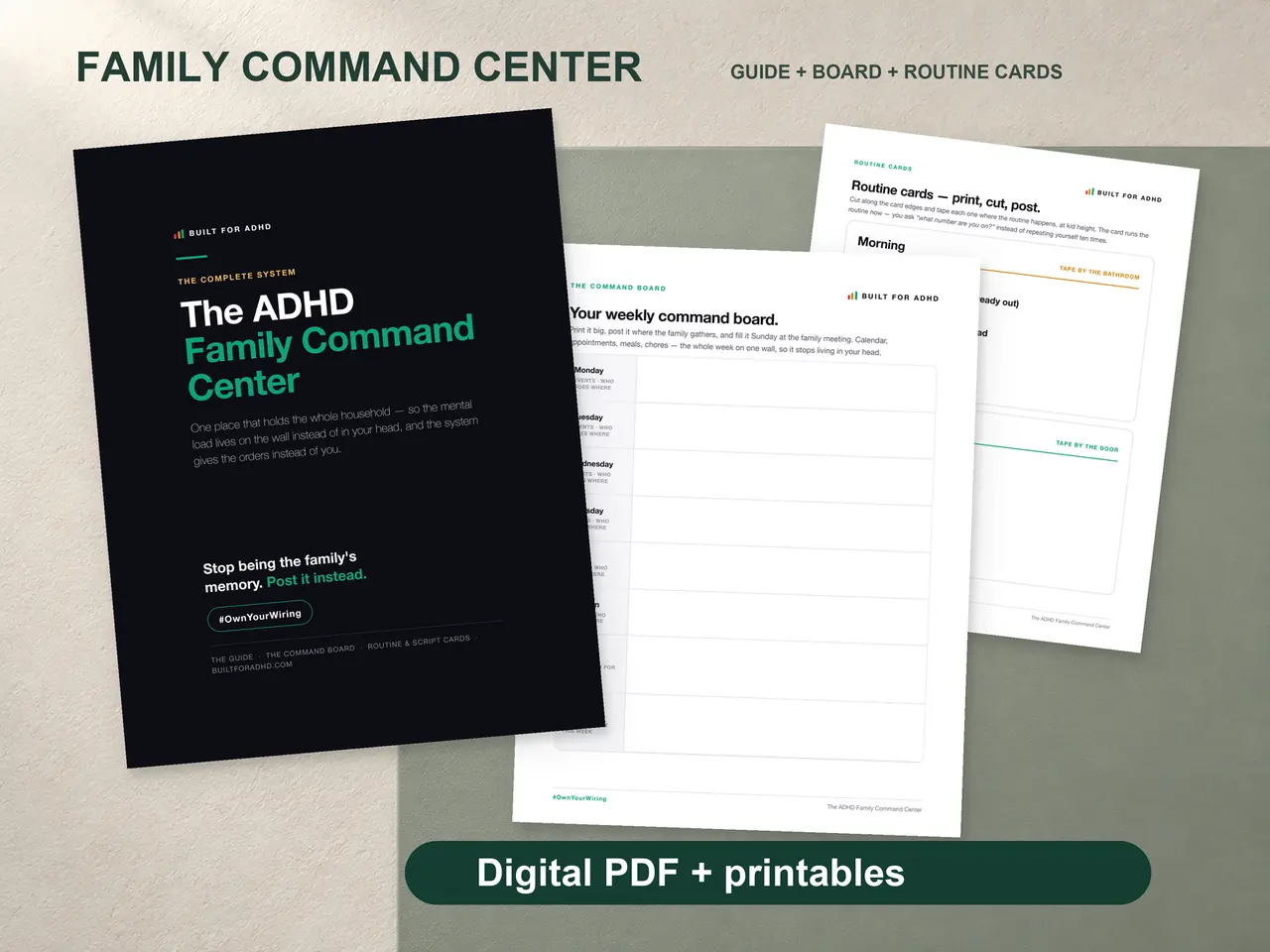
The ADHD Home Manager’s weekly overview lets you map chores to energy blocks across the entire week. Monday evening might be the only time you have energy for laundry. Wednesday morning might work for a quick kitchen reset. Saturday afternoon might be family cleaning time.
When you can see the whole week at once, you stop trying to do everything every day. You distribute tasks across the week based on when you actually have the capacity, not when a chart says you should.
This also helps you spot the days that are already full. If Tuesday is packed with school events and appointments, that’s not a chore day. Giving yourself permission to skip is part of the system, not a failure of it.
Getting Kids Involved Without the Power Struggle
The fastest way to kill a chore system is to make it a battle. If every chore ends in a negotiation, the system costs more energy than it saves.
Two things help here. First, let kids choose from a short list of options. “Do you want to wipe the table or put away the silverware?” Choice creates buy-in. Second, make the chore concrete and tiny. Not “help with dishes” but “put these four plates in the dishwasher.” The smaller the ask, the lower the resistance.
And when they do the chore — even imperfectly, even with complaining — acknowledge it immediately. ADHD brains need instant feedback. A quick “thank you, that helped” goes further than a sticker on a chart they won’t look at again.
The Chore Chart That Works Is the One You Actually Use
Forget lamination. Forget color coding. The best chore system for an ADHD family is the one that’s simple enough to survive the worst week of the month. If it only works when everyone is well-rested and motivated, it’s not a system — it’s a fantasy.
Start with one chore per person, attached to an existing routine, with immediate acknowledgment. That’s the whole system. Build from there only when it’s working. And when it stops working — because it will sometimes — reset without guilt. The system is always there, waiting, with no judgment about the gap.