You’ve done this before. The exam is in two weeks. You tell yourself you’ll start studying this weekend. The weekend comes and goes. Then it’s one week out. Then three days. Then you’re sitting on your bed at 11 PM the night before, textbook open for the first time, running on energy drinks and self-loathing.
You passed, probably. Maybe even did okay. But the process wrecked you, and deep down you know your grade doesn’t reflect what you actually know. It reflects what you could absorb in six hours of desperate cramming.
This cycle isn’t a study skills problem. It’s an ADHD problem. And it has a structural solution.
The ADHD Study Trap
Here’s what actually happens in your brain when an exam is two weeks away. Your prefrontal cortex — the part responsible for planning, prioritizing, and initiating tasks — looks at the deadline and says “not urgent.” No urgency means no dopamine. No dopamine means no activation energy. No activation energy means the textbook stays closed.
Meanwhile, your brain is perfectly happy to spend three hours researching something random, reorganizing your room, or learning a new skill that has nothing to do with the exam. That’s not procrastination. That’s your brain seeking dopamine from sources that actually provide it. Studying for a test two weeks away provides approximately zero dopamine. Your brain is doing math, and the math says “not worth it.”
The only thing that eventually overrides this equation is panic. When the exam is tomorrow, the threat level finally exceeds the activation threshold, and your brain floods with enough stress hormones to get you moving. It works, technically. But it’s brutal on your mental health and it produces worse outcomes than consistent studying would.
Reverse-Engineering Your Exam Date
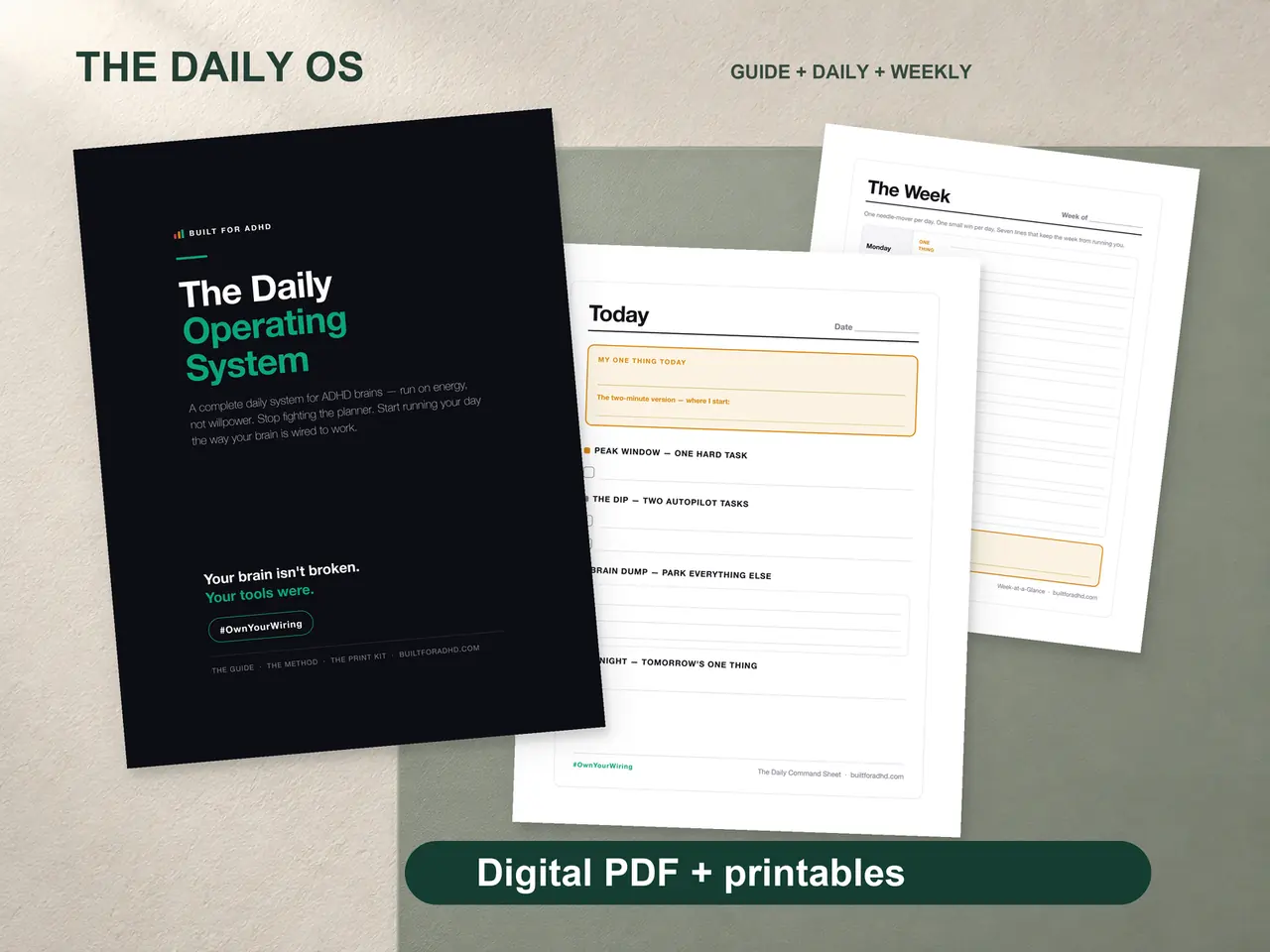
The alternative is to remove the need for panic by creating external structure that does what your brain won’t do internally. The Daily OS gives you a page to take your exam date and work backwards.
First, you count your available study days. Not calendar days — days you can actually sit down and study. You account for classes, weekends, and the buffer days you’ll need for when executive function takes a vacation.
Then you distribute your study material across those days. Chapter 1 on Monday. Chapters 2 and 3 on Wednesday. Practice problems on Friday. Once it’s written down, you don’t have to figure out what to study or when — the page already holds the decision.
This matters because one of the biggest reasons ADHD students don’t start studying is the overwhelm of not knowing where to begin. When you open the study guide and see twelve chapters, forty key terms, and six essay prompts, your brain hits a wall. But when the page in front of you says “today, read pages 45-62 and highlight three key concepts,” your brain has something specific enough to actually engage with.
Daily View Keeps You Focused
The Daily View is especially important for exam prep. When you’re studying for one exam, you might also have assignments due in other classes, a part-time job, and a social life that keeps texting you. The Daily View is a sheet you copy only today’s study tasks onto — no more than six items across all your active plans.
This prevents the classic ADHD trap of seeing everything you need to do and doing none of it. You don’t need to think about Thursday’s study session right now. You need to think about today’s. The rest stays on the master plan.
Next to each study task you write a specific starting action. Not “study biology” but “open Chapter 7 and read the section on mitosis.” The more specific the entry point, the lower the activation cost, and the more likely you are to actually begin.
When Cramming Is Your Only Option
Look, sometimes you’re going to open this planner three days before the exam having done nothing. It happens. Panic Mode exists specifically for this moment.
Panic Mode doesn’t try to cram everything into three days. That’s physically impossible and emotionally destructive. Instead, it walks you through flagging the material most likely to have the highest impact on your grade — the topics your professor emphasized, the concepts that appear most frequently in practice tests, the chapters with the most weight.
Then you lay out a realistic study plan for your remaining time. Maybe you can’t cover everything, but you can cover the things that matter most. That’s a dramatically better outcome than the unstructured panic-cram that hits everything at surface level and retains nothing.
Building Exam Confidence Over Time
The Done Tracker gives you something ADHD brains rarely get during exam season — evidence that you’re making progress. Every completed study session, you shade in another segment of the progress bar. Every milestone crossed, you mark off — visible proof you’re moving.
This is important because ADHD studying usually feels like running on a treadmill. You study for an hour and don’t feel more prepared. You study for three hours and still feel behind. The progress bar breaks that cycle by showing you concrete evidence that your preparation is building.
Over time, this changes your relationship with exams entirely. Instead of dreading them as panic events, you start experiencing them as structured timelines with daily checkpoints. You stop relying on your future self to handle it and start giving your present self a clear, manageable assignment.
The exam isn’t the enemy. The lack of structure is. Fix the structure and the studying follows.