Time blindness might be the single most underrated ADHD symptom. It doesn’t make headlines like hyperactivity or distractibility. Nobody makes TikToks about it. But it quietly ruins deadlines, relationships, and self-trust on a daily basis.
If you have ADHD, your brain experiences time in two categories: now and not now. A deadline three days from today and a deadline three weeks from today both live in the “not now” bucket, and your brain treats them with roughly equal urgency — which is to say, none at all. Until the deadline crosses into “now,” at which point the panic alarm blares and you have no time left.
This isn’t a mindset problem. It’s neurology. And no amount of calendar reminders will fix it, because reminders still rely on your brain to feel urgency, which it won’t do until it’s too late.
Why Calendars Don’t Solve Time Blindness
You’ve tried putting deadlines on your calendar. You’ve set reminders. You’ve even tried those apps that count down the days. And none of it worked the way it should, because all of those tools present time as a number, and numbers are abstract.
“14 days until deadline” is a fact your brain can read but not feel. It’s like knowing the sun is 93 million miles away — the information is technically in your head but it doesn’t change your behavior. For time tools to work with ADHD, they need to convert time into action. Not “you have 14 days” but “here’s what you need to do today.”
That conversion — from abstract time to concrete daily tasks — is what actually compensates for time blindness. You stop trying to feel time and start following a structure that accounts for it.
Making Time Visible and Actionable
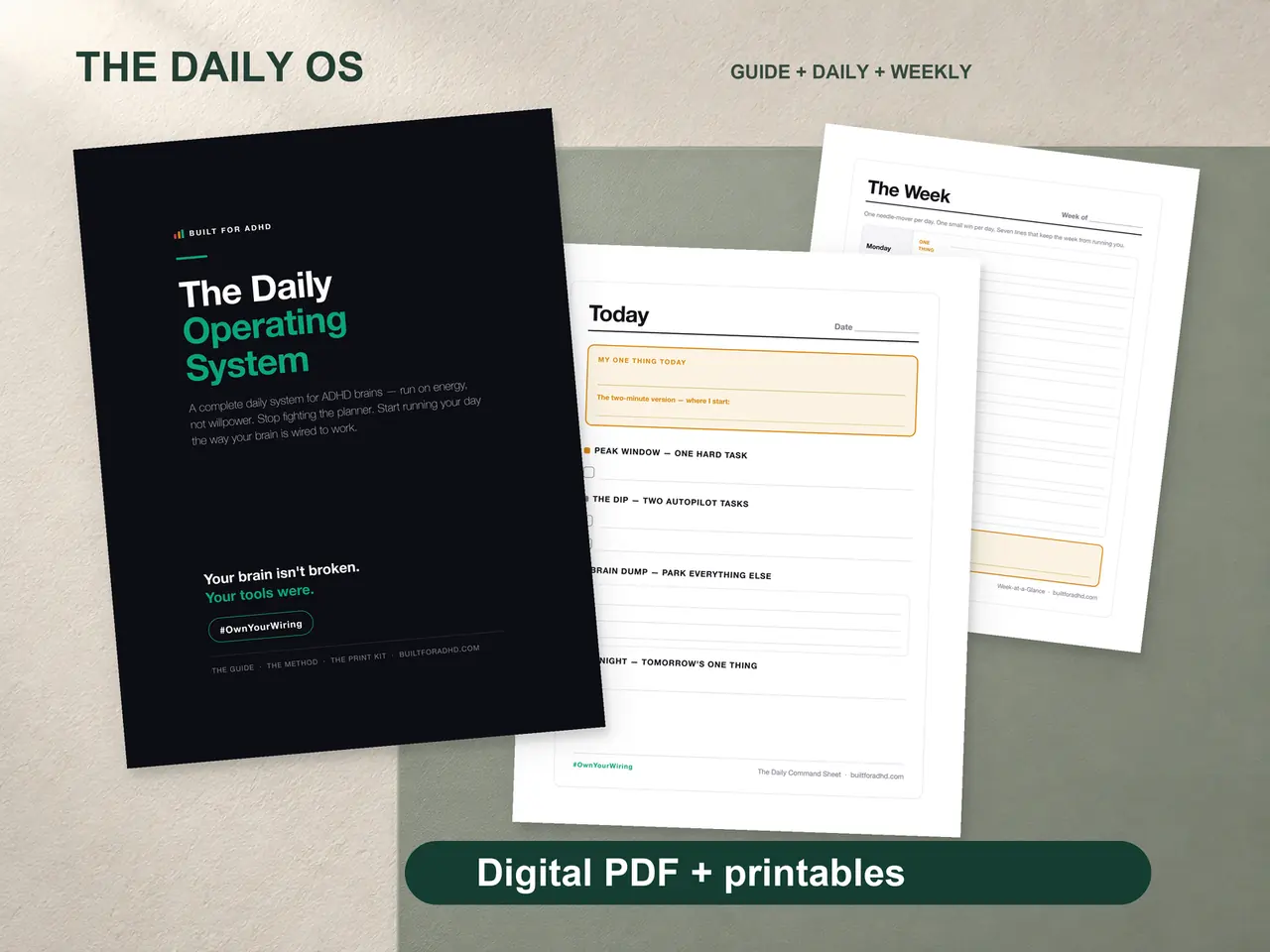
The Daily OS approaches time blindness from a practical angle. When you write in a deadline, the first thing you do is count your working days remaining. Not calendar days. Working days — because you cross off weekends, off days, and buffer days as you go.
That number is your real timeline. And it’s almost always smaller than you think, which is genuinely useful. Seeing “8 working days” instead of “two weeks” creates a much more accurate sense of how much time you actually have. Your brain can hold onto 8 more easily than it can hold onto “a couple weeks.”
From there, you spread your sub-tasks across those 8 days. Each day gets a specific assignment. You never have to wonder “am I on track?” because the page in front of you shows the pace you set.
Buffer Days Are Not Optional
Here’s where most time management systems fail ADHD brains. They calculate the timeline based on perfect execution — every day productive, every task completed on schedule, zero disruptions. That’s not your life. That’s not anyone’s life, but it’s especially not your life.
Buffer days are days with no assigned tasks. They exist specifically to absorb the days when executive function goes offline, when you get pulled into something unexpected, or when a task takes three times longer than it should have. The layout gives you room to build these in from the start — you leave days blank on purpose.
This is critical because when an ADHD brain falls behind schedule, the response is usually catastrophic. You don’t think “I’ll catch up tomorrow.” You think “I’m already behind, what’s the point, this is ruined.” Buffer days prevent that spiral by making falling behind impossible — the slack is already in the system.
The Daily View as a Time Anchor
When time is invisible inside your head, you need it to be visible outside your head. The Today page acts as your time anchor. It holds exactly what today requires — the tasks you wrote onto it. Not this week. Not the whole project. Today.
For time-blind brains, this is transformative. Instead of trying to hold a multi-week timeline in your head and figure out where you are in it, you look at the page and see your immediate obligations. Maximum six tasks. Clear starting actions. No ambiguity about what “working on it” means.
The progress bar adds another layer of time awareness. Shading it in as you finish tasks gives you a spatial sense of where you are in the project. It turns elapsed time and completed work into a visual that your brain can actually interpret.
Building a Prosthetic Time Sense
You’re never going to wake up one day and suddenly feel time accurately. That’s okay. Plenty of people wear glasses instead of wishing their eyes worked differently. Time blindness tools are the same concept — external support for an internal system that doesn’t work the way the world expects it to.
The goal isn’t to cure time blindness. The goal is to build a system so reliable that time blindness stops mattering. When every deadline is reverse-engineered into daily steps with buffer built in, when every day shows you exactly what to do, when progress is visible and celebrated — your relationship with time changes. Not because you can feel it now, but because you don’t need to.
The planner doesn’t ask your brain to do something it can’t. It gives you a place to do the time math on paper — count the days, spread the tasks — and a daily assignment to follow. That’s it. That’s the whole trick. And it works.