You’re staring at your screen, and you know there’s something you need to do. Maybe several things. But your brain feels like it’s wrapped in gauze. The thoughts are in there somewhere — you can almost feel them — but you can’t quite grab any single one long enough to act on it. Everything is blurry. Everything is vague. Everything is exhausting.
This is ADHD brain fog, and it’s one of the most misunderstood symptoms of the condition. People think ADHD is about bouncing off the walls and being distracted by shiny objects. But this — this thick, heavy, can’t-access-your-own-brain feeling — is often the daily reality. And it doesn’t get talked about nearly enough.
The thing is, your brain isn’t empty during brain fog. It’s the opposite. It’s running dozens of background processes — unfinished tasks, half-formed worries, random ideas, emotional residue from yesterday — and none of them are resolved. They’re all just sitting in working memory, using up bandwidth, and leaving nothing for the task right in front of you.
Mental clarity isn’t about thinking harder. It’s about thinking about fewer things at once.
Why Your Brain Hoards Thoughts
ADHD working memory is like a desk with no drawers. Everything has to sit on the surface. Every task, every worry, every half-idea, every appointment — they’re all sitting right there in front of you, all the time. A neurotypical brain has drawers. It files things away and retrieves them when needed. Your brain keeps everything out where it can see it, because it doesn’t trust itself to remember things it can’t see.
This is smart, actually. Your brain learned that if it puts something away, it might forget it exists entirely. So it keeps everything visible. The problem is that a desk with fifty things on it is functionally useless. You can’t work on anything because you can’t find anything.
Mental clarity isn’t about having fewer thoughts. It’s about having a trusted place to put them so your brain stops hoarding them on the desk.
The Clarity Process for ADHD Brains
This works because it respects how your brain actually operates instead of demanding it work differently.
Step one: Chaos capture. Open a blank space — physical or digital — and get everything out. Every thought, every task, every worry, every random thing your brain is holding. Don’t organize. Don’t filter. Don’t judge whether something is “worth” writing down. If your brain is holding it, it’s using bandwidth. Get it out. The messier this step looks, the better it’s working.
Step two: Sort without ranking. Here’s where most systems lose ADHD brains. They tell you to prioritize, which requires the exact executive function that brain fog has taken offline. Instead, sort into simple buckets: Do Today, This Week, Someday, or Delete. You’re not ranking importance. You’re just putting things where they belong based on time horizon. This is a much smaller cognitive ask.
Step three: Surface one action. Pick one thing from your Do Today bucket. Not the most important one. Not the hardest one. Just one. Look at it and ask: what’s the tiniest first step? Not “work on the project.” Something like “open the document.” Tiny first steps bypass the initiation barrier that brain fog creates. Once you’re moving, clarity follows movement. It almost never precedes it.
The Myth of Waiting for Clarity
Here’s a trap ADHD brains fall into constantly: waiting to feel clear before starting. “I’ll work on it when my head is clearer.” “I’ll figure it out when the brain fog lifts.” But clarity doesn’t arrive on its own. For ADHD brains, clarity is generated by action, not the other way around.
Think about the last time you were deep in a task, fully locked in. You didn’t plan your way into that flow state. You stumbled into it by starting something — probably something small — and then your brain caught the wave. The fog didn’t lift before you started. It lifted because you started.
This is why a mental clarity template that gives you a tiny first step is so much more effective than one that asks you to plan your way through the fog. You don’t need a plan. You need a single entry point.
A Template That Creates Clarity on Demand
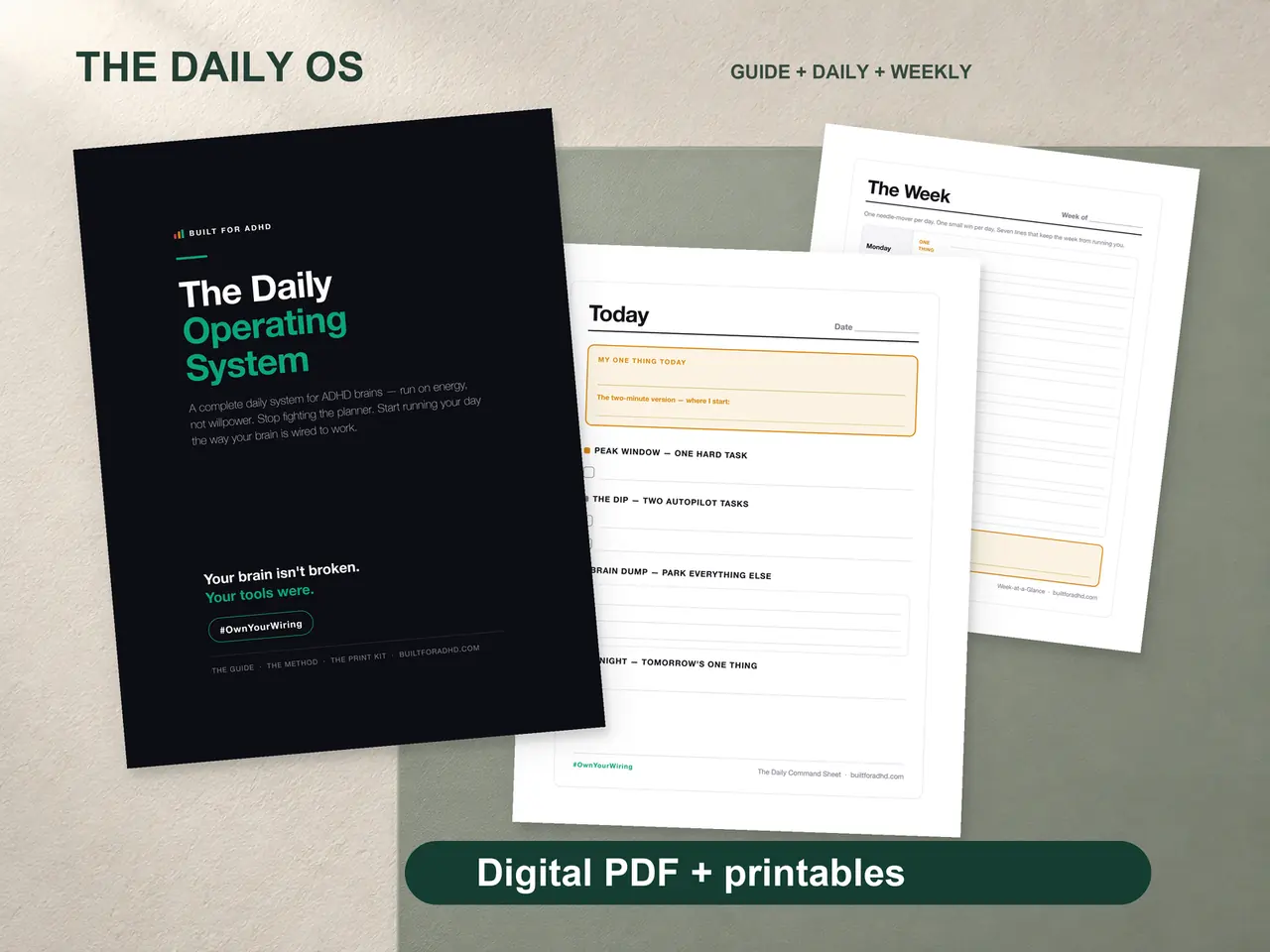
The Daily OS is designed for exactly this process. The Brain Dump page gives you a massive grid for pure chaos capture — no categories, no structure, just space for everything your brain is holding. That alone can drop the fog feeling significantly.
Then the Sort page lets you bucket items into Do Today, This Week, Someday, or Delete. No priority matrices. No color-coded urgency systems. Just honest, low-effort sorting that your brain can handle even on its worst days.
The Action Cards are where clarity actually happens. You turn each sorted task into a card with a tiny first step and a built-in reward. Your brain doesn’t have to figure out where to start — it’s already decided for you. And when you finish something, you add it to the Done List page, giving your brain visible confirmation that the fog is lifting and you’re making progress.
Clarity Is a System, Not a State
You’ve been treating mental clarity like weather — something that happens to you, something you wait for, something outside your control. But clarity is a system. It’s the result of externalizing your thoughts, sorting them into manageable buckets, and acting on one thing at a time.
Your brain isn’t foggy because it’s broken. It’s foggy because it’s holding too much with too little bandwidth. Give it a place to put things down, and watch how fast the fog clears.