Your brain is running forty-seven tabs right now. Some are tasks. Some are worries. Some are random song lyrics from 2003. And your brain is treating all of them with equal urgency, which is why you feel like you can’t start anything.
That’s not a character flaw. That’s ADHD working memory doing its thing — holding too much, prioritizing nothing, and making you feel paralyzed in the process.
A brain dump is one small first move to try when your head is full and starting feels difficult. Not a to-do list. Not a planner. A dump. Raw, unfiltered, no judgment.
Get the free printable worksheet
Get the free Brain Dump Sheet. Sign up there to open the download page immediately. The three-page PDF includes a short how-to, the reusable worksheet, and an optional next step into the paid Daily OS. No separate action cards or paid purchase are needed to use the free sheet.
The worksheet has exactly three parts:
| On the sheet | A filled-in example |
|---|---|
| Everything in my head right now | Book the dentist; finish the proposal; buy milk; clear the kitchen counter |
| The one that matters today | Send the proposal draft |
| Its two-minute starting move | Open the proposal document and write the first heading |
This is an illustration, not a customer result. You can copy the three headings onto scrap paper right now. The other items can stay on the page while you take that one starting step.
Why Traditional Brain Dumps Fail ADHD Brains
You’ve probably tried brain dumps before. Maybe you grabbed a notebook, wrote down everything you could think of, felt briefly relieved, and then… stared at a chaotic list that somehow made things worse.
That’s because most brain dump advice stops at step one. “Just write it all down!” Great. Now you have a giant messy list and zero idea what to do next. For a neurotypical brain, scanning and sorting that list is intuitive. For your brain, that list is a new source of overwhelm.
The missing piece isn’t the dump itself. It’s what happens after.
What Actually Works: Dump, Then Sort
Here’s the approach that clicks for ADHD brains. It’s two steps, and neither one requires you to have your life together.
Step one: Capture everything. And I mean everything. The dentist appointment. The project that’s due Friday. The thing you said three weeks ago that you’re still cringing about. The grocery list. The business idea. Get it all out. Don’t organize. Don’t judge. Don’t even write in complete sentences if you don’t want to. This is chaos capture, and it’s supposed to look messy.
Step two: Sort by energy, not importance. This is where most templates get it wrong. They ask you to prioritize by urgency or importance, which requires executive function — the exact thing your brain struggles with. Instead, sort into buckets that match your current capacity. What can you do right now in the next five minutes? What needs a block of focus time this week? What’s a someday-maybe? What can you just delete entirely?
You’d be surprised how many things on your list can just be deleted.
Three Tips for Better ADHD Brain Dumps
Keep the bar on the floor. Your brain dump doesn’t need to be complete. It doesn’t need to capture every thought. It just needs to capture enough to give your working memory some breathing room. Even five items is a win.
Use a dedicated space. Don’t brain dump on sticky notes, napkins, or random apps. Your brain needs one reliable landing zone so it learns to trust the system. When your brain trusts the system, it stops trying to hold everything internally, and that’s when the anxiety drops.
Don’t skip the sort. The dump feels good, but the sort is where behavior change happens. When you take a chaotic pile of thoughts and turn even three of them into concrete next steps, you’ve gone from overwhelmed to in motion. That shift is everything. And if one item is too big to even see a next step, hand just that one to a task-chopper — Goblin Tools is free and splits it into small steps in seconds (the review covers where it stops helping, too).
Pair it with a reward you decided on in advance. The sort costs real focus, and an ADHD brain that gets nothing back from it learns to skip it. Pick the payoff before you start rather than negotiating with yourself afterward — a dopamine menu is a written list of those small resets sorted by how long they take, so the one you reach for takes ten minutes instead of swallowing the afternoon.
A Template Built for This Exact Problem
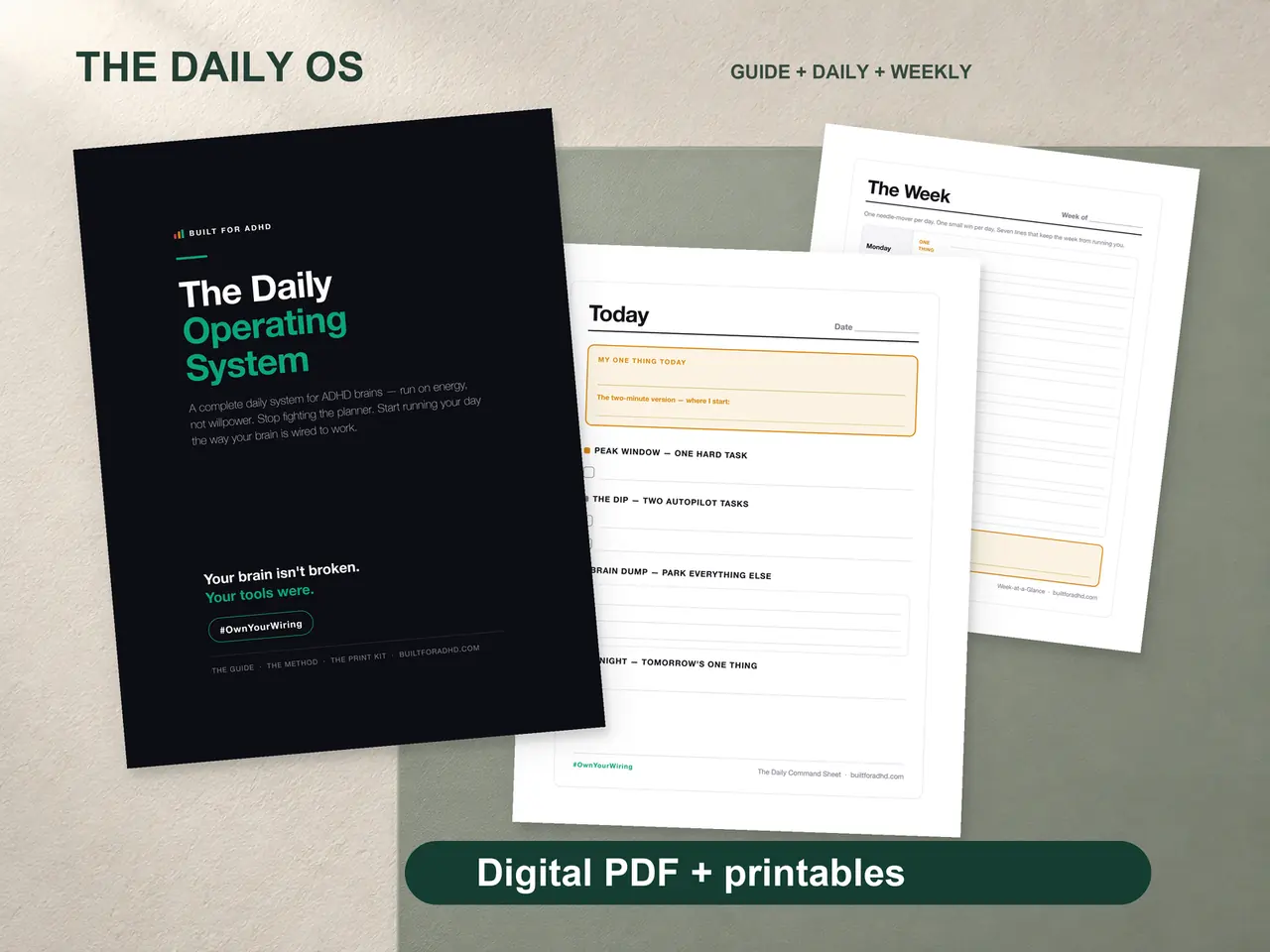
The free sheet is for getting started. The paid Daily OS adds a broader daily routine: an energy-sort reference card, a Daily Command Sheet, a Week-at-a-Glance, a Weekly Review, and a Done-Today tracker.
On the Daily Command Sheet, you name one thing that matters, write its two-minute start, put a demanding task in your peak window, and save two routine tasks for lower-focus time. There is a brain-dump space for everything else. The guide also includes examples and a reset protocol for days that go sideways.
Use the free worksheet first. If that solves today’s problem, you already have what you came for. The fuller planning system is there when you want help deciding where those captured tasks fit into your day.
Your Brain Isn’t Broken
The problem was never that you can’t get things done. The problem is that every system you’ve tried was designed for a brain that works differently than yours. Your brain needs to externalize thoughts, sort by energy instead of priority, and get rewarded for progress.
A brain dump is the starting line. What you do with it after determines whether you stay stuck or start moving. And if the first item still won’t start, body doubling for ADHD is the cheapest way to borrow the initiation energy you’re missing — another person’s quiet focus, doing its thing next to yours.