When was the last time you ate a full meal? Not a handful of goldfish crackers standing over the sink while packing lunches. An actual meal, sitting down, with food you chose for yourself.
If you had to think about it, that’s the problem this page is about.
Self-Care for ADHD Moms Is Not What Instagram Shows You
Let’s get one thing straight. Self-care for you is not a face mask and a glass of wine. It’s not a two-hour bath with candles. It’s not a weekend retreat where you journal about your intentions.
Self-care for an ADHD mom is eating. It’s drinking water. It’s taking your medication on time. It’s moving your body enough that your brain gets what it needs neurochemically. These are the basics, and if you’re being honest, you skip at least two of them most days.
Not because you don’t know they matter. Because your brain is so consumed with managing everyone else’s needs that your own needs become background noise. You don’t decide to skip lunch — you just look up at 2 PM and realize you forgot.
The Self-Care Tracker: Four Checkboxes
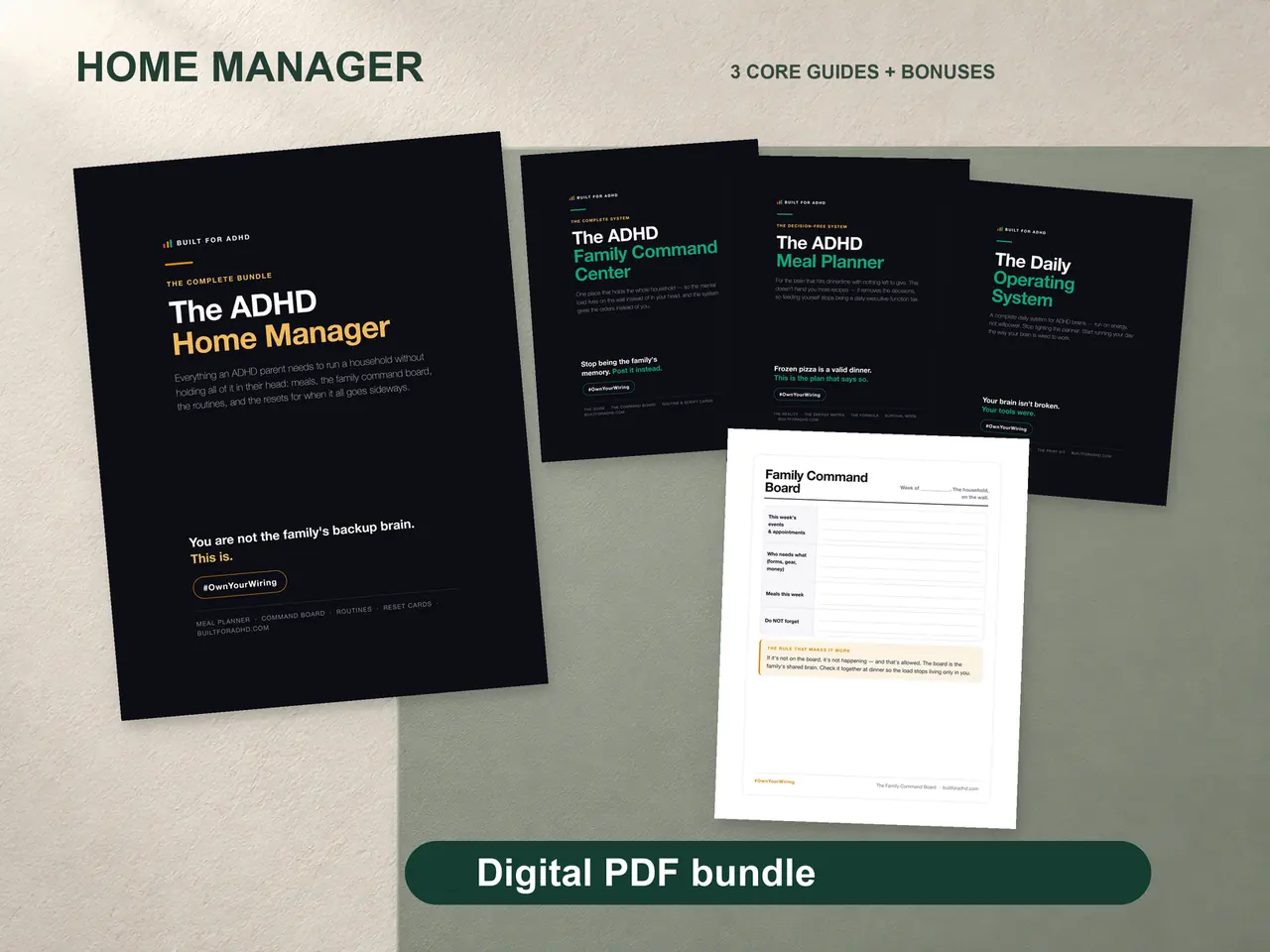
The ADHD Home Manager includes a Self-Care Tracker with exactly four items: eat, water, meds, move. No elaborate wellness routines. No habit trackers with thirty categories. Four things.
This matters because ADHD brains are overwhelmed by complexity. A self-care plan with twelve items is a self-care plan you’ll abandon by Wednesday. Four checkboxes is maintainable. It’s glanceable. And it’s honest about what baseline self-care actually looks like when you’re running a household with a brain that’s already overloaded.
The tracker isn’t about perfection. It’s about awareness. When you see three days in a row where “eat” is unchecked, you notice the pattern. That awareness — not guilt, just noticing — is the first step toward change.
Why You Skip Your Own Basics
ADHD creates a paradox around self-care. You can hyperfocus on your kids’ needs for hours — packing the perfect lunch, remembering every allergy, tracking every appointment — while completely forgetting that you haven’t eaten since 7 AM.
This happens because ADHD brains are wired for external demands. Someone else’s deadline feels urgent. Your own hunger doesn’t. Someone else’s medication reminder is a priority. Your own meds sit on the counter untaken until noon.
The result is a cycle: you give everything to everyone else, you crash because your body isn’t getting what it needs, and then you feel guilty about crashing because you “should” have more energy. But you can’t have more energy when you’re running on coffee and adrenaline.
Attaching Self-Care to Existing Routines
You’re not going to add a self-care block to your schedule. Be real. That block will get sacrificed the first time a kid needs something. Instead, attach self-care to things that are already happening.
When you make the kids’ breakfast, make yours. When you pour coffee, fill a water bottle and set it where you’ll see it. When your phone alarm goes off for school pickup, that’s also your meds reminder. When you’re waiting in the car line, do two minutes of stretching.
These aren’t extra steps. They’re piggybacked onto existing moments. Your brain doesn’t need to generate new motivation because the trigger is already there.
The Brain Dump as Self-Care
Here’s a form of self-care nobody talks about: getting the thoughts out of your head.
The mental load of motherhood is heaviest when it’s invisible. The worries, the tasks, the guilt, the appointments, the things you said that you’re replaying — all of it circling in your head with nowhere to go.
The Brain Dump section of the planner is a pressure valve. Before you plan anything, dump everything. It doesn’t have to be organized. It doesn’t have to make sense. It just has to leave your head and land on a page.
This single act — externalizing the mental load — reduces anxiety, frees up working memory, and gives you back a small piece of cognitive space that was being consumed by background processing. That’s self-care. Unglamorous, no-candles, profoundly effective self-care.
You Cannot Pour From an Empty Cup (and Yours Has Been Empty)
You’ve heard this metaphor a thousand times and it probably makes you roll your eyes. But here’s what they don’t tell you: the cup doesn’t empty dramatically. It drips. Slowly. One skipped meal, one forgotten medication, one night of no sleep at a time.
And then one day you snap at your kid over something minor and wonder what happened. What happened is that you’ve been running a deficit for weeks, and the crash finally arrived.
The Self-Care Tracker won’t prevent every crash. But it makes the pattern visible. Four checkboxes. Did you eat. Did you drink water. Did you take your meds. Did you move. Not a judgment — a check-in. With yourself. Because you are also someone worth taking care of.