You have a list of projects. Maybe it’s mental, maybe it’s in a notes app, maybe it’s scattered across fourteen browser tabs you’ve kept open for three weeks. Side projects, home projects, work projects, life projects. Each one felt urgent and exciting when it occurred to you. Each one still feels important. And not a single one has moved past the idea stage.
This is the ADHD project graveyard — where brilliant ideas go to die in the gap between “I should do this” and “I am doing this.” And you’ve lived here long enough to know that the problem isn’t a lack of ideas, motivation, or even time. The problem is starting.
Task initiation is one of the core executive function deficits in ADHD, and it’s the one that causes the most frustration because it looks, from the outside, like laziness. You’re sitting there, wanting to start, knowing you should start, maybe even feeling excited to start — and your body just won’t move. The bridge between intention and action has a gap in the middle, and no amount of wanting will close it.
Why Planning Becomes Procrastination
Here’s a pattern you’ll recognize: you get an idea for a project. You’re excited. So you start planning it. You research tools. You create a folder structure. You make a list of everything that needs to happen. You watch YouTube videos about how other people did similar projects. You buy supplies.
And then… nothing. The planning felt productive. It gave your brain dopamine — the novelty of the idea, the research rabbit holes, the supply shopping. But planning isn’t doing. Planning is often the most sophisticated form of procrastination your ADHD brain has invented, because it feels like progress while requiring zero commitment to action.
The moment you finish planning, you’re faced with the actual first step. And that first step has no novelty left. The dopamine is gone. The excitement phase is over. Now it’s just work, and your brain has already mentally moved on to the next shiny idea.
The Tiny First Step Method
The antidote to ADHD project paralysis isn’t better planning. It’s smaller starting. Ridiculously, almost insultingly small starting.
Your brain can’t initiate “build a website.” That’s too abstract, too large, and too undefined. But your brain can initiate “open a new browser tab.” That’s concrete, tiny, and requires zero executive function. And here’s the secret: once you open that tab, you’ll probably type something in. And once you type something in, you’ll probably click a link. And fifteen minutes later, you’re actually working on the project.
The initiation is the bottleneck. Everything after initiation flows more naturally because your brain is now engaged, dopamine is firing from the activity itself, and momentum is carrying you forward. The entire game is making the start so small that your brain doesn’t even register it as a project — it’s just one physical action.
From Chaos to First Action
This process works specifically because it doesn’t require executive function in the right order. It works in whatever order your brain gives it to you.
Dump every project-related thought. Open a blank space and get everything out. Not just the project ideas — the worries about them, the supplies you think you need, the questions you haven’t answered, the steps you can imagine, the reasons you haven’t started. All of it. This step isn’t about organizing your project. It’s about emptying the mental load so your brain has room to actually engage.
Sort into honest buckets. Look at everything you dumped and sort it. Do Today means you’re committing to touching this thing today — not finishing it, just touching it. This Week means it gets attention in the next seven days. Someday is for things that are real but not urgent. And Delete is for the projects and steps you know, deep down, you’re never going to do. Deleting projects isn’t failure. It’s focus. Every project you delete gives the remaining ones more of your limited bandwidth.
Take the one tiny action. Look at your Do Today bucket. Pick one item. Define the single smallest physical action you could take in the next two minutes. Not “work on the project.” Something like “open the folder,” “text your friend about it,” or “write one sentence.” Do that action. Just that one. If you keep going after, great. If you stop, that’s fine too — you broke the initiation barrier, and that’s the hardest part.
The Done List page: Dopamine on Demand
The second biggest challenge after starting a project is sustaining it. ADHD brains lose steam when progress feels invisible, which happens fast with large projects. You’ve been working for an hour and the project looks… exactly the same as before. No visible change. No reward signal. Your brain interprets this as “not worth continuing.”
That’s why visible progress tracking matters more than any productivity technique. When you can see completed steps accumulating — a Done List page that shows every tiny action you’ve finished, in your own handwriting — your brain gets the dopamine evidence it needs to keep going. Not because the project is done, but because you can prove to yourself that you’ve been moving forward.
A Template That Gets You Off the Starting Line
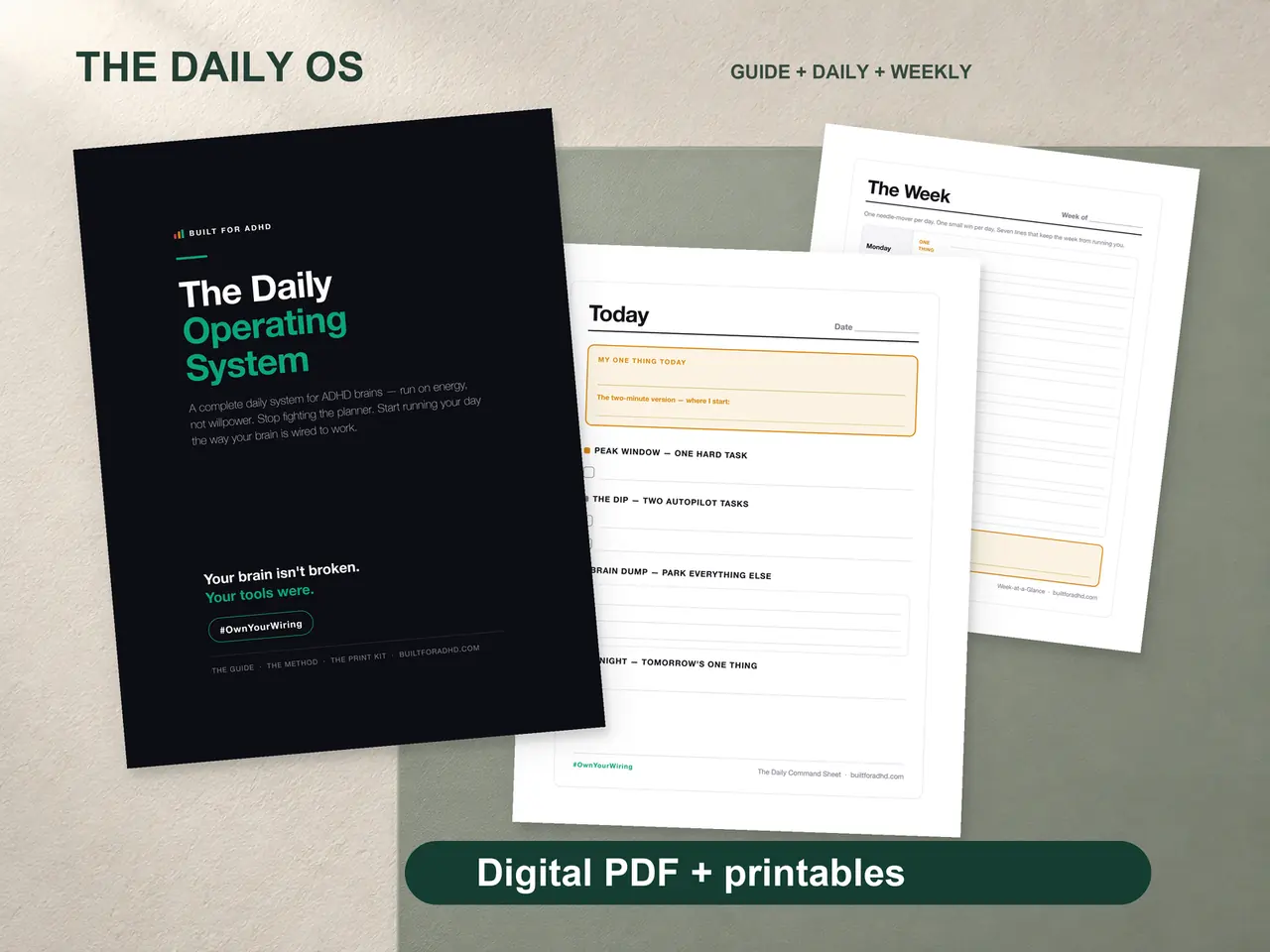
The Daily OS is designed for the exact moment when you have ideas but can’t start. The Brain Dump page gives you a massive grid for chaos capture — dump every project, every sub-step, every random thought about it. Then the Sort page lets you bucket items into honest buckets without needing to prioritize or plan.
The Action Cards are where the magic happens for project starters. You turn each sorted item into a card and write in one tiny first step. Then, when it’s time to act, you don’t have to figure out where to start again — you did that thinking once, on the card, and the card’s structure walked you through it. And each card has a spot for a built-in reward, because your brain needs to associate starting with a positive outcome.
The Done List page holds every completed action — you write each one down as you finish it. Over days and weeks, it becomes visible proof that you’re not someone who “can’t start things.” You’re someone who starts things one tiny step at a time.
You Don’t Need a Better Plan
You need a smaller first step. The project isn’t too big. The first action you’re imagining is too big. Shrink it until it’s almost embarrassing, and then do that. The project will follow.