Your manager assigns a project on Monday. Deadline: three weeks out. You nod, write it down, and immediately get pulled into the twelve smaller tasks screaming for your attention. Emails. Slack messages. A quick meeting that runs long. By the end of the day, you haven’t touched the project, but you feel like you worked hard — because you did. Just not on the thing that actually matters.
This repeats for two and a half weeks. Then the deadline is three days away and you’re working until midnight producing a version of the deliverable that’s functional but far below what you’re capable of. Your manager says “good work” and you feel like a fraud, because you know what it would have looked like if you’d started on time.
You have ADHD. This is what ADHD does to work projects. And it has nothing to do with how smart or capable you are.
The Urgency Trap at Work
ADHD professionals often look productive. You’re responsive to emails, available on Slack, great in meetings, and fast at handling whatever just landed on your desk. The problem is that everything you’re good at handling is urgent, and the work that actually defines your career — the projects, the strategy, the deep deliverables — none of that is urgent until it’s almost too late.
Your brain runs on an urgency-based operating system. Tasks without imminent deadlines simply don’t generate enough activation energy to compete with the constant stream of short-term demands. That three-week project will always lose to the Slack message that just pinged, because the message has immediate social consequences and the project doesn’t. Yet.
This creates a painful gap between your daily experience — feeling busy, being responsive, checking things off — and your actual output on the work that matters most. You’re spinning fast but not moving forward.
Turning Projects Into Daily Assignments
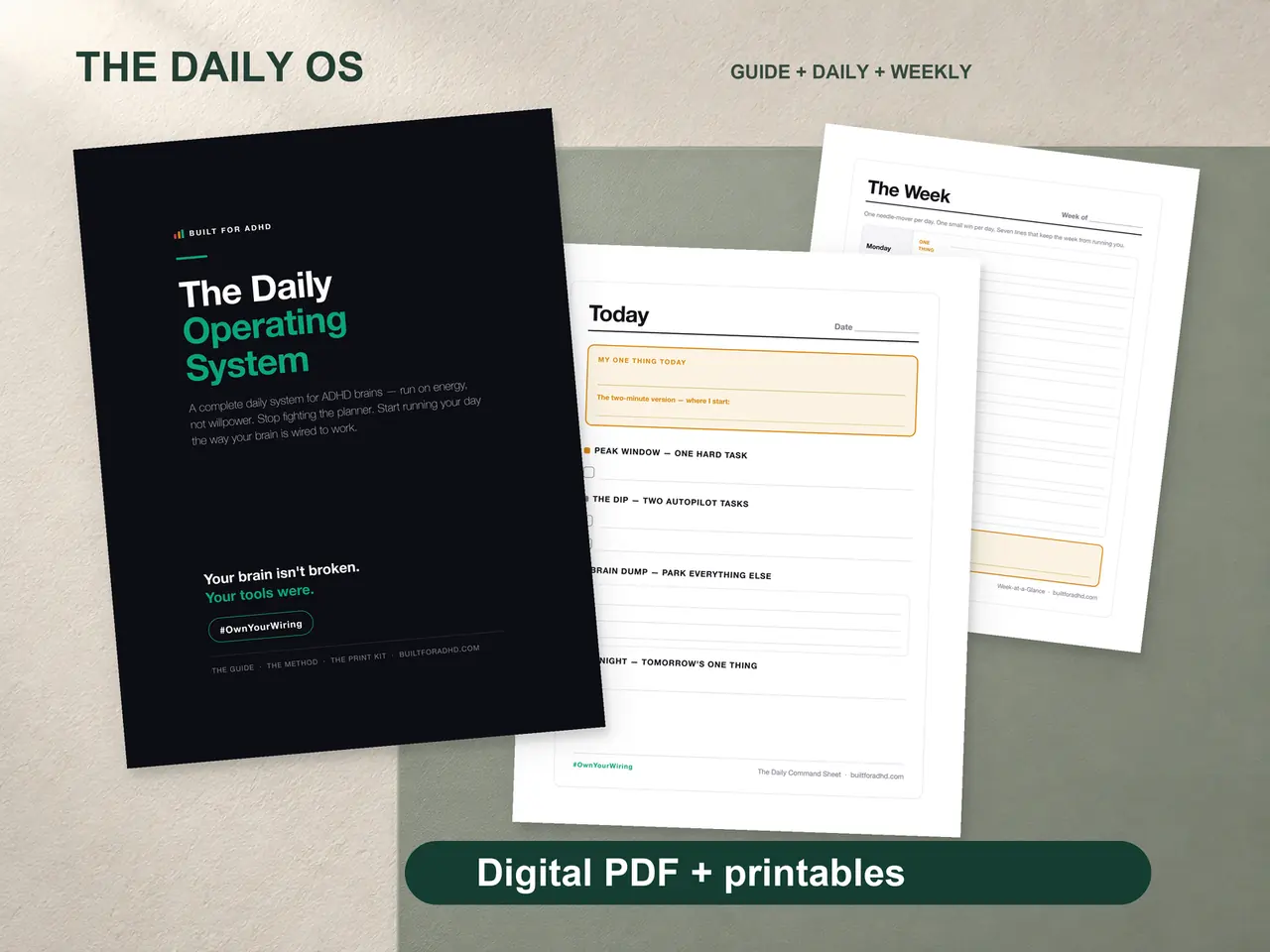
The Daily OS solves this by converting shapeless projects into specific daily tasks. Instead of a project that lives in the back of your mind as a vague source of anxiety, you get a concrete assignment for today. Not “work on the report.” Instead: “write the executive summary section — two paragraphs, 200 words.”
This specificity changes everything for ADHD brains. Vague tasks require your prefrontal cortex to do extra work — deciding what to do, how to start, and when to stop. That extra cognitive load is often enough to prevent you from starting at all. But a specific, bounded task with a clear starting action bypasses the decision layer entirely. Your brain knows exactly what to do and approximately how long it will take.
The planner walks you through counting your working days between now and the deadline, listing your sub-tasks, and mapping them across that timeline on the page. Buffer days are built into the layout for the meetings that run long, the unexpected fires, and the days when your brain simply won’t engage with deep work.
The Daily View Is Your Shield
Open a project management tool like Asana or Monday and you’ll see every task for every project across your entire team. For ADHD brains, that’s an overwhelm machine. The more you see, the less you do.
The Daily View page gives you space for a maximum of six tasks for today, pulled from all your active projects. That’s your entire work plan. Not tomorrow’s. Not next week’s. Today’s. When you finish a task, you cross it off and move to the next one. When you’ve done all six, you’re done for the day.
This cap matters because ADHD brains have a tendency to see ten tasks and freeze, then do zero. Six is the number that feels manageable. It’s enough to make meaningful progress but not enough to trigger the “there’s too much, why bother” response.
The Daily View also protects you from yourself. When you finish today’s project task and feel the pull to keep going — that hyperfocus energy that wants to do the whole thing right now — the page in front of you reminds you that you have other tasks across other projects. Balance across projects beats binge-working on one.
Progress Your Brain Can Feel
The Done Tracker gives you something corporate project management never does — visual feedback on your progress that you build by hand. Every completed task fills in another segment of the progress bar. Every milestone you cross gets a checkpoint you mark off. These aren’t decorations. They’re functional dopamine delivery mechanisms.
Without visible progress, ADHD brains lose motivation rapidly. You’ve been working on this project for a week and it still feels incomplete. Your brain interprets that as failure, even though you’re right on schedule. The progress bar corrects that distortion. Thirty-five percent done after week one means you’re ahead of pace, and your brain can see that, feel that, and use it as fuel for the next day.
This is especially valuable in professional settings where feedback cycles are long. Your manager might not review your work for weeks. The Done Tracker provides the interim validation your brain needs to keep going between external checkpoints.
Your Work Isn’t the Problem
Your brain is doing exactly what ADHD brains do — prioritizing urgency over importance, seeking immediate rewards over delayed ones, and struggling to generate activation energy for tasks that aren’t due yet. Every ADHD professional fights this same battle.
The difference between the ones who struggle and the ones who succeed isn’t intelligence or work ethic. It’s structure. The right structure turns “I have a project due in three weeks” into “I have a task due today.” And your brain knows exactly what to do with a task due today.
Stop managing projects in your head. Your head isn’t built for it. Use a system that converts future deadlines into present action, and let your brain do what it’s actually good at — executing clearly defined tasks with energy and skill.