The office had problems. The fluorescent lights, the small talk, the commute. But it had one thing your home office doesn’t: external structure. Someone expected you at a desk at a certain time. Meetings created forced transitions. The mere presence of coworkers provided ambient accountability.
Now you work from home and all of that scaffolding is gone. Your brain is supposed to generate its own structure, its own transitions, its own accountability. And your ADHD brain is looking at that job description and laughing.
Working from home with ADHD isn’t just “working from home but harder.” It’s a fundamentally different challenge because you’re asking the part of your brain that struggles most — executive function — to do all the heavy lifting that your environment used to handle.
Why Your Home Is a Productivity Minefield
Your home is optimized for comfort, not output. Every room contains dopamine alternatives that are more immediately rewarding than whatever work task is in front of you. The fridge. The couch. Your phone. That closet you’ve been meaning to reorganize. The guitar in the corner. Your bed, which is literally twenty steps away at all times.
In an office, those alternatives don’t exist. The friction of leaving the building to do something else is enough to keep you in your seat. At home, the friction is zero. Your brain can switch from “work” to “not work” without any physical barrier, and ADHD brains are already wired to seek the most immediately rewarding option.
Then there’s the time problem. ADHD comes with time blindness — a genuine difficulty perceiving how long tasks take and how time is passing. In an office, meetings and lunch breaks create external time markers. At home, you look up from your phone and three hours have evaporated. You meant to check Instagram for two minutes and somehow it’s noon.
And the isolation factor compounds everything. ADHD brains are often activated by other people’s energy. Working alone removes that activation. The quiet house that was supposed to be “distraction-free” becomes an energy vacuum where your brain can’t find enough stimulation to engage.
Building Structure Your Brain Won’t Resist
The key to ADHD work-from-home productivity isn’t discipline. It’s designing your environment and workflow to provide the structure your brain needs without requiring willpower to maintain.
Start every work session with a brain dump. Before you open email, before you check Slack, before you do anything, spend five minutes dumping every task and thought onto paper or a screen. This externalizes your working memory and gives your brain a clear picture of what exists. Without this step, your brain holds everything internally and spends the day anxiously cycling through it instead of doing any of it.
Sort by energy windows. You know your patterns. Maybe you’re sharp in the morning and useless after lunch. Maybe you don’t really come alive until 2pm. Stop fighting your rhythms and start building around them. Put deep-focus work in your peak window. Put emails and admin in your low-energy window. Put creative work whenever inspiration tends to strike.
Work in one-task mode. Close every tab except what you need. Hide your to-do list. Put your phone in another room. Your workspace should contain evidence of exactly one task at any given time. When ADHD brains see multiple options, they spend energy choosing instead of doing. Remove the choice.
(Putting the phone in another room treats the symptom. If it is buzzing a few hundred times a day, the one-evening notification purge is the version that actually holds — every interruption costs a re-entry your brain pays for whether or not you pick the phone up.)
Create artificial transitions. In an office, walking to a meeting room creates a mental transition between tasks. At home, you need to manufacture these. Stand up. Walk to the kitchen. Get water. Come back. That thirty-second break tells your brain “the last thing is over, the next thing is starting.” Without transitions, tasks bleed together and nothing feels finished.
The Work-From-Home Brain Dump System
Here’s a specific workflow that ADHD remote workers swear by.
8:55 AM (or whenever you start). Open the Brain Dump page. Set a five-minute timer. Dump everything work-related that’s on your mind. Projects. Emails to send. Meetings to prep for. Deadlines. That thing your manager mentioned last Tuesday that you’re pretty sure was important.
9:00 AM. Sort your dump using energy-based sorting. What matches your current energy level right now? Put two or three things in Do Today. Move everything else to This Week or Someday. Delete anything that’s not actually your problem.
9:05 AM onward. Work from your Action Cards one at a time. Each card shows you the tiny first step, not the whole project. Finish one, celebrate it, move to the next. If you complete your Do Today list before end of day, you’re done. Actually done. Not “I should probably also…” done.
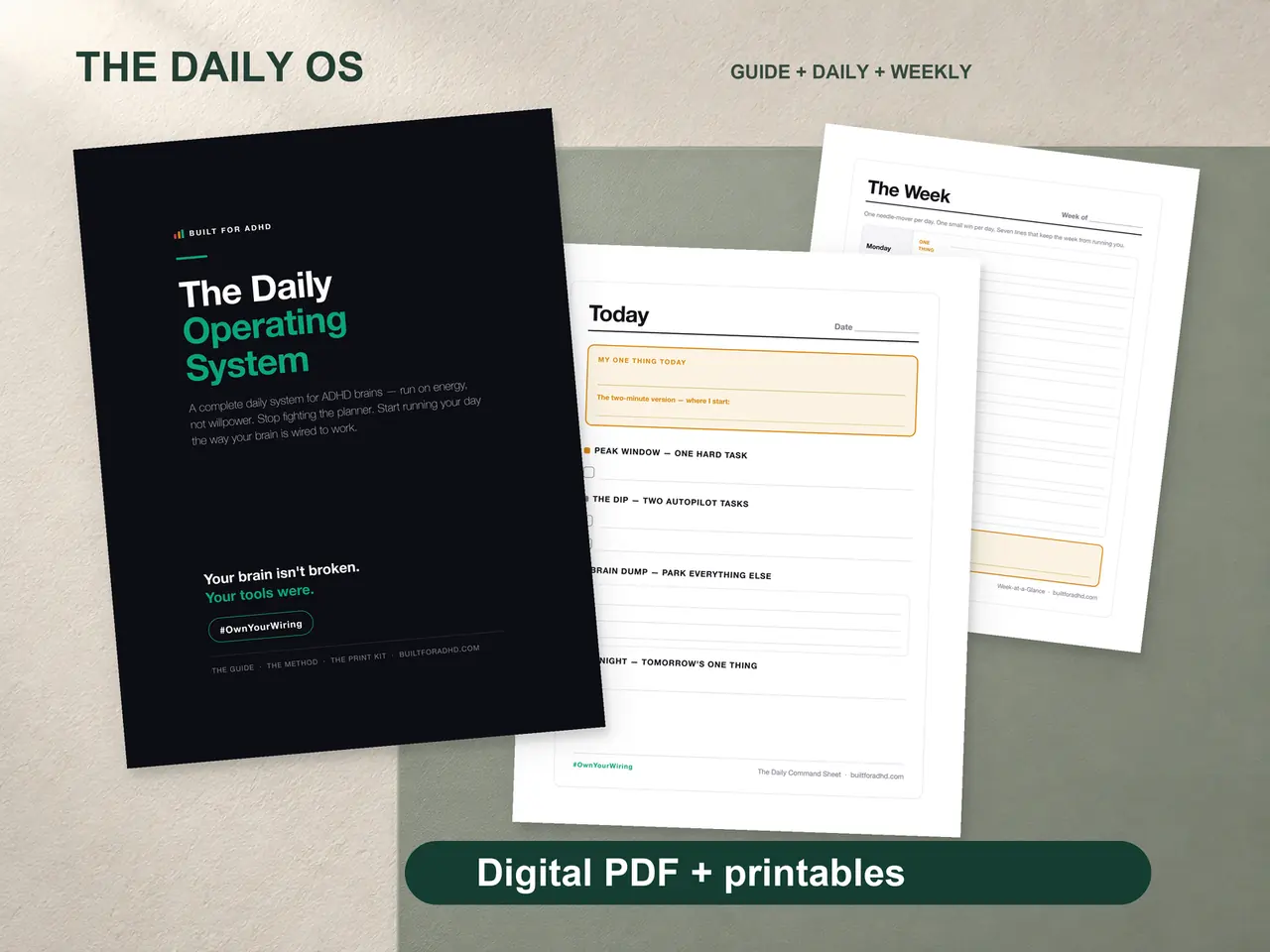
The Daily OS was designed with exactly this workflow in mind. The massive dump grid handles the morning capture. The Sort framework makes bucketing fast and intuitive. And the one-task-at-a-time page means your home environment can contain as many distractions as it wants — you’re only looking at one thing.
Permission to Work Differently
Remote work was supposed to give you freedom. For ADHD brains, freedom without structure is just chaos with better furniture. But with the right system — one that handles the executive function your brain outsources — remote work can actually become the best thing that ever happened to your productivity.
Because when you stop trying to work like a neurotypical person in an office and start working like the ADHD brain you actually have, everything shifts. You’re not broken. Your environment just needs better design.