In this article
It’s 1am. Your body is done — heavy, aching, ready. But your brain is wide awake, writing emails to people from 2015, replaying a conversation from Tuesday, and planning a project you will almost certainly never start.
You are exhausted and you cannot sleep. And tomorrow you’ll be wrecked, which makes the whole next day harder, which makes tomorrow night worse.
If this is you, you’re not broken and you’re not bad at sleeping. Sleep is one of the least-talked-about parts of adult ADHD, and something a lot of people quietly struggle with. The good news: once you understand why your brain does this, you can actually do something about it. (The full evening version lives in my ADHD wind-down routine guide.)
You don’t have a sleep problem. You have a shutdown problem.
Here’s the reframe that changes everything: most ADHD sleep trouble isn’t about being unable to sleep. It’s about being unable to stop.
Think about what actually happens. Your body clocked out hours ago. Your brain didn’t — because nothing ever told it to. There was no moment where the day was declared finished, nothing was marked handled, and nothing got put down. So it keeps running the day, out loud, in the dark, at the only hour quiet enough for you to hear it.
That’s the thing to fix. Not “falling asleep” — stopping. They’re different problems and they have different solutions. Chasing sleep directly is a fight you can’t win by trying harder; giving the day an ending is something you can actually build.
Three things are usually driving it at once, and it’s worth being able to name yours:
- Revenge bedtime procrastination. The whole day belonged to other people. The hours after everyone went to bed were the first ones nobody wanted anything from you — so going to bed means handing them back. That’s not a discipline failure. It’s an unmet need showing up at the only hour it can get a word in, which is exactly why “just go to bed earlier” has never once worked on you. (The full breakdown of the ADHD version, and the fix that lives in the daytime, is here.)
- The scroll is the most interesting thing that happened all day. After a day of effortful, boring, uphill things, the phone is where your brain finally gets something it wants. You’re not weak for reaching for it. You’re a brain going and getting what it was short on.
- The open loops won’t release. The 1am thoughts are almost always unfinished business — things you haven’t written down, so your brain keeps rehearsing them so you won’t forget. It’s genuinely trying to help. It just picked the worst possible time.
Naming which one is loudest tonight is most of the work, because all three have completely different fixes. Revenge bedtime procrastination needs the evening moved, not shortened. The scroll needs something to do, not a ban. The loops need somewhere to go.
How to give your brain an off-ramp
You can’t slam an ADHD brain from 60 to 0. But you can build a gentle exit it will actually take. Two moves do most of the work.
Move the phone out of reach. Not face-down on the nightstand — across the room, or in another room entirely. This is old advice and it’s old because it works: if ending the scroll requires physically standing up, it mostly ends on its own. It asks nothing of your willpower at 1am, which is exactly when you have none. It costs nothing. Do it tonight.
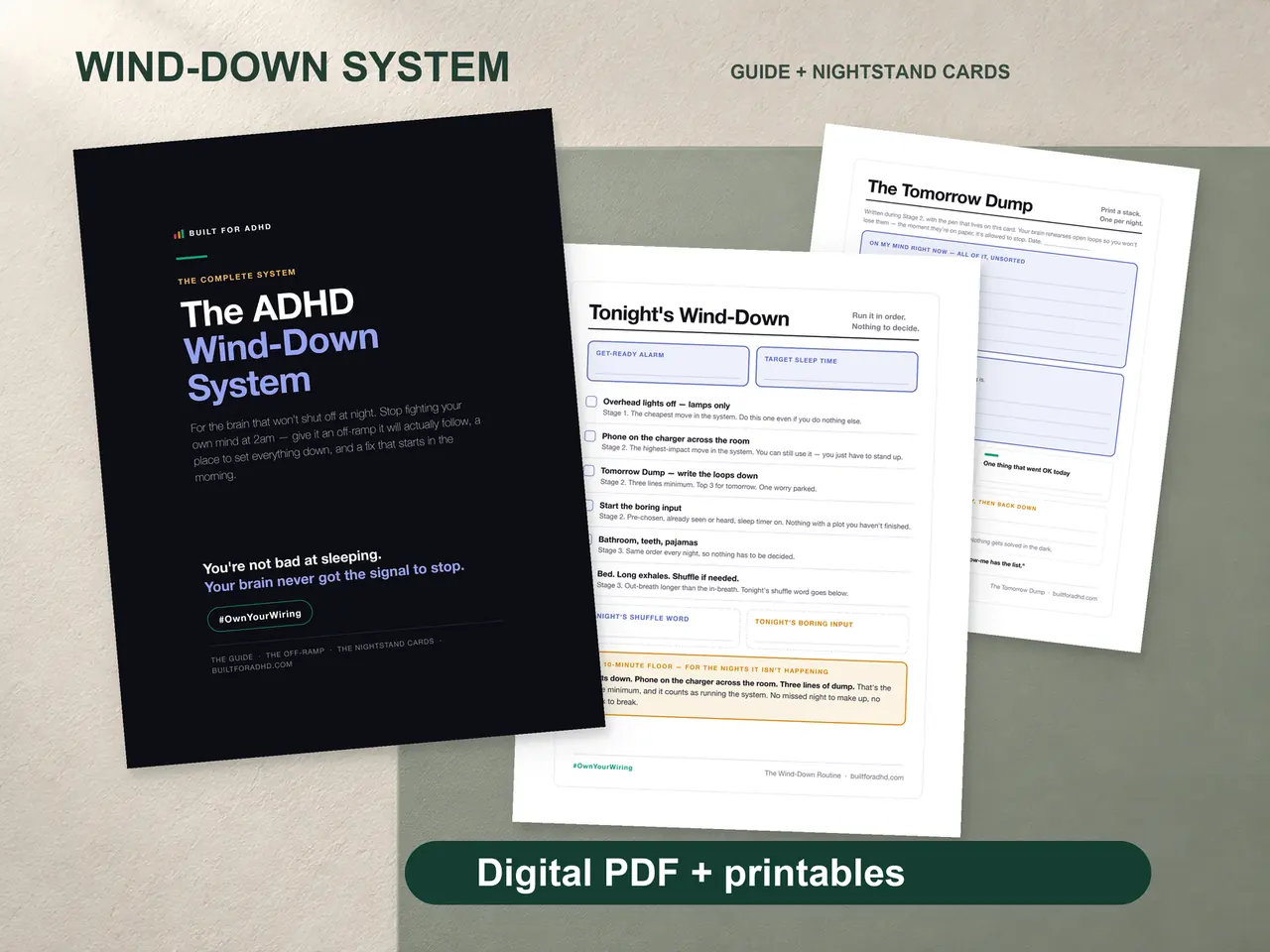
Empty the loops onto paper before bed. Write down everything your brain is holding for tomorrow — every task, every worry, the thing you must not forget — plus the one thing that actually matters tomorrow. Then close it with a sentence said out loud, something to the effect of it’s written down, it’s handled, I don’t have to carry it tonight. Saying it feels ridiculous the first few times and then it starts working, because your brain only holds the loop while it believes nothing else has it.
Around those two, build a short, repeatable wind-down: dim the lights, one calm low-stimulation input (a book, a shower, something you’ve already seen or heard), and a few slow breaths where the out-breath is longer than the in-breath. Same order every night, so it becomes automatic instead of one more thing to decide.
And on the nights it all falls apart anyway? Lower the bar. Do the brain dump and nothing else. A two-minute version you actually do beats a perfect routine you skip.
One more thing worth knowing, because it’s the least intuitive part: the night is not really where sleep gets fixed. What you do in the first hour after you wake up does more for tonight than anything you can force at midnight — which is the part almost nobody tells you.
The point isn’t a perfect night. It’s an off switch.
You’re not trying to become a person who sleeps eight flawless hours. You’re trying to give your brain the signal it never got: the day is over, the loops are handled, you’re allowed to stop. Give it that signal, most nights, and sleep slowly stops being a fight.
None of this is medical advice and none of it is treatment — it’s a way of organizing your evening, nothing more. If bad nights are most nights, or you’re wrung out no matter what you change, talk to a qualified healthcare provider. Some things that wreck sleep have nothing to do with behavior, and no blog post or printable can tell the difference.
This post gives you the reframe and a version you can run tonight. If you want the tuned one, that’s the ADHD Wind-Down System: the evening built as a staged off-ramp instead of a bedtime — with an honest 10-minute floor for the nights nothing is happening — a full worked evening from 9:45pm to the next morning (including the twenty minutes it goes wrong), the 3am protocol for when you wake at 3am, the exact scripts for asking a partner or a household to cooperate, the morning-side reset that does the actual clock-shifting, the climb back after a bad week that doesn’t involve a heroic 8:30pm, and the nightstand cards so it survives the tab closing. One-time download, yours to keep and print forever. No app, no sleep tracker, nothing to maintain. (It’s one of every ADHD tool we make — all built on the same externalize-it principle.)
Your brain isn’t broken. Your tools were. #OwnYourWiring