In this article
If you have ADHD and keep forgetting to eat until you suddenly crash — shaky, foggy, irritable, useless — the cause is usually a mix of three things working together: weak interoception (your body’s hunger signal is quiet), hyperfocus (it overrides the signal that does get through), and time blindness (hours vanish without registering). The fix is not “remember harder.” It is external scaffolding — a visible, zero-decision food system that does the remembering for you, because the part of your brain that is supposed to track this is the part ADHD affects. (The full version of that system — low-decision meals, the planning template, the grocery side — is in the ADHD meal planning guide.)
Why your hunger signal goes missing
Most people get a steady, escalating hunger cue and eat in response. With ADHD, that loop is unreliable for a few overlapping reasons:
- Interoception is blunted. Interoception is your sense of what is happening inside your body, and in ADHD it often runs quiet. The signal that says “you are getting hungry” either does not fire clearly or does not break through the noise — so you skip right past “hungry” and land on “starving and dysregulated.”
- Hyperfocus overrides it. When an ADHD brain locks onto something interesting, the rest of the body goes dark. The 2025 hyperfocus research summarized by ADDA found that around 40% of people neglect other responsibilities during hyperfocus — and eating is one of the first things to go.
- Time blindness hides the clock. ADDA describes time blindness as “the inability to sense how much time has passed,” and stresses it “does not mean someone is lazy.” You genuinely do not feel the four hours that passed since you last ate.
Stack those three and “I forgot to eat” stops being a quirk and starts being predictable.
The crash is not just unpleasant — it makes ADHD worse
Skipping meals does not only leave you hungry. When blood sugar drops, the symptoms — irritability, brain fog, shakiness, a complete loss of focus — look exactly like ADHD turned up to maximum. So the crash steals the rest of your day: you are now dysregulated and behind, and the late, frantic eating that follows is its own problem.
There is a more serious edge here worth naming plainly. People with ADHD are significantly more likely to struggle with disordered eating — a peer-reviewed meta-analysis found ADHD was associated with substantially higher odds of an eating disorder, with binge eating especially linked. The skip-then-crash-then-overeat cycle is part of how that risk shows up. This is not said to scare you. It is said so you take “I keep forgetting to eat” seriously as a real pattern with real consequences — not a moral failing to white-knuckle.
The fix is a system, not willpower
You cannot fix a missing internal signal by trying to feel it harder. You replace it with an external one. Three layers:
1. Decouple eating from hunger
Stop waiting to feel hungry — that signal is exactly the one that is unreliable. Eat on a rough schedule or on external cues (after a meeting, on the hour, when an alarm goes off), not on appetite. An alarm you respect is more reliable than your stomach.
2. Remove every decision from the food itself
The reason a good intention to eat fails is that “eat something” still contains a decision, and a depleted or hyperfocused brain will skip anything with a decision attached. So the food has to be zero-effort and pre-decided: a short list of fail-safe meals you chose in advance, staged where you will see them. When eating requires no thinking, it survives the days your brain is offline.
3. Make the cue visible
A plan in your head does not exist when you are hyperfocused. A “Survival Dinners” list and a stocked shelf of grab-and-go options, physically in your sightline, is the external cue that gets you fed when your internal one is silent. Out of sight is out of mind; in sight is dinner.
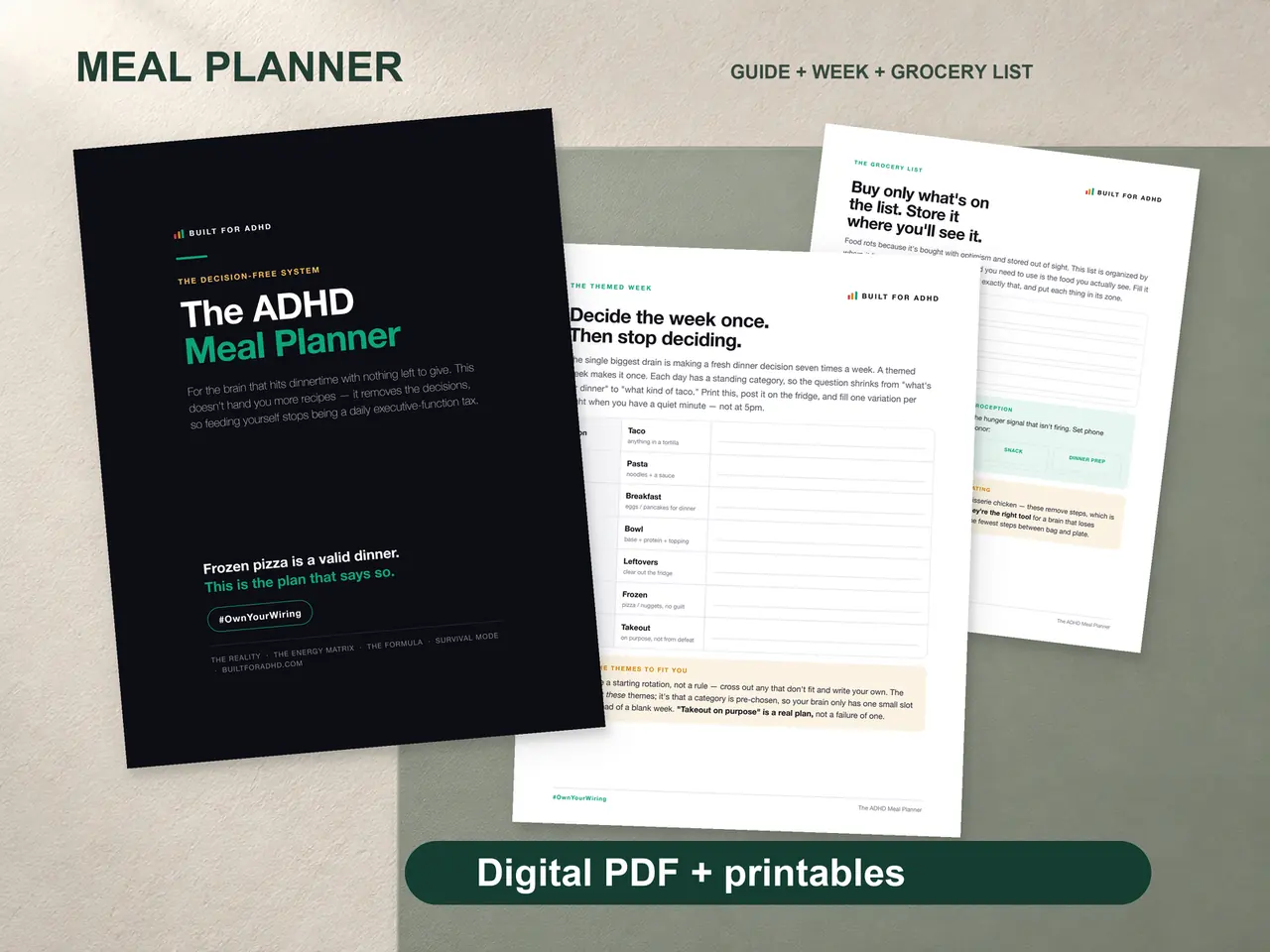
This is the whole idea behind the ADHD Meal Planner: a no-decision, energy-sorted food system with a Survival Dinners list built to live on your fridge, so getting fed does not depend on a hunger signal you cannot count on. It is the external scaffolding for a brain whose internal version runs quiet — the same way the Wind-Down System externalizes the “the day is over” signal your brain forgets to send. If external scaffolding is what works for you, you can browse the full tools library — every system we make is built the same way.
When to get more help
If forgetting to eat has tipped into a pattern that feels out of control — bingeing, restricting, eating that causes you distress — please talk to a doctor or a registered dietitian who understands ADHD. In the U.S., the National Alliance for Eating Disorders runs a free clinician-staffed helpline at 1-866-662-1235. A printable system is genuinely useful scaffolding, but it is not treatment, and you deserve real support if you need it.
You are not careless and you are not broken. Your hunger signal is quiet and your focus is loud. Build the system that feeds you anyway.
This is educational, not medical or nutritional advice.