In this article
If you run a business with ADHD, the productivity system you need is not a stricter version of the one you keep abandoning. It is a looser frame attached to the only thing your brain reliably cares about: results you can see. Most business systems fail ADHD entrepreneurs because they demand sustained willpower and linear prioritization — two things an ADHD brain does not produce on command. The fix is a minimum viable structure built around revenue, not discipline.
That is the whole article in four sentences. Here is why it is true, and how to build it. (For the tools that hold the frame, start with ADHD organization tools for the self-employed.)
You are not bad at business. Your brain is wired for it.
Start here, because the shame is the first thing to clear. People with higher hyperactivity traits are measurably more likely to be self-employed — in a study of more than 7,000 Swedish twins, researchers at Rotterdam School of Management found hyperactivity raised the odds of self-employment, a result replicated across 13,000+ students. The traits that make traditional jobs miserable — impatience, risk tolerance, the need for novelty — are the same traits that start companies. As Syracuse researcher Johan Wiklund told ADDitude, “Those with ADHD tend to spur themselves into action regardless of uncertainty.”
So the problem was never your ambition. The problem is that the operating layer — the daily running of the thing — assumes an executive-function system you do not have in steady supply.
Why generic productivity systems fail an ADHD founder
ADHD is, at its core, a disorder of executive function and self-regulation — not of knowing what to do. As Dr. Russell Barkley puts it, ADHD is “not a disorder of knowing what to do; it’s a disorder of doing what you know.” Standard business systems are built almost entirely on the part that is impaired:
- They assume linear prioritization. “Rank your tasks 1 through 10 and work top-down.” An ADHD brain does not weight tasks by importance — it weights them by interest, urgency, and novelty. By 10am the ranked list is fiction.
- They run on willpower. Streaks, daily disciplines, “just be consistent.” Willpower is exactly the renewable resource ADHD does not renew reliably. One bad day breaks the chain and the shame ends the system.
- They hide the reward. Neurotypical systems can run on delayed payoff. ADHD brains are chronically under-stimulated by delayed reward — if the dopamine is three weeks away, the brain treats the task as if it does not exist.
- They are invisible. Out of sight is out of mind, and for an ADHD founder, out of mind is gone. A plan living in your head or buried in an app you forgot to open is not a system. It is a hope.
This is also why I wrote the consumer version of this argument in Why Every Productivity System Fails ADHD Brains. The business version is worse, because now the missed task is a client, an invoice, or payroll.
The same wiring shows up in output. If part of your business is publishing, “post consistently” is the willpower bullet above wearing a different hat, and the fix is structural: a content bank and a two-mode week instead of a steady daily trickle you cannot produce.
The operating system that actually works
The system that survives contact with an ADHD brain has four properties. Build for these, not for discipline.
1. Minimum viable structure
Enough scaffolding to catch what falls, not so much that maintaining the system becomes its own full-time job. ADHD founders kill their systems by over-building them — a 14-tab dashboard you have to feed is a system you will abandon by Thursday. You need the fewest moving parts that still keep a client from slipping through.
2. Sort by energy, not by priority
Stop asking “what is most important?” Start asking “what can I actually do with the brain I have right now?” High-energy mornings get the hard, ambiguous, revenue-generating work. Low-energy afternoons get the admin you can do half-asleep. This is the same engine behind energy-based task management — it just runs your company instead of your day.
3. Make revenue the dopamine
This is the unlock. If your system shows you money — pipeline value, what closed this week, what is owed — the page itself becomes stimulating. You are not relying on the discipline to “check your numbers.” You are looking at the numbers because watching them move is the reward. You weaponize the dopamine deficit instead of fighting it.
4. Externalize everything, visibly
Every commitment, every follow-up, every half-formed idea lives somewhere you will physically see it — not in your head, not in a closed app. A visible client pipeline means a deal does not die because you had a bad executive-function day and forgot it existed.
What this looks like in practice
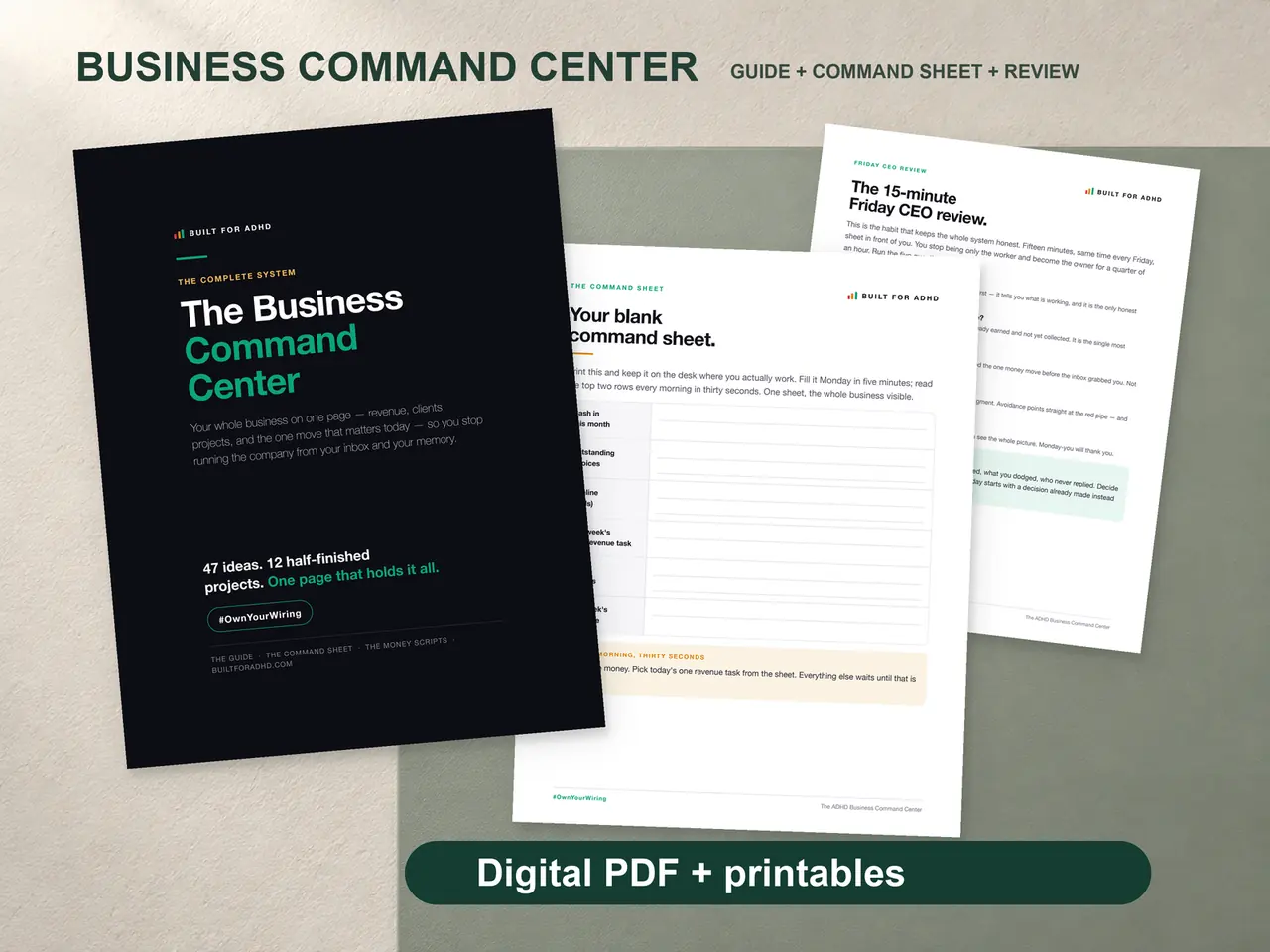
Those four properties are exactly what I built the ADHD Business Command Center around: a one-page revenue snapshot you update by hand, a visible client pipeline so nothing gets dropped, energy-sorted projects instead of a priority list you will ignore, an idea parking lot so the 2am genius idea does not derail Tuesday, and a weekly CEO review that takes fifteen minutes and tells you what actually matters. It is one printable system, not an app to maintain.
If you want the whole stack — the business cockpit plus the Hyperfocus-to-Revenue Playbook and the budgeting system — the ADHD Entrepreneur System bundles them. And if you’re still comparing options, our full guide to ADHD tools for adults walks through the whole lineup.
The one mindset shift
Stop trying to become the kind of founder who runs a tight, disciplined system. That person is not coming. Build the system that runs even when you are not disciplined — visible, energy-sorted, revenue-forward, and small enough to actually maintain. Your brain isn’t broken. The system you were handed was built for someone else’s.
This is educational, not medical or financial advice. If ADHD is significantly disrupting your work or wellbeing, talk to a qualified clinician.