In this article
If managing clients with ADHD feels impossible, it is usually not the work that breaks down — it is the emotion around the work. A single piece of critical feedback can land like a personal catastrophe, trigger avoidance, and leave you ghosting an email you fully intend to answer for nine days. The fix is two-part: treat feedback as data instead of a verdict, and put your clients into a visible pipeline so a deal never dies just because you had a bad emotional day. Your follow-through should not depend on your mood.
Name the thing that is actually happening: RSD
What wrecks ADHD client relationships is rarely incompetence. It is rejection sensitive dysphoria — extreme emotional pain triggered by the perception of being criticized or rejected. According to Dr. William Dodson, who has studied it extensively, RSD is something “almost 100% of people with ADHD experience,” and roughly a third of his adult ADHD patients describe it as the single most impairing part of their ADHD — more than the focus problems.
Here is how it shows up in a business:
- A client says “this isn’t quite what I had in mind,” and your brain hears “you are a fraud and this whole thing is over.”
- The pain is so sharp that you avoid the email. Avoiding it feels better for an hour, so you keep avoiding it.
- Now the unanswered email is itself a source of shame, which makes opening it harder, which makes you avoid it more.
- A week later you have a ghosted client, a stalled invoice, and a story about how you are “bad at business.”
You are not bad at business. You had a normal ADHD nervous-system response and no system to catch you while it passed.
Reframe one: feedback is data, not a verdict
The feeling that feedback is an existential threat is real, but it is not accurate. A client telling you the blue is too dark is giving you information that makes the work shippable. It is the most useful thing they can do.
You will not feel this in the moment — RSD does not respond to logic mid-spiral. So you build the reframe into a rule you follow regardless of feeling: client feedback gets a same-day acknowledgment, even if the fix takes a week. A simple “Got it — thanks for the notes, I’ll have a revision back to you by Thursday” closes the loop, kills the avoidance shame, and buys you time to do the work when your brain is back online. The acknowledgment is the system. The emotion is just weather.
Reframe two: separate the feeling from the follow-up
The reason RSD is so expensive in business is that it attaches a tactical task (reply to client) to an emotional event (I feel rejected). When the emotion spikes, the task gets buried with it.
So you separate them physically. The follow-up does not live in your inbox, where it is tangled up with the feeling. It lives in a pipeline — a visible board where every client and every open thread sits in plain sight, independent of how you feel about any one of them. On a bad day you do not have to remember the follow-up. You just look at the board, and the board has not forgotten.
This is the same principle behind body doubling and externalized task systems: an ADHD brain is unreliable as a storage device, so you move the storage outside your head. With clients, the storage is the pipeline.
The system: a client pipeline that survives your worst day
A working ADHD client system has three parts:
- A visible pipeline. Every active client and every open deal in one place — lead, proposal sent, in progress, awaiting feedback, invoice out, paid. You see the whole board at a glance, so nothing lives only in the fog of your memory.
- An idea and follow-up parking lot. The “I should circle back to that client about the upsell” thought gets captured the instant it appears, so it does not evaporate or, worse, gnaw at you for weeks.
- A weekly review. Fifteen minutes, once a week, looking at the board on purpose — who is waiting on you, what is owed, what is about to slip. This is when you catch the thing that RSD made you avoid on Tuesday, on a calmer day when you can actually act.
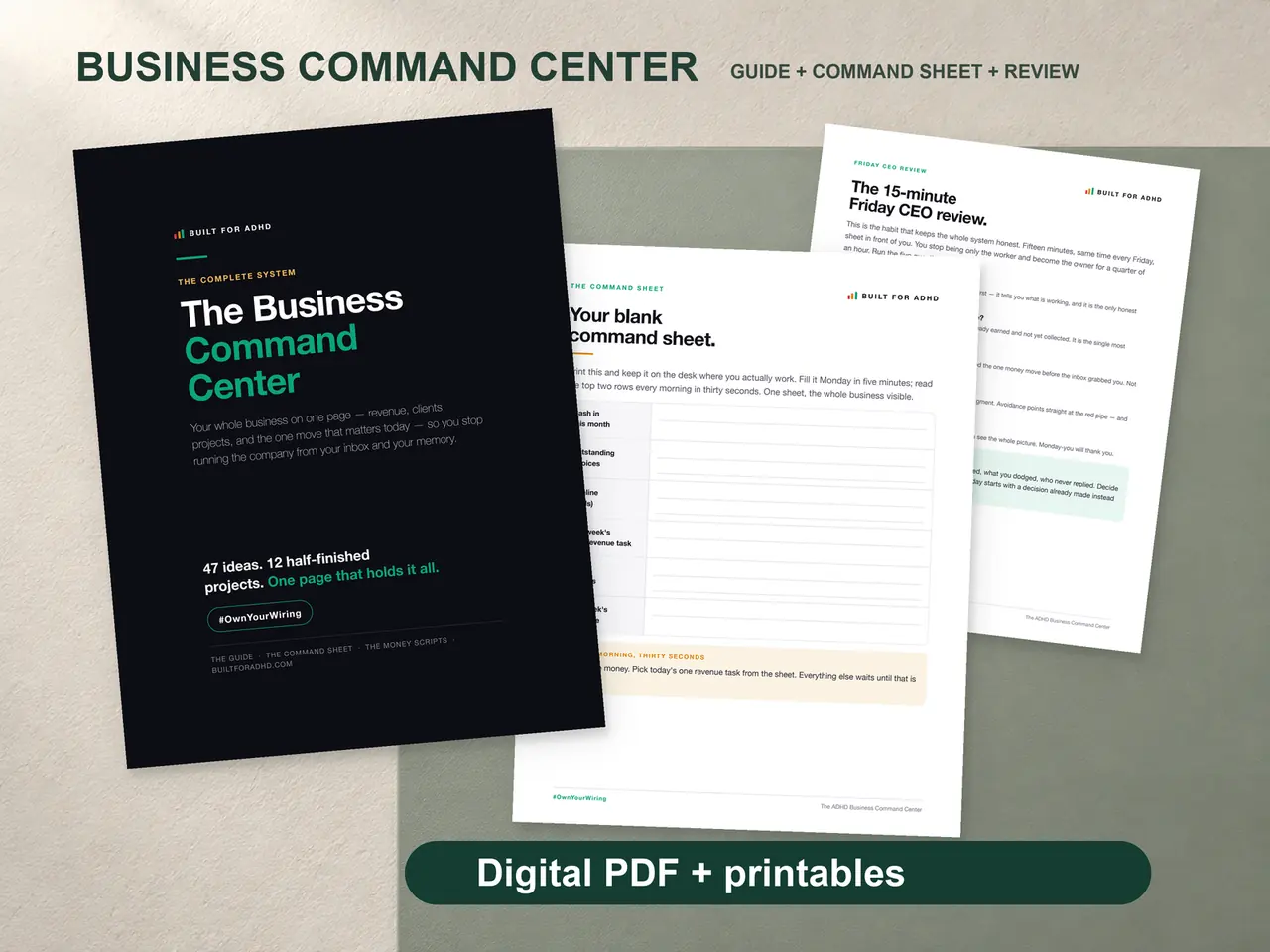
I built the ADHD Business Command Center around exactly this: a client pipeline, an idea parking lot, and a weekly CEO review, so your business keeps moving on the days your nervous system does not. It works the same way the rest of my tools do — externalize the system so your brain doesn’t have to run it. All of our printable ADHD tools follow that same rule.
The bottom line
You will keep having RSD reactions. That part is not going away. What you can change is whether a bad emotional hour costs you a client. Acknowledge feedback the same day, keep your follow-ups on a visible board instead of in your head, and review it weekly. The pipeline does not have rejection sensitivity. Let it carry the part of the job your nervous system cannot.
This is educational, not medical advice. RSD is real and can be intense — if rejection sensitivity is significantly affecting your life, a clinician who understands ADHD can help.