You’ve heard the advice a hundred times: “Just wait 48 hours before you buy it.” Great idea. One problem — your ADHD brain treats 48 hours like 48 years. By hour three, that thing you wanted feels absolutely critical to your survival.
And then there’s the other side of ADHD. You write it down, set it aside, and genuinely forget it exists. Three weeks later you find a note that says “blue backpack???” and have zero idea what you were talking about.
The 48-hour rule is actually brilliant for ADHD brains. You just need a tracker that accounts for how your brain actually handles waiting.
Why the 48-Hour Rule Works (When You Can Actually Do It)
Here’s the thing about impulse purchases: most of them don’t survive 48 hours. Plenty of unplanned buys lose their appeal once the initial excitement wears off. Your brain saw something shiny, flooded you with dopamine, and convinced you it was the most important purchase of your life.
Two days later? You can’t even remember why you wanted it.
That’s not a bug — that’s a feature. Your ADHD brain cycles through interests fast. The 48-hour rule takes advantage of that natural cycle. If something survives two full days of your brain moving on to other things, it’s probably something you genuinely want.
The Problem: ADHD and Waiting Don’t Mix
Telling an ADHD brain to wait is like telling water to flow uphill. Your executive function — the part of your brain that handles delayed gratification — is literally working with less fuel than a neurotypical brain.
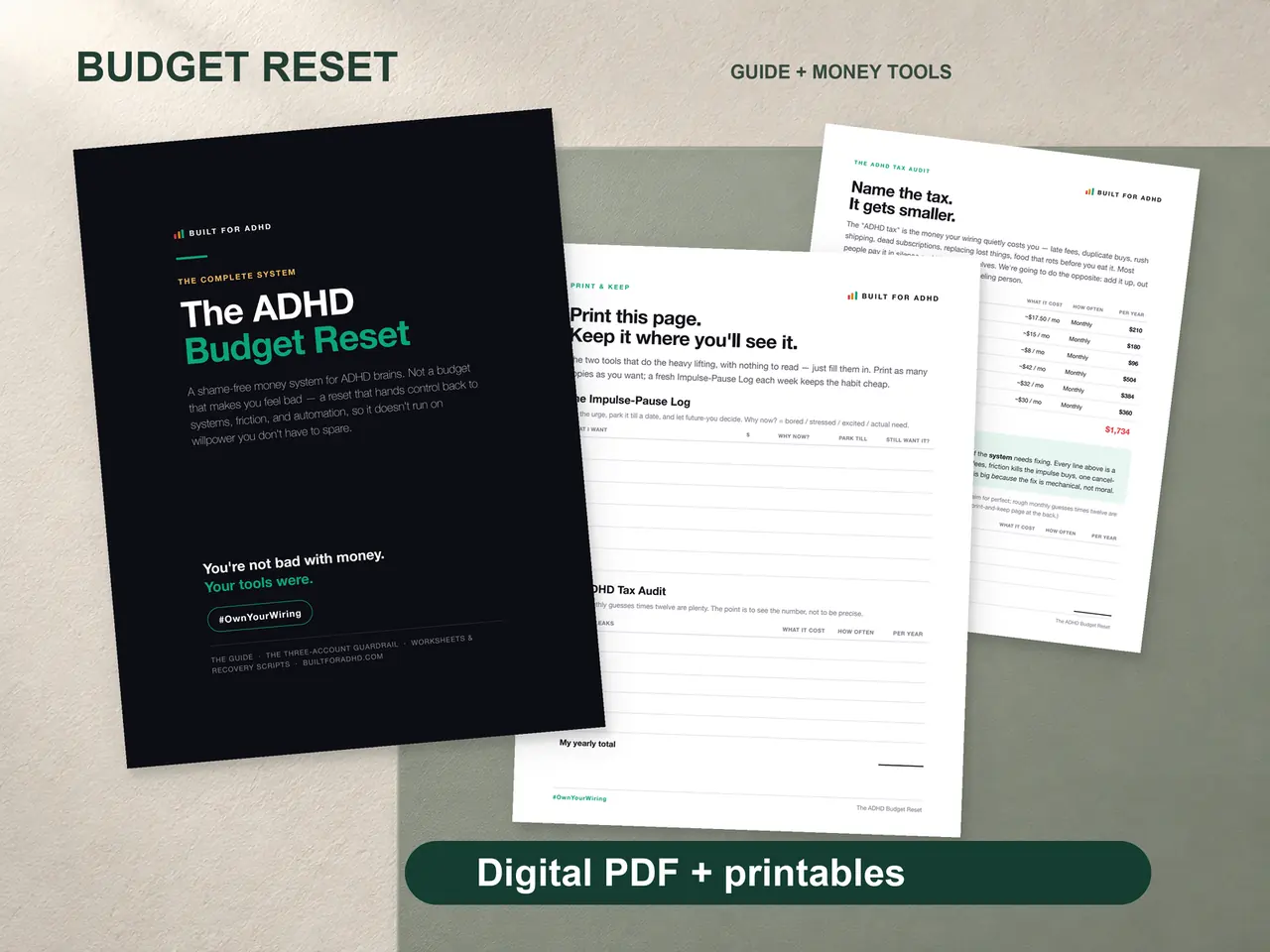
So you need external support. A tracker. Something outside your head where you write down what you’re waiting on and the date the 48 hours are up — so the wait lives on the page instead of relying on you to remember.
Without a tracker, the 48-hour rule becomes one of three things: something you forget about entirely, something you white-knuckle through with pure willpower (exhausting), or something you abandon after 20 minutes because your brain decided this purchase is “different.”
How an ADHD-Friendly 48-Hour Tracker Works
When you spot something you want to buy, you log it. Name, price, date, and time. Then you answer the 4-question decision framework to get your initial pause score.
Green score? You might not even need to wait. Your logical brain is on board with this one.
Yellow score? This is where the 48-hour wait really shines. Put it on the tracker and let your brain do its thing. Come back in two days and see if you still care.
Red score? Your brain is almost certainly chasing dopamine. Log it, wait, and prepare to be amazed at how little you care about it by Thursday.
The Savings Tracker Changes Everything
Here’s where it gets satisfying. Every item you decide not to buy after the 48-hour wait gets its price added to your savings tracker. You get to watch that number climb.
That $35 kitchen gadget you forgot about? Saved. The $80 hoodie that seemed essential at midnight? Saved. The $120 thing you can’t even name anymore? Saved.
After a month, most people using this system are looking at hundreds of dollars they didn’t spend. Real money. Money that’s sitting in their account instead of arriving in boxes they’ll never open.
For an ADHD brain, that growing number is its own dopamine hit. You’re replacing the rush of buying with the rush of saving. Same brain chemistry, better outcome.
Making It Stick
The tracker is phone-friendly by design. Screenshot it, save it to your home screen, whatever works for your workflow. The goal is zero friction between “I want to buy this” and “let me check my tracker first.”
You don’t need to be perfect with it. You don’t need to track every coffee or every grocery run. Just the unplanned stuff. The things that show up in your cart because your brain decided browsing was a good idea at 11 PM.
Start with one week. Track every unplanned purchase urge, wait the 48 hours, and see what happens. Most people are genuinely shocked at how many things they completely forget about.
Your brain moves fast. That’s not the problem. The problem is buying at the speed your brain moves. Give yourself a 48-hour speed bump and let your natural ADHD attention cycling work in your favor for once.