You didn’t need that thing. You know you didn’t need that thing. And yet there it is, in your cart, purchased, shipped, and arriving Tuesday. Your brain already got its dopamine hit the second you clicked “Buy Now.” By the time the package actually shows up, you’ll barely remember ordering it.
This is the ADHD impulse buying cycle, and if you’re reading this, you’ve probably been stuck in it for years. The late-night Amazon scrolls. The “treat yourself” Starbucks runs that happen five times a week. The hobby supplies for a hobby you were passionate about for exactly eleven days. The cart full of organizational products you bought to get organized — and then never organized.
You’re not irresponsible. You’re not bad with money. Your brain is literally under-producing the neurotransmitter that helps other people pause before purchasing. Dopamine is the molecule of “maybe I should think about this first,” and yours is running on fumes.
Understanding the Dopamine-Purchase Connection
Here’s what’s actually happening in your brain when you impulse buy: your prefrontal cortex — the part responsible for executive function, planning, and impulse control — is understimulated. Buying something new creates a burst of dopamine that temporarily brings your brain online. It feels like relief. Like scratching an itch you couldn’t quite reach.
The problem isn’t the purchase. The problem is that the dopamine fades in minutes, but the credit card charge lasts forever. So you buy again. And again. And the shame compounds faster than the credit card interest.
Understanding this isn’t an excuse. It’s tactical information. Once you know why you’re doing it, you can build systems that give your brain what it actually needs without destroying your bank account.
Four Strategies to Interrupt the Impulse Cycle
1. Create friction, not willpower. Delete saved credit cards from every shopping site. Remove Apple Pay and Google Pay from your phone. Make purchasing require effort — finding your wallet, typing card numbers, confirming addresses. Every second of friction is a second your prefrontal cortex might catch up and ask, “Do I actually need this?”
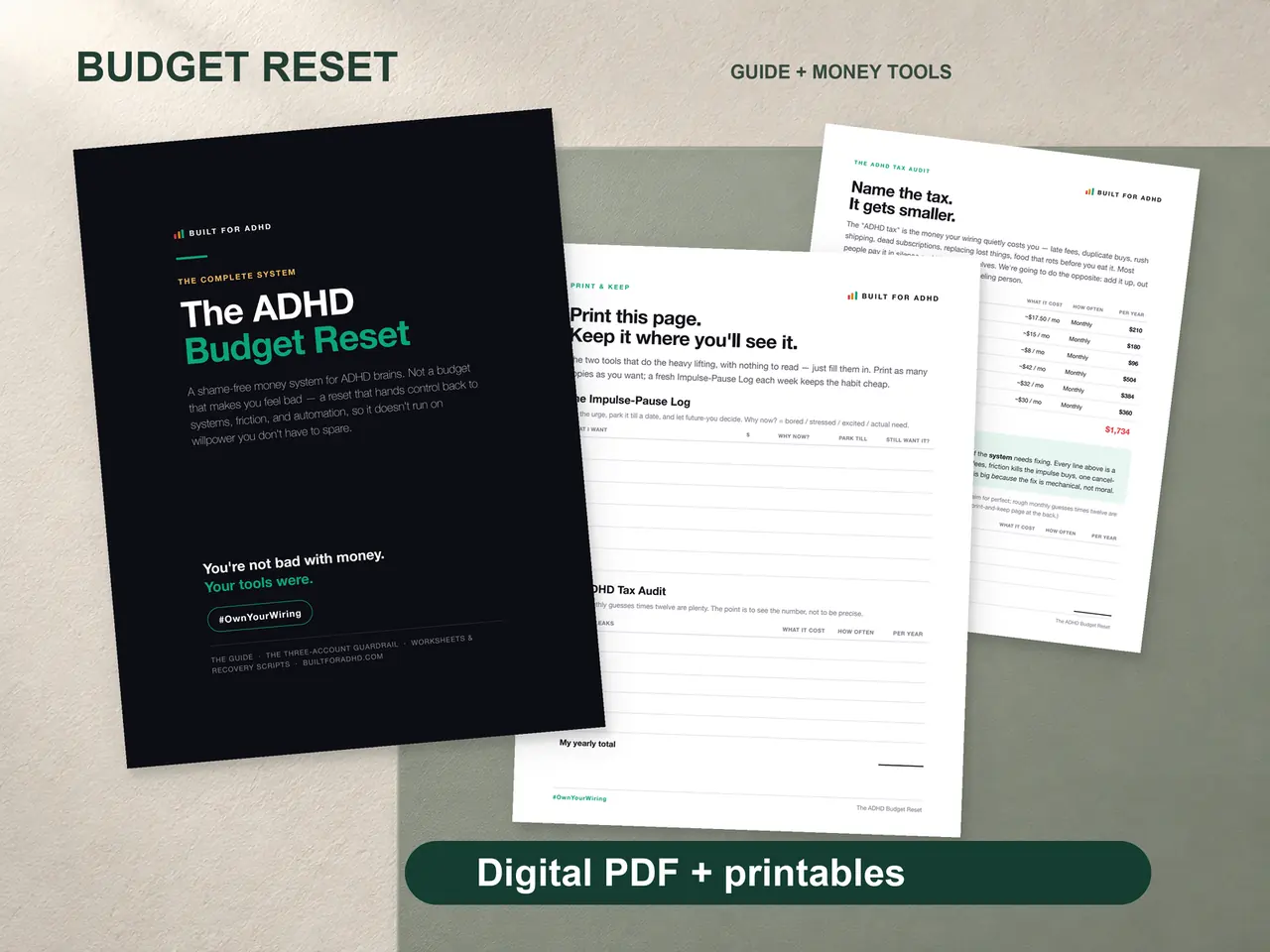
2. Use the Impulse Log instead of buying. When you feel the urge to purchase something, log it instead. Write down what you wanted, how much it costs, and what you were feeling when the urge hit. This does something remarkable — it gives your brain a micro-action to perform, which provides a small dopamine hit of its own. You did something. You didn’t just sit there fighting an urge. Over time, the log becomes a goldmine of self-awareness.
3. Apply the 48-hour rule for anything over $20. Put it in your cart but don’t buy it. Come back in 48 hours. If you still want it — genuinely want it, not just remember you wanted it — buy it guilt-free. Most impulse buys don’t survive a 24-hour pause, let alone 48. Your future self will thank you.
4. Track your ADHD Tax. Create a visible, non-judgmental category for impulse buys, late fees, forgotten subscriptions, and other ADHD-related costs. When you can see the total monthly number, it becomes data instead of shame. Data you can work with. Shame just makes you buy more to feel better.
The Pattern Recognition Payoff
The most powerful thing about tracking impulse purchases isn’t the money you save today. It’s the patterns you discover over weeks and months. You’ll start noticing that your worst spending happens on Sunday evenings (anxiety about Monday), after stressful meetings (emotional regulation), or between 10 PM and midnight (understimulated, exhausted prefrontal cortex).
Once you see the patterns, you can address the root causes. Sunday evening anxiety might need a wind-down routine. Post-meeting spending might need a walk around the block. Late-night scrolling might need a phone curfew.
A Tracker Built for the ADHD Brain
The Budget Reset includes a dedicated Impulse Log page that makes recording “almost purchases” as easy as the purchase itself. The ADHD Tax page gives you an honest, shame-free accounting of what impulsivity actually costs you each month. And because you capture first and sort later, you’re not stuck categorizing in the moment — your brain is freed up for the more important work of noticing your patterns. It’s an instant-download PDF — guide, workbook, and print-and-keep pages — so you can print the Impulse Log and keep it where the urges hit.
The monthly view spread shows your progress with fill-in progress bars, not spreadsheet rows. Your brain responds to visual data. Give it what it wants.
It’s yours forever, works on any device, no app or login. It’s probably less than your last impulse buy — and this is the purchase that will actually save you money.
You’re not fighting a character flaw. You’re managing a neurological difference. And having the right tool makes all the difference.