You’ve seen the no-buy challenge posts. The people on social media who didn’t buy anything unnecessary for thirty whole days and saved $500 and found inner peace and probably also achieved enlightenment. And you thought, “I could do that.” So you committed. You were fired up. You made it to day two.
Then your brain found the loophole. “This doesn’t count because it was on sale.” “This is technically a need.” “I’ll start over on Monday.” And by Wednesday, you’d bought three things you didn’t need and felt worse than before because now you’d added failure to the shame pile.
Here’s the thing nobody talks about: no-buy challenges were not designed for ADHD brains. They were designed for neurotypical brains that overspend due to habit, not neurology. Your impulse buying isn’t a bad habit — it’s a dopamine-seeking behavior driven by an understimulated prefrontal cortex. Asking you to white-knuckle through a no-buy month with pure willpower is like asking someone with a broken thermostat to just decide to be warmer. The hardware doesn’t support it.
But that doesn’t mean no-buy challenges are off the table. It means they need to be rebuilt for how your brain actually works.
Why Traditional No-Buy Challenges Backfire
Standard no-buy challenges operate on a restriction model: stop buying, save money, feel good. Simple, right? For ADHD brains, restriction creates three specific problems.
The deprivation spiral. When you tell an ADHD brain “you can’t have this,” the brain becomes obsessed with having it. This is the same mechanism that makes ADHD brains hyperfocus on forbidden tasks. Restriction doesn’t reduce desire — it amplifies it. By day three of a no-buy challenge, you’re not thinking about all the things you’re saving. You’re thinking about all the things you can’t buy. Every ad, every email, every store window becomes a test of willpower you didn’t have much of to begin with.
The all-or-nothing trap. ADHD brains tend toward binary thinking. Either you’re doing the challenge perfectly, or you’ve failed entirely. One impulse purchase on day four doesn’t feel like a minor slip — it feels like total failure. So you quit. “I already messed up, might as well go all in.” And the post-restriction spending spree is often worse than the normal spending you were trying to curb.
The invisible progress problem. Not buying things doesn’t produce visible results. Your bank account goes up slightly, but it doesn’t feel like you did something. ADHD brains need visible evidence of progress to stay motivated. The money you saved by not buying something is invisible money. It doesn’t trigger reward circuitry. So there’s no neurological payoff for the effort.
The ADHD No-Buy Challenge: Modified Rules
An ADHD-adapted no-buy challenge replaces willpower with systems and makes invisible savings visible.
Start with one week. Not thirty days. Not even two weeks. Seven days. A goal your brain can see the end of from the beginning. When you complete seven days, the accomplishment is real and recent enough to generate genuine dopamine. Then you can try another seven days. Stacking small wins is more sustainable than attempting one massive win.
Log instead of resist. When you feel the urge to buy something, don’t fight the urge. Log it. Write down what you wanted, how much it costs, and what you were feeling when the urge hit. This does three things: it gives your brain a micro-action (which provides a small dopamine hit), it creates a record of your impulse patterns, and it makes the money you saved by not buying visible and countable.
Track the “saved” total. At the end of each day, add up everything you logged but didn’t buy. That number is your daily savings. Watch it accumulate over the week. By day seven, you might have $50, $100, or $200 in “almost bought” savings. That visible number is the missing reward signal your brain needs.
Build friction for spending. Before starting the challenge, delete saved payment methods from every shopping app and website. Remove Apple Pay and Google Pay. Put your credit cards in a drawer — not in your wallet. Every layer of friction adds a few seconds of delay between impulse and action, and those seconds are where your prefrontal cortex has a chance to intervene.
The Impulse Log Changes Everything
The single most powerful tool in an ADHD no-buy challenge isn’t willpower or rules. It’s the Impulse Log. Every time you want to buy something and don’t, you log it. Over a week, this log becomes a goldmine of self-awareness.
You’ll see patterns you’ve never noticed. Maybe your worst impulse hours are 9-11 PM (understimulated, tired prefrontal cortex). Maybe impulses spike after stressful emails (emotional regulation seeking). Maybe certain websites or stores trigger spending urges that others don’t (environmental cues).
Once you see patterns, you can address root causes. Block the triggering websites. Create an evening routine that replaces late-night scrolling. Build a post-stress response that isn’t shopping. The log turns unconscious impulse spending into conscious, manageable data.
A Tracker Built for the Challenge
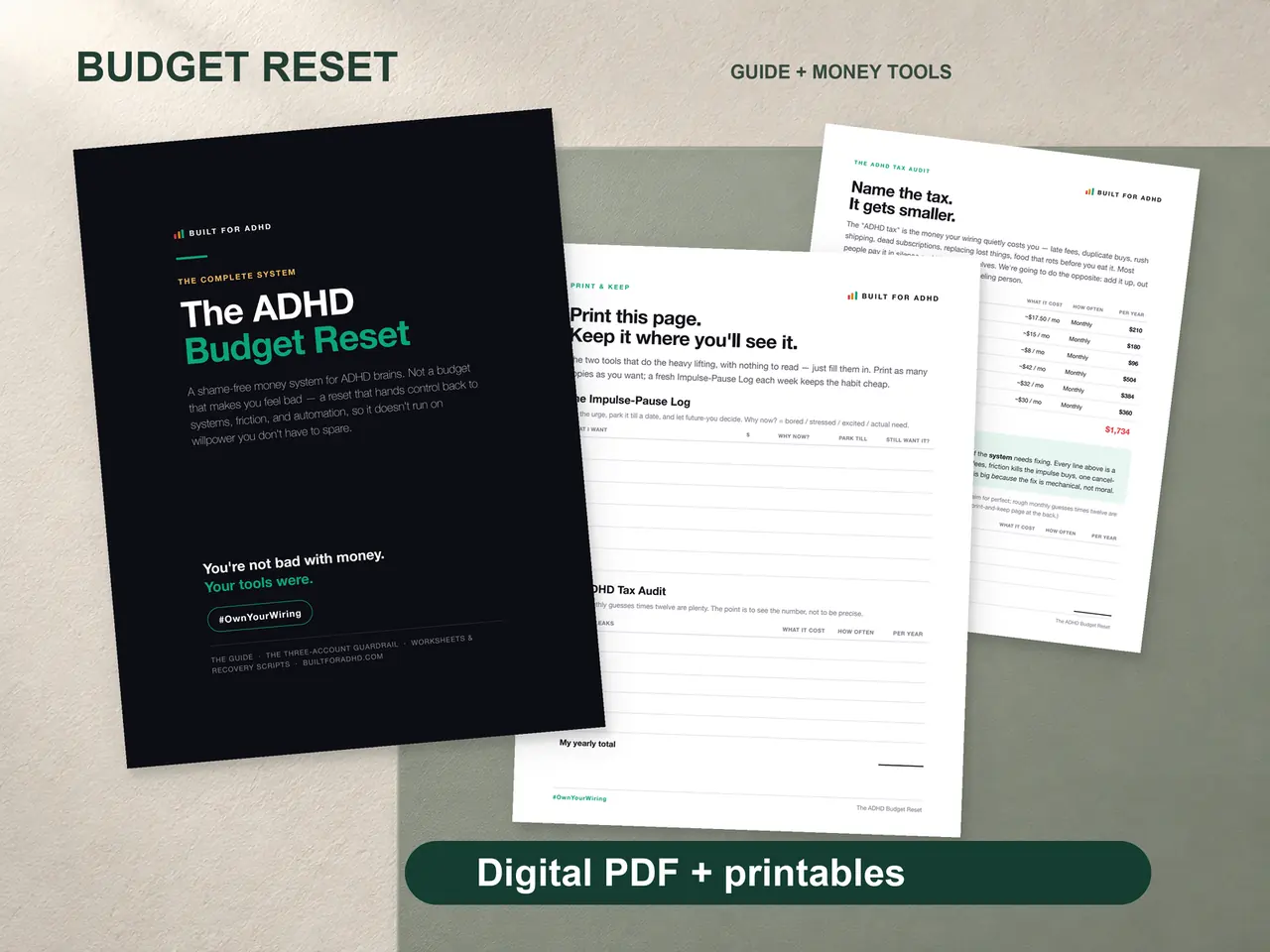
The Budget Reset makes the no-buy challenge sustainable. The Impulse Log is built directly into the tool — logging what you almost bought is as easy as logging what you actually bought. The Monthly page shows your progress with fill-in progress bars, so the money you’re saving by not spending becomes visible and real.
The ADHD Tax category helps you see the full cost of past impulse spending — the buys, the late fees, the forgotten subscriptions. When you can see what impulsivity has cost you historically, the motivation to change isn’t based on guilt — it’s based on data. And the Subscription Tracker lets you audit recurring charges, canceling the ones you forgot about, which is often the easiest money you’ll save all month.
Progress Over Perfection
A perfect no-buy challenge doesn’t exist for ADHD brains. A useful one does. Track the urges. Log the saves. See the patterns. Build the friction. And when you slip — because you will — log it, learn from it, and keep going.
Seven days at a time. That’s the whole challenge. And seven days from now, you’ll have data, savings, and proof that your brain can do this.