You don’t actually want the thing. You want the feeling of buying the thing. And if you have ADHD, that distinction explains a whole lot of your credit card statement.
That kitchen gadget you used once. The hobby supplies for an interest that lasted four days. The “perfect” organizer that’s now sitting disorganized in a drawer. You didn’t buy those because you’re irresponsible. You bought them because your brain needed a dopamine hit, and buying stuff is one of the fastest ways to get one.
Your Brain on a Shopping Trip
Let’s walk through what happens neurologically when you buy something impulsively.
Your ADHD brain operates with lower baseline dopamine than a neurotypical brain. Dopamine is the chemical that drives motivation, reward, and that feeling of “this matters right now.” When your baseline is low, your brain is constantly scanning for ways to boost it.
Enter shopping. The moment you spot something interesting, dopamine starts flowing. Not when you buy it — when you start wanting it. The browsing, the comparing, the reading reviews, the imagining yourself using it — all of that is dopamine. The actual purchase is just the peak of a wave that started the moment something caught your eye.
Then the wave crashes. You got the thing. Dopamine drops back to baseline — or below. The thing that felt essential five minutes ago is now just another object. And your brain starts scanning for the next hit.
The Stuff You Accumulate Is Evidence, Not Shame
Look around your space. If you see things you bought in a rush of excitement and barely touched, that’s not evidence of personal failure. That’s evidence of a dopamine-seeking brain doing its job.
The pile of unused hobby supplies? Your brain got the dopamine from the planning and purchasing phase. It didn’t need the actual hobby. The closet of clothes with tags still on? Same thing. Your brain wanted the rush of finding the deal and making the decision. Wearing the clothes was never really the point.
This pattern is so common in ADHD that researchers have a term for it: “reward-seeking behavior.” Your brain is literally wired to chase the feeling more than the outcome. Understanding this isn’t an excuse — it’s the information you need to build a system that works.
Why Willpower Fails Every Time
Telling yourself “I won’t buy unnecessary things” is like telling yourself “I won’t get hungry.” The urge to seek dopamine isn’t optional. It’s a fundamental drive in your brain.
What you can do is redirect how your brain gets that hit. And the first step is creating a pause point — a moment between the impulse and the action where your prefrontal cortex gets a chance to chime in.
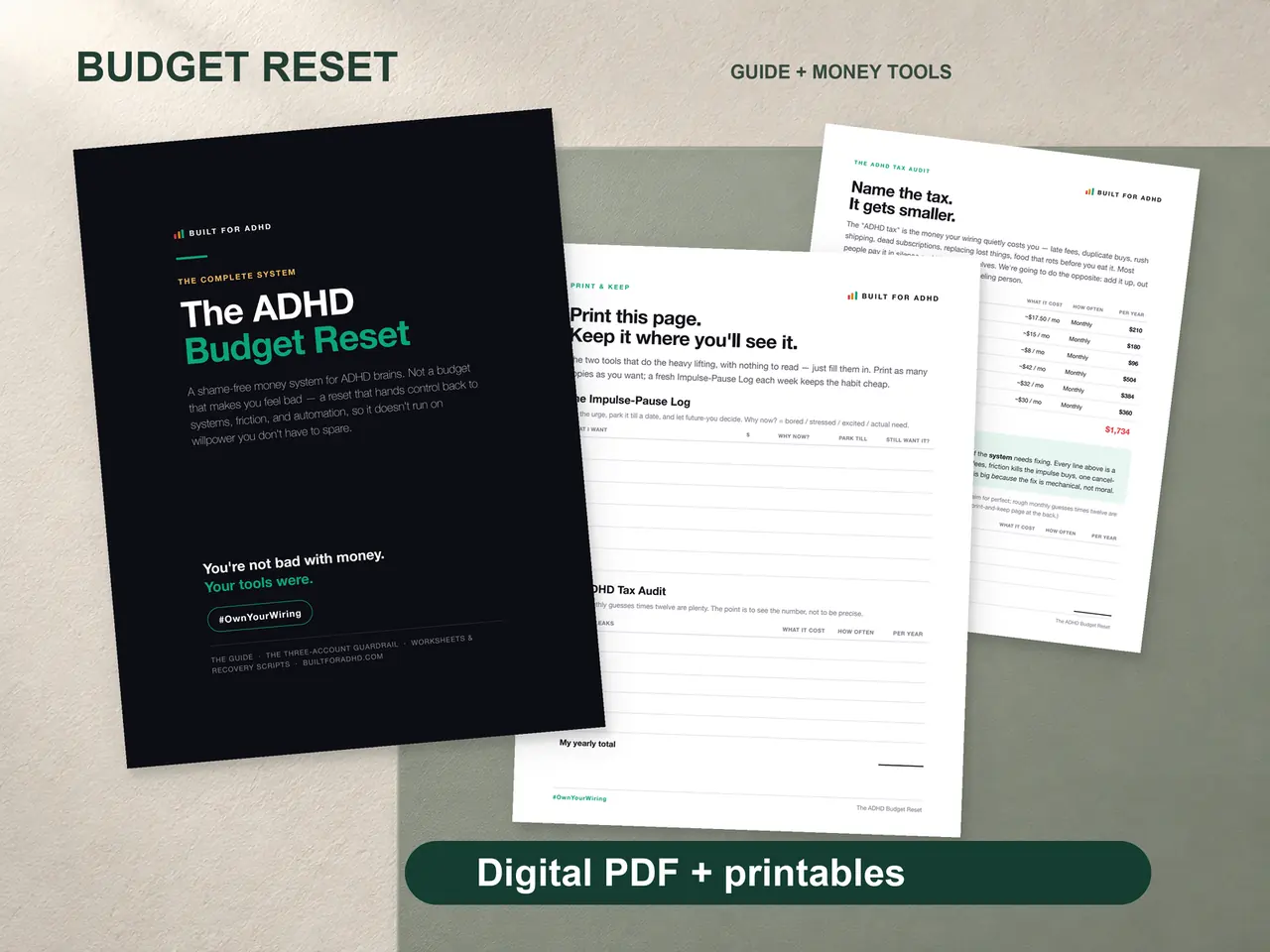
The Budget Reset creates that pause with a 60-second gut check. Four questions. A red/yellow/green score. That’s it. Fast enough that your brain won’t skip it, structured enough that it actually works.
When you answer those four questions honestly, something shifts. You go from “I need this” to “oh wait, my brain is doing the thing again.” That awareness is where change starts.
Redirecting the Dopamine Drive
Your brain’s going to seek dopamine no matter what. The question isn’t whether, it’s where. When you catch a dopamine spending urge and redirect it, you need something to replace the hit.
The running total of money you didn’t spend serves this exact purpose. Every paused purchase adds to a visible savings number. Watching that number grow provides its own small dopamine hit — proof that your system is working, progress you can see.
Over time, you start to notice the pattern more clearly. You can see which times of day you’re most vulnerable, which triggers set you off, and which types of products your brain gravitates toward. That data becomes power.
Starting the Pattern Interrupt
You don’t need to overhaul your life. You need one tool, used consistently, in the moment between “I want that” and “I bought that.”
The 60-second gut check isn’t complicated. It doesn’t require setup, maintenance, or a degree in behavioral psychology. It’s four questions that your brain can handle even when it’s mid-impulse.
Over time, the pause becomes a habit. Your brain starts to expect the check before a purchase. And gradually, the automatic pipeline from “see thing” to “buy thing” develops a speed bump that your logical brain can actually use.
You’re not broken for spending money on dopamine. You’re human, with an ADHD brain, in a world engineered to exploit exactly this kind of spending. Giving yourself a tool is just evening the odds.