You’re not shopping because you need things. You’re shopping because your brain needs something, and buying stuff is the fastest way to get it.
That thing your brain needs is dopamine. And when you have ADHD, your brain’s dopamine tank runs lower than everyone else’s. So it’s constantly scanning for ways to fill up. Shopping is fast, available, and requires almost no activation energy — especially when your phone can have something in your cart in under 30 seconds.
The problem isn’t that retail therapy feels good. The problem is that it only feels good for about seven minutes. Then the dopamine drops, the guilt kicks in, and you’re left with a package arriving Thursday that you’re already not excited about.
The Real Problem Behind the Cart
Retail therapy isn’t a spending problem. It’s a feeling problem. You shop when you’re bored, overwhelmed, anxious, understimulated, or avoiding something hard. The purchase is the symptom, not the disease.
That’s why “just stop buying things” doesn’t work. You can’t stop seeking dopamine any more than you can stop getting hungry. The drive is built into your brain. What you can do is find different sources that don’t cost money and don’t leave you feeling worse afterward.
Your brain doesn’t actually care what produces the dopamine. It just needs the novelty, the decision-making, the sense of completion, or the sensory hit. Shopping packages all of those together in a convenient bundle — but you can get each of them separately, for free.
Free Dopamine Sources That Actually Work
Here’s what most “alternatives to retail therapy” lists get wrong: they suggest things like “take a walk” or “call a friend.” Those are fine in theory, but they require too much activation energy for an ADHD brain in the middle of a dopamine dip. You need alternatives that are as easy and immediate as opening a shopping app.
Rearranging a room gives you novelty and visual stimulation without spending a dime. Move the furniture, rehang some art, reorganize a shelf. Your brain gets the “new environment” hit without the credit card bill.
Organizing a single drawer or surface provides that satisfying sense of completion. Start messy, end clean. Before and after. Your brain loves that kind of visible progress.
Starting a micro-project — drawing something, writing a page, fixing one small broken thing in your house — scratches the itch of creating instead of consuming. The dopamine from making something lasts longer than the dopamine from buying something.
Even curating a wish list without buying can serve the urge. The browsing, comparing, and deciding are where most of the dopamine lives anyway. The actual purchase is almost an afterthought.
Using the Pause to Find Your Alternative
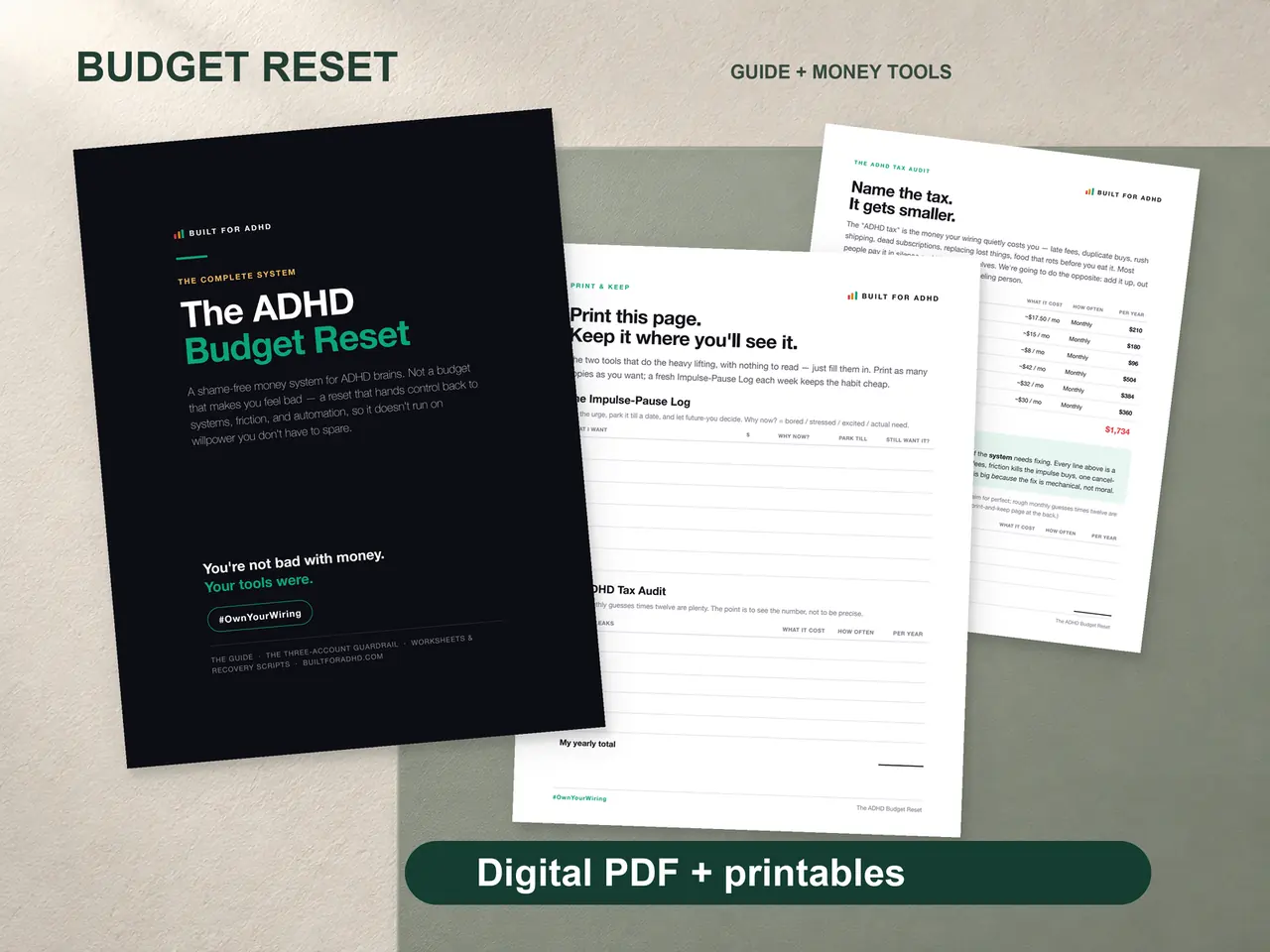
The Budget Reset isn’t just a stop sign. It’s a redirect. When you feel the pull to buy something, the 60-second check-in gives you enough space to ask: “What am I actually feeling right now? Bored? Stressed? Understimulated?”
Once you name the feeling, you can match it to an alternative. Bored? Try rearranging or organizing. Stressed? Physical movement or a change of scenery. Understimulated? Something creative or novel that doesn’t require your wallet.
The four questions in the decision framework aren’t designed to make you feel bad about wanting to shop. They’re designed to help you figure out what your brain actually needs, so you can give it something that works better and lasts longer.
The Savings Tracker as Dopamine Replacement
Here’s the twist that makes this system work for ADHD brains: every time you redirect a retail therapy urge, the money you would have spent goes on your savings tracker. You watch that number climb every time you add to it.
After a week of redirecting even a few shopping urges, you might see $100 or more on that tracker. That’s not abstract savings — that’s visible, tangible proof that you found something better. And for a brain that needs immediate feedback and concrete progress, that number becomes its own source of dopamine.
You’re not denying yourself. You’re choosing differently. And you get to see exactly how much that choice is worth.
Building Your Personal Dopamine Menu
Over time, you’ll discover which alternatives work best for you specifically. Maybe organizing is your thing. Maybe it’s walking in a new neighborhood. Maybe it’s cooking something elaborate or doing a puzzle or reorganizing your phone’s home screen.
The key is building a short list — three to five alternatives — that you can grab without thinking. When the shopping urge hits, you don’t want to brainstorm options. You want to glance at a list and pick one. Keep it on your phone right next to the checklist.
Your brain will always seek dopamine. That’s not changing, and it doesn’t need to. What changes is where you find it. And once you’ve got a few reliable free sources, the grip that retail therapy has on you starts to loosen — not because you’re forcing it, but because you found something that actually works better.