You didn’t just randomly buy that thing. Something triggered it. Maybe you were bored. Maybe you had a bad interaction with your boss. Maybe it was 11 PM and your brain was running on fumes. Maybe a TikTok ad hit you at exactly the right moment.
ADHD spending isn’t random, even when it feels like it. There are patterns. And once you see them, you can start blocking them.
The Trigger Map You Don’t Know You Have
Every person with ADHD has a spending trigger profile — a specific set of conditions that make impulse buying almost inevitable. The problem is, you’ve never mapped it. You just experience the aftermath: unexpected charges, packages at the door, and the vague guilt of knowing you did it again.
Here are the triggers that show up most often for ADHD adults:
Boredom. This is the big one. When your brain isn’t stimulated, it panics. It starts scanning for dopamine, and shopping is one of the easiest, most accessible sources available. You’re not even shopping because you want something specific. You’re shopping because scrolling through products is more interesting than whatever you’re supposed to be doing.
Stress and emotional dysregulation. Bad day at work. Argument with a partner. The vague anxiety that lives in the background of ADHD life. When emotions spike, your brain looks for a quick reset. Buying something provides a brief emotional lift — a moment of excitement and control in the middle of chaos.
Late-night low executive function. Your impulse control runs on a battery, and by 10 PM that battery is dead. This is why so many ADHD impulse purchases happen after midnight. Your dopamine-seeking system is still fully operational, but the part of your brain that says “maybe don’t” is asleep.
Transition periods. The gaps between tasks — finishing work, waiting for dinner, the dead time between activities — are peak vulnerability windows. Your brain isn’t engaged with anything specific, so it goes looking for stimulation.
Social media and targeted ads. Algorithms know what you like. They show you things calibrated to trigger your wanting response. And they deliver those triggers directly to the device you use to purchase things. It’s a closed loop designed to exploit exactly the kind of brain you have.
From Awareness to Action
Knowing your triggers is valuable, but knowledge alone doesn’t stop impulse purchases. You need a system that activates at the trigger point — before you’ve opened the app, before you’ve added to cart, before your card info auto-fills.
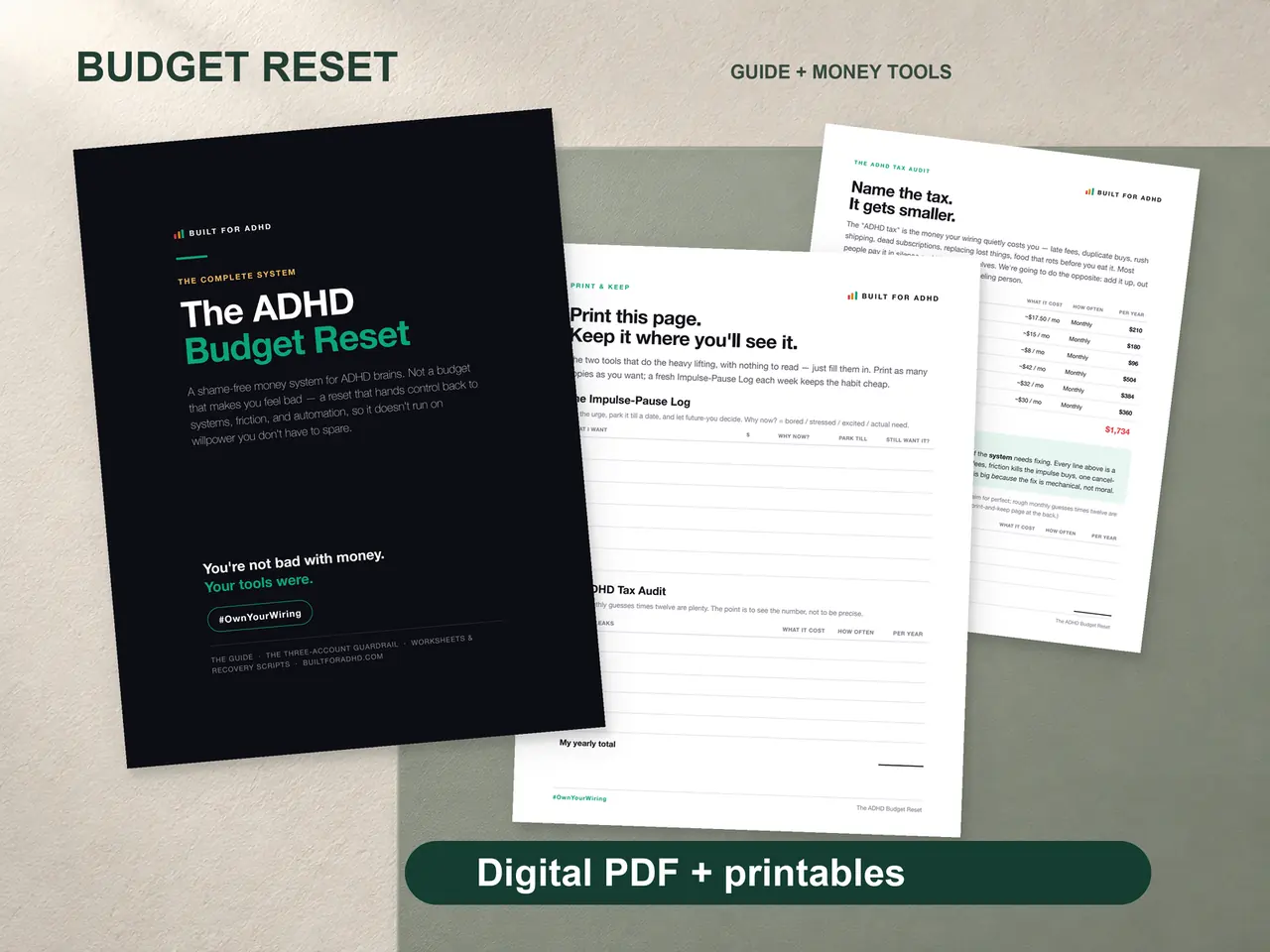
The Budget Reset works as a trigger interrupt. When you feel the urge to buy, you run through four quick questions. The act of answering those questions does two things: it creates a time gap between impulse and action, and it forces your prefrontal cortex to engage.
The pause score — red, yellow, or green — gives you a clear, external signal. When you’re in the grip of a trigger, your internal signals are unreliable. Everything feels urgent and necessary. An external scoring system cuts through that noise.
Building Your Personal Trigger Block List
Over a week or two of using the checklist, you’ll start to see your patterns clearly. Maybe 60% of your impulse purchases happen after 9 PM. Maybe most of your spending is triggered by boredom, not genuine want. Maybe social media is the entry point for every single unplanned purchase.
Once you see the pattern, you can build targeted blocks:
Late-night spending? Remove payment info from apps you use after 9 PM. Boredom spending? Keep a list of zero-cost dopamine activities on your phone. Social media triggers? Unfollow shopping accounts and use ad blockers.
These blocks won’t catch everything. That’s what the checklist is for — the last line of defense when a trigger slips through your other barriers.
Tracking What You Block
The running total of money you didn’t spend becomes your scoreboard. Every blocked impulse purchase adds to the number. That number is evidence that your trigger awareness is working.
After a month, you’ll be able to look at that total and know — concretely, not abstractly — that understanding your triggers saved you real money. For an ADHD brain that struggles with abstract motivation, that concrete proof is everything.
You don’t need to analyze yourself into paralysis. You just need to start noticing the moment before the purchase. That moment has a trigger, and that trigger has a pattern, and that pattern can be interrupted.
Start paying attention. The data will tell you what your brain won’t.