Every personal finance guru makes it sound simple. Track your spending. Make a budget. Stick to it. Three steps. Easy.
Except when you have ADHD, those three steps each contain about forty invisible sub-steps that your brain skips, forgets, or abandons the moment something more interesting happens. And then you’re standing in your kitchen at 1 AM, staring at a bank balance that doesn’t make sense, trying to figure out where $400 went this week.
You’ve tried the apps. You’ve watched the YouTube videos. You’ve built the spreadsheets — beautiful, color-coded spreadsheets that you used enthusiastically for four days before they became digital ghost towns. The problem was never your motivation. The problem is that conventional money management systems are built for neurotypical brains, and yours doesn’t work that way.
The Three ADHD Money Traps
Before you can manage money with ADHD, you need to understand the three traps your brain falls into repeatedly.
Trap 1: The Invisible Expense. Your working memory is limited, so small purchases vanish from your mental accounting the moment they happen. A coffee here, a subscription there, a “quick” Target run that somehow costs $87. Individually, these feel insignificant. Collectively, they’re draining hundreds per month.
Trap 2: The Time Blindness Tax. Bills due next week feel exactly as distant as bills due next month. Both are “later,” and later doesn’t exist to the ADHD brain. This results in late fees, penalty charges, and that special brand of panic when you realize rent was due yesterday.
Trap 3: The Dopamine Deficit Spend. When your brain is bored, stressed, or understimulated, buying something creates an instant neurochemical reward. You’re not buying the product. You’re buying 90 seconds of feeling good. Understanding this changes how you approach the problem.
Trap 3 Is Really Three Problems
Impulse spending is where most ADHD money plans actually die, and the reason generic advice bounces off it is that “stop impulse buying” treats one label as one problem. It isn’t. There are three separate moments, they need different tools, and a tactic aimed at one does nothing for the other two.
Before you buy — the decision moment. This is the cheapest place to intervene, because nothing has left your account yet. A want vs need decision template gives your brain a question to answer instead of an urge to white-knuckle. The 48-hour rule tracker and, for bigger purchases, a longer cooling-off period both work on the same principle — put time between the urge and the checkout button, because the urge expires and the money doesn’t come back.
At the trigger — the moment your brain reaches. You can’t intervene at a moment you can’t see coming, which is why identifying your spending triggers comes before any tactic. For most ADHD adults one environment does the majority of the damage — usually Amazon, late at night, one tap from a saved card. Underneath all of it is the mechanism from Trap 3: dopamine spending, where you’re buying the hit and not the object. When that’s what’s happening, more restriction doesn’t help — cheaper sources of the same dopamine do.
After the fact — making it visible. Your working memory will not hold this for you, so the spending has to live somewhere outside your head. An impulse buying tracker shows you the pattern in your own handwriting, a no-buy challenge tracker turns not-spending into something with a visible score, and an impulse control template gives the whole loop a repeatable shape. If the spending has crossed from expensive into genuinely frightening, ADHD shopping addiction help is the more serious version of this conversation.
Four Money Management Moves for ADHD Brains
1. Dump first, sort later. Stop trying to categorize expenses as they happen. Your brain won’t do it consistently, and the friction of deciding “is this groceries or household?” kills the habit entirely. Just write down the amount and a one-word description. Drop it in a bucket later.
2. Use three categories — max. Needs. Wants. ADHD Tax. That’s it. Needs are survival expenses. Wants are intentional purchases that improve your life. ADHD Tax is everything your ADHD cost you — impulse buys, late fees, forgotten subscriptions, duplicate purchases. Three categories. No analysis paralysis.
3. Keep it in sight. Your brain forgets what it can’t see. A printed page on your desk beats a spreadsheet tab you have to remember to open. A one-page monthly view beats scrolling a transaction list. If your budget lives where your eyes already go, you’ll actually check it. If you have to dig for it, you won’t.
4. Audit your subscriptions quarterly. It’s easy to lose track of subscriptions you forgot you signed up for. That’s money leaking out of your account every month for services you don’t use. Set a quarterly reminder to review every recurring charge, or keep a running subscription tracker so the list is already written down when you sit down to do it. Cancel anything you haven’t used in 30 days.
5. Give the spending a physical boundary. For the categories that reliably run away from you, a digital cash envelope system puts a visible ceiling on the money before you spend it, instead of asking you to remember a limit mid-purchase. The same logic is why savings accounts never seem to stick with ADHD — money you can see and reach is money your brain treats as available.
The Bill Automation Rule
Here’s a non-negotiable for ADHD money management: automate every single bill you can. Rent, utilities, insurance, minimum debt payments — all of it should happen automatically on the same day each month, ideally the day after your paycheck deposits.
For the bills you can’t automate, batch them. Pick one day per month — your “money day” — and pay everything at once. Put the specific amounts and account numbers in your calendar event so you don’t have to look anything up. Reduce the steps, reduce the friction, reduce the chances your brain wanders off.
Stop Managing, Start Automating
The goal of ADHD money management isn’t to become someone who loves tracking finances. It’s to build a system so automated and low-friction that managing money requires as little executive function as possible.
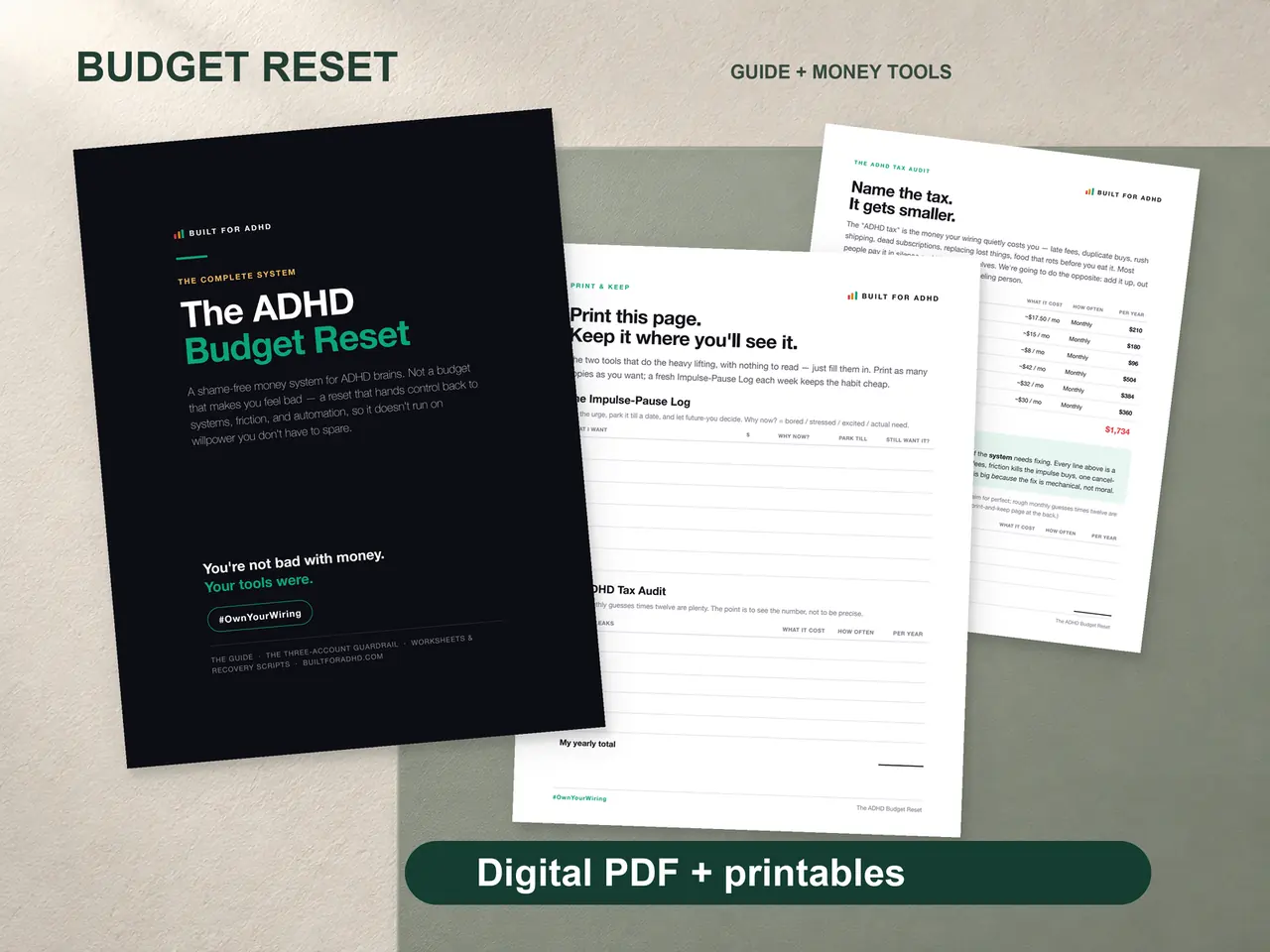
The Budget Reset was designed around this principle. The Money Dump page lets you write down expenses in under 10 seconds without categorizing. The simple 3-category framework keeps the organization to Needs, Wants, and ADHD Tax. The print-and-keep monthly pages give you a one-sheet view — not a spreadsheet — so you can check your financial health in a single glance. And the subscription audit page walks you through every recurring charge so you can catch those forgotten ones before they eat another month’s budget.
It’s an instant-download PDF — guide, workbook, and print-and-keep pages. No app, no spreadsheet, no login, no subscription. At $7, it replaces the complicated systems that never worked with something built for the way your brain actually operates. Because the best money management system for ADHD isn’t the most detailed one — it’s the one you’ll actually use.
Your brain can handle money. It just needs the right container.