The teacher sent an email three days ago and you just found it. It was about a field trip permission slip that was due yesterday. Your kid mentioned something about a project on Tuesday, but you can’t remember the details and the paper that came home about it has vanished into the backpack void.
You are not the only parent who struggles with this. But when you have ADHD, school communication isn’t just one more thing to manage — it’s a system of random, inconsistent inputs arriving through multiple channels, all requiring different types of responses on different timelines. That’s basically your brain’s worst nightmare.
Why School Communication Is an ADHD Trap
Think about what school communication actually requires. Emails from teachers arrive at random times. Papers come home in backpacks that you may or may not check. Verbal messages get relayed by children with varying degrees of accuracy and urgency. Deadlines range from “today” to “three weeks from now” with no consistent pattern.
For a brain that struggles with working memory, time estimation, and consistent follow-through, this is a setup for failure. You’d need to check multiple channels daily, remember things told to you in passing, track overlapping deadlines for different kids, and respond promptly to things you might not see for days.
No wonder things slip through. The system is designed for brains that can hold multiple pending items indefinitely and check a mental follow-up list every morning. That’s not how ADHD works.
One Place for Everything School
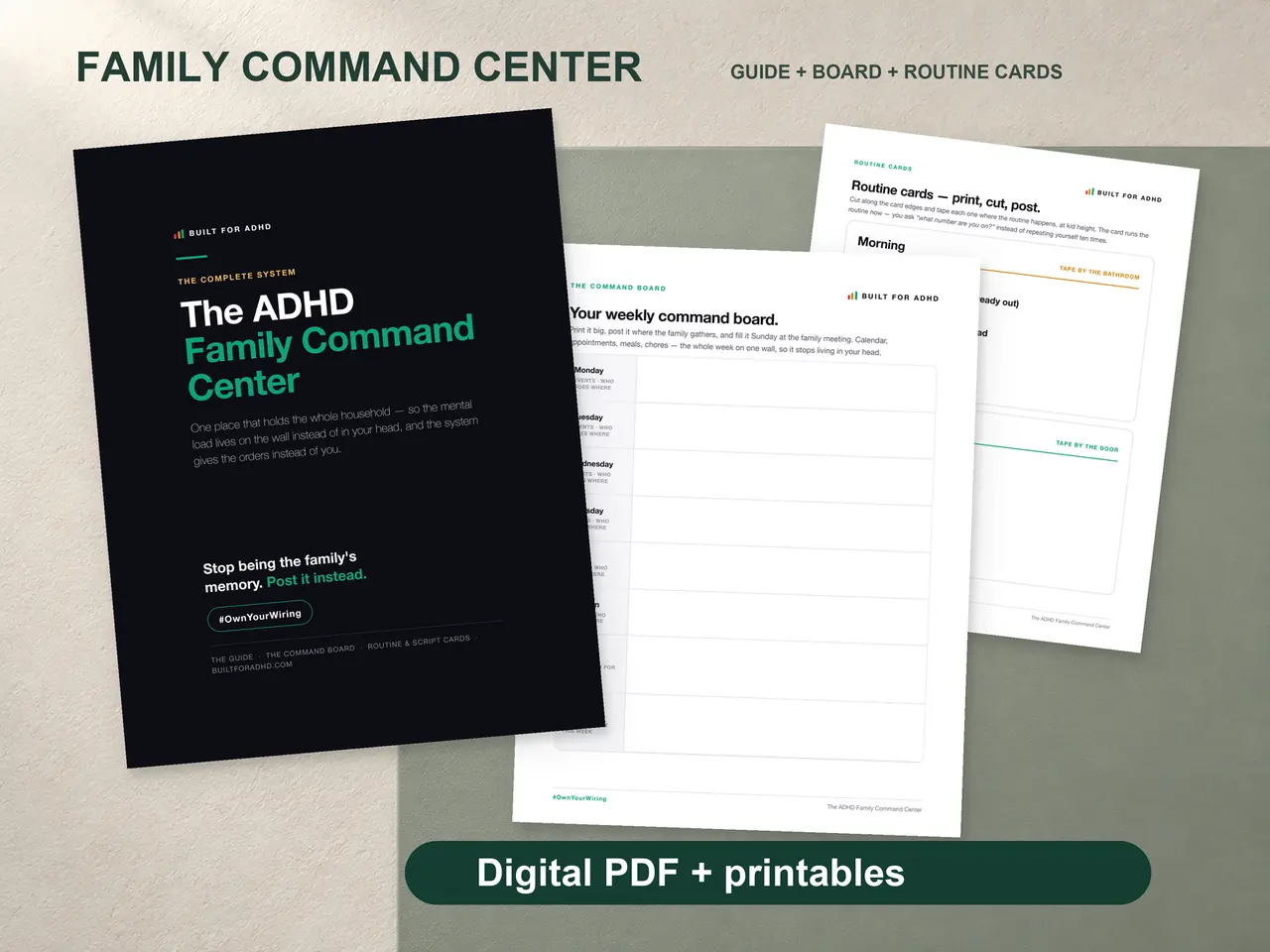
The Kid Stuff section of the ADHD Family Command Center gives each child their own tracking lane. When a school email comes in, it goes into that kid’s section. When a crumpled paper emerges from the backpack, the relevant details go there too. When your child casually mentions at dinner that they need poster board by Friday, you write it there before your brain can delete it.
This isn’t about being hyper-organized. It’s about having one single location where school-related information goes, instead of scattered across your email, your memory, the kitchen counter, and your phone’s notes app.
When everything lives in one place, the question changes from “what am I forgetting?” to “let me check the list.” That’s a fundamentally different mental operation. Checking a list uses almost no executive function. Trying to remember uses enormous amounts of it.
The Backpack Problem
Let’s talk about the backpack. That bottomless pit of crumpled papers, half-eaten snacks, and critical information you were supposed to see three days ago.
ADHD parents don’t forget to check backpacks because they don’t care. They forget because checking the backpack requires initiating a task that has no external trigger, no consistent timing, and no immediate consequence if you skip it. Those are the exact conditions under which ADHD brains drop things.
The weekly planning ritual builds backpack-checking into a routine. Fifteen minutes, once a week, you scan through backpack contents alongside everything else — kid schedules, upcoming school events, pending teacher follow-ups. The information gets captured and placed into the week where it belongs.
For some families, a daily backpack check works better. The planner supports that too — just make it part of the after-school energy block. The point is making it a scheduled action instead of relying on spontaneous memory, because spontaneous memory is the one thing ADHD guarantees you won’t have.
Managing Multiple Kids, Multiple Schools
If you have more than one child, school communication multiplies in complexity. Different teachers with different communication styles, different school calendars, different expectations. Information that applies to one kid can easily get confused with another’s, especially when you’re processing it while simultaneously cooking dinner and mediating an argument.
Per-kid tracking eliminates the blend. You can see at a glance that your older child has a science fair project due next Friday and your younger child needs a costume for the class play on Wednesday. No cross-referencing. No mental gymnastics. Just one section per kid with everything relevant to them.
This is especially critical during busy periods — back-to-school season, conference weeks, end-of-year events — when the volume of school communication spikes and your brain is already maxed out from the schedule changes.
The Follow-Up System
Teacher communication often requires a response — signing something, sending supplies, scheduling a meeting, or simply replying to an email. Each of these is a pending task with a deadline, and ADHD brains are notorious for letting pending tasks dissolve into the background.
When a follow-up is needed, it goes into the Kid Stuff section with the relevant details. During the weekly planning ritual, you scan the open items and move anything time-sensitive into your energy blocks for the week. An email that needs a response becomes a task in your Tuesday morning block. A permission slip that needs signing goes into tonight’s evening block.
The brain dump catches the rest — the vague worries about your child’s progress, the question you keep meaning to ask the teacher, the nagging feeling that you’re supposed to volunteer for something. Getting those out of your head and onto paper means they can’t keep running as background processes draining your mental energy.
You’re Not the Disorganized Parent
You might feel like every other parent has it together and you’re the one scrambling. You’re not. You’re just dealing with a brain that processes these specific kinds of tasks differently. The parents who seem effortless at this either don’t have ADHD, or they’ve found a system that works for their brain.
This is yours. One page per kid. One weekly check-in. One place where nothing gets lost. Not perfect — just enough structure to catch the things that matter before they become emergencies.