It’s 6:30 PM and you’re sitting at the kitchen table for the third time tonight trying to get your child to finish a worksheet that should take fifteen minutes. They’re fidgeting, staring at the ceiling, melting down about question four, and you’re oscillating between frustration and guilt because you’re not sure if you’re helping or making it worse.
If this scene plays out in your house most weeknights, you’re not alone. And if either you or your child has ADHD — or both — homework isn’t just a task. It’s a nightly stress test on the entire family’s nervous system.
Why Homework Is Uniquely Brutal for ADHD Families
Homework requires sustained attention on non-preferred tasks with delayed rewards. That’s basically the definition of “things ADHD brains cannot do without support.” Your child spent all day at school using every ounce of executive function they have — sitting still, following instructions, suppressing impulses, transitioning between activities. By the time they get home, they’re running on fumes.
Now you’re asking them to do more of the same thing, except without the structure of a classroom and with the added emotional weight of parental expectations. Their brain genuinely does not have the resources. It’s not defiance. It’s depletion.
And if you have ADHD too? You’re trying to provide structure and patience with a brain that’s also depleted from its own day. Two ADHD brains trying to navigate homework together is an exercise in mutual frustration unless there’s a system holding things in place.
The After-School Sequence That Actually Works
The most effective homework routine for ADHD kids follows a predictable sequence: arrive home, snack, movement, homework, done.
Snack first because hunger destroys focus. A child whose blood sugar is low cannot think clearly, and an ADHD child with low blood sugar is a meltdown waiting to happen. Feed them before you ask them to think.
Movement second because their body has been sitting all day and their brain needs a transition. Fifteen to thirty minutes of running around, playing, jumping — anything physical. This isn’t a reward for later. It’s a biological requirement for a brain that needs to discharge energy before it can focus.
Homework third, in the same place at the same time every day. Consistency matters because it removes the decision about when and where to start. Decision-making is expensive for ADHD brains. When homework happens at the table at 4:30 every day, there’s no negotiation, no “in a minute,” no daily battle about getting started.
Using the Weekly Overview for Homework
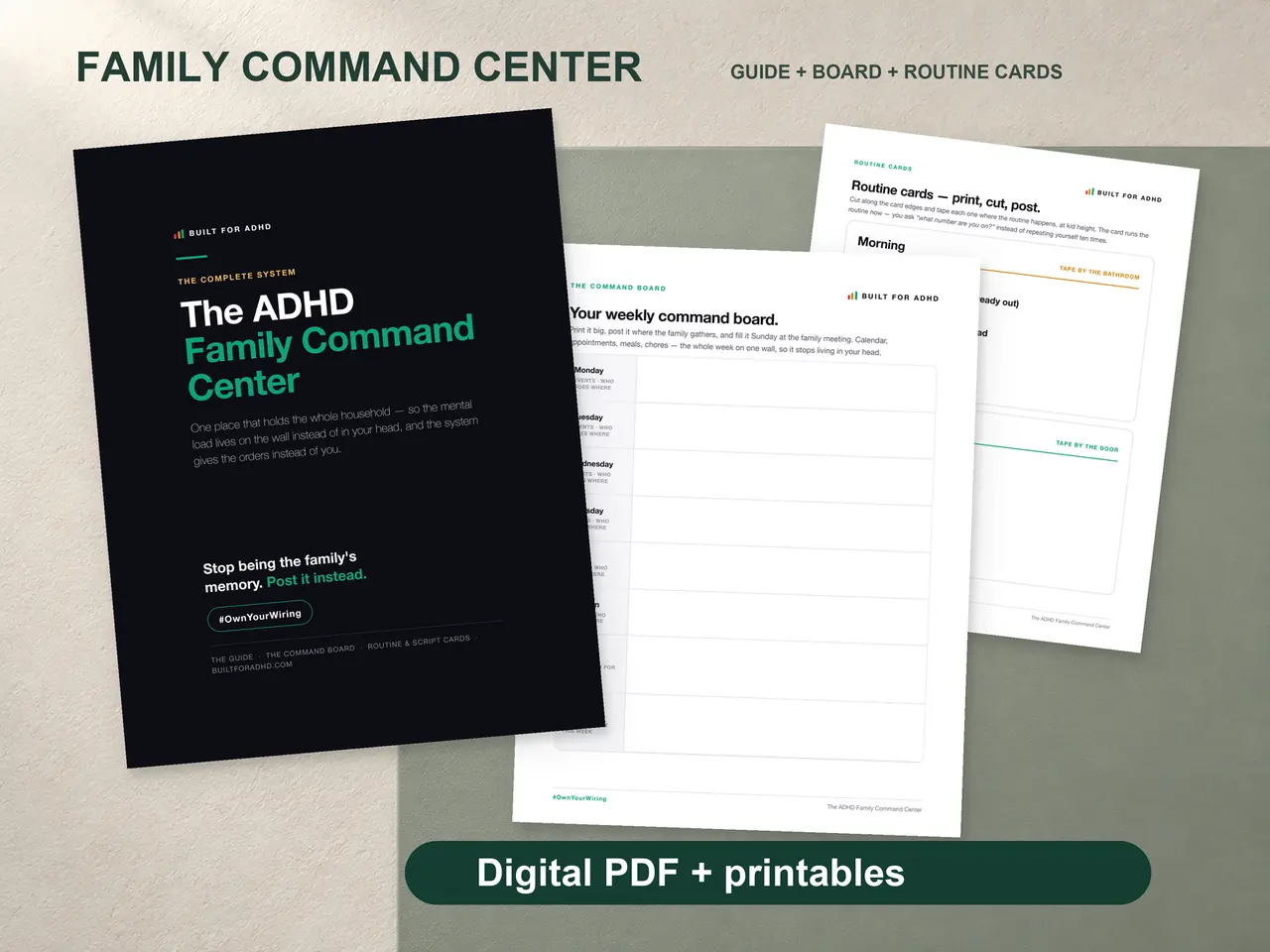
The Weekly Overview helps you see homework in the context of your whole week instead of treating each night as an isolated event. When you plan the week during your 15-minute ritual, you can see which nights are already packed with activities and which ones have breathing room.
Tuesday has soccer practice until 5:30? That’s a light homework night. Thursday is wide open? That’s when the bigger project gets attention. Friday you’re all exhausted? Maybe that’s a homework-free night by design — talk to the teacher if needed.
The Kid Stuff section tracks what homework and projects are active for each child. When you have multiple kids with different assignments and different due dates, keeping it in your head guarantees something will get missed. Having it written down — per kid, per week — means you can glance at the planner instead of trying to remember who has what due when.
The Self-Care Piece You’re Skipping
The Self-Care Tracker isn’t for your kids. It’s for you. Because here’s what happens when homework is a nightly battle: you stop taking care of yourself. You skip meals, you forget your own meds, you don’t move your body, you run on caffeine and anxiety until bedtime.
Eat, water, meds, move. Four checkboxes. They take thirty seconds to scan and they keep you functional enough to show up for homework hour without losing your patience three minutes in. You can’t support your child’s regulation if your own nervous system is shot.
When to Step Back
Not every homework night is going to work. Some nights, your child is too dysregulated to focus. Some nights, you are. Some nights, the assignment is genuinely too hard and pushing through will cause more harm than skipping it.
Write the teacher a note. “We attempted homework tonight and it wasn’t possible.” That’s a complete sentence. Most teachers, especially ones familiar with ADHD, would rather hear that than watch a child develop an anxiety response to schoolwork.
And if hard nights are the pattern rather than the exception, that’s a signal the workload itself needs formal adjustment — a 504 plan for ADHD can put reduced homework loads and extended deadlines in writing, so relief doesn’t depend on each teacher’s goodwill.
The homework routine template is designed for the nights it works — and it will work most nights once the routine becomes automatic. But it’s also designed to bend. Skip a night, pick it up the next day, no guilt. Your child’s relationship with learning matters more than any single worksheet.
Building the Routine Over Time
The first week of a new homework routine will be the hardest. Your child’s brain is used to the old pattern — negotiation, delay, eventual compliance under pressure. Changing that pattern means enduring some resistance while the new routine establishes itself.
Give it two to three weeks of consistent repetition before judging whether it works. Same sequence, same time, same place. The ADHD brain resists change but eventually craves consistency. Once the routine is wired in, homework stops being a nightly negotiation and becomes just the thing that happens at 4:30 at the kitchen table.
You’re not failing at homework. You’re navigating a system that wasn’t designed for your brain — or your child’s. Give both of you the structure to make it manageable, and save your energy for the moments that matter more than any worksheet ever will.