College is an organizational challenge designed for neurotypical brains. Show up to class, do the readings, submit the assignments, manage your money, feed yourself, maintain friendships, get enough sleep. Straightforward, right? Except that every single one of those tasks requires executive function, and your ADHD brain allocates executive function like a lottery — some days you get a full tank, other days you get fumes.
So you end up in the cycle. Good week, bad week, good week, terrible week. One area of your life gets organized while three others fall apart. You finally get on top of your assignments and your finances implode. You fix your budget and suddenly you’re three weeks behind on readings. It feels like playing whack-a-mole with your entire life, and you can never hit enough moles to feel in control.
The problem isn’t that you need to try harder. The problem is that you’re managing five different areas of life with five different systems — or no system at all — and your brain doesn’t have the bandwidth for that.
The College ADHD Organizational Spiral
Here’s how it usually plays out. Freshman year, you buy a planner. You use it for two weeks. The novelty wears off and it ends up under your bed. Sophomore year, you try a planner app. Same trajectory — two weeks of enthusiasm, then ghost. By junior year, you’ve tried five different systems and concluded that you’re just bad at being organized.
You’re not bad at being organized. You’ve been using systems that require the one thing your brain can’t consistently provide: self-initiated structure. Every planner you’ve tried assumed you would fill it in, check it daily, and update it when things change. That’s three separate executive function demands just to maintain the tool, before it even helps you with anything.
What you need is a system that captures your chaos, sorts it for you, and requires as little daily maintenance as possible. Not a planner that creates more work. A system that reduces it.
Brain Dump: Where the Chaos Goes
The Brain Dump guide is the foundation of the pack, and it works because it starts where your brain already is — scattered. You don’t need to organize your thoughts before writing them down. You dump everything. The homework due Thursday. The laundry you’ve been ignoring. The text you need to send your professor. The worry about your bank account. The random idea for a club event. All of it, onto one printed grid, no sorting required.
Then you sort into four buckets. Do Today. This Week. Someday. Delete. The sorting takes less than five minutes because you’re not analyzing — you’re making fast gut calls. Anything that lands in “Do Today” goes onto an Action Card, where you write a specific first step and a time estimate. Suddenly your day isn’t a swirling cloud of obligations. It’s a short list of concrete tasks.
For college students, this single page can replace every organizational system you’ve tried and abandoned. It doesn’t need to be opened at a specific time. It doesn’t require a routine. Print a stack and use one whenever you need it — during a study break, between classes, or at 1 AM when anxiety won’t let you sleep.
Budget Tracking Without the Guilt
ADHD and money in college is a rough combination. Your income is limited — financial aid, part-time work, maybe help from family. Your expenses feel unpredictable. And your impulse control is at war with every targeted ad, every group dinner invite, and every late-night online shopping session.
The Budget Reset in this pack doesn’t lecture you about spending. It doesn’t require daily input or complicated categories. You write down what you spend when you spend it — amount, what it was, done. Three columns: Needs, Wants, and ADHD Tax. The ADHD Tax column is the one that changes behavior, because it shows you in concrete numbers how much you’re losing to late fees, forgotten subscriptions, and purchases you don’t remember making.
No shame. Just data. And data is what eventually shifts the pattern.
The 2 AM Amazon Problem
Every ADHD college student knows this moment. It’s late. You’re supposed to be studying. Instead, you’re on Amazon adding things to your cart that feel absolutely essential right now and will feel completely unnecessary by morning. A ring light for your dorm. A new water bottle. A planner, ironically. The dopamine of buying is more accessible than the dopamine of studying, so your brain chooses the path with the immediate reward.
The 60-second Budget Reset sits between that moment of want and the moment of purchase. Four questions, answered honestly. It’s not designed to stop you from ever buying anything — it’s designed to create enough pause for your prefrontal cortex to catch up with your impulse. That pause is often all it takes to talk yourself out of a purchase you’d have regretted by morning.
One System, Three Templates, Zero Maintenance Overhead
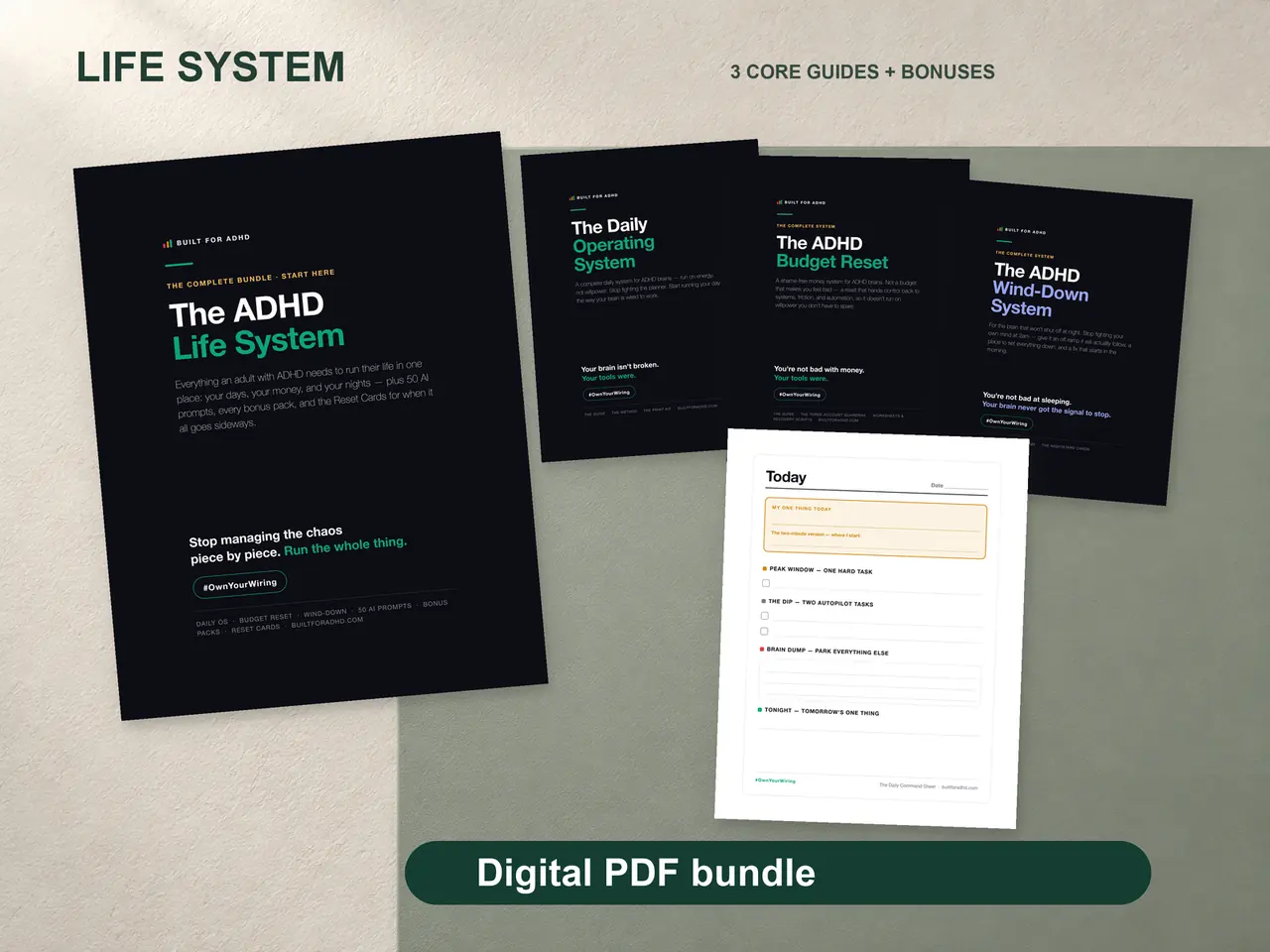
The ADHD Student Organization Pack isn’t three separate tools duct-taped together. It’s one system covering three critical areas — thought management, money management, and impulse control — built with the same design logic and the same understanding of how ADHD brains work.
You don’t need five apps and three planners and a bullet journal. You need one system that catches everything, tracks your money, and stops the spending leaks. Use it when you need it, not on a schedule. That’s organization that actually works for brains like yours.