It’s 5:17 PM. You’re staring into the refrigerator like it owes you an answer. There’s half an onion, some chicken you’re not sure is still good, and three different condiments that don’t go together. Your brain is blank. Everyone is hungry. And the voice in your head says the same thing it says every night: “Why didn’t I plan for this?”
Because planning meals requires exactly the kind of thinking that ADHD brains are worst at. Future-oriented, multi-step, decision-heavy thinking that has to happen when you’re not hungry, not tired, and not dealing with seventeen other demands. Good luck finding that window.
Why ADHD Brains Hate Meal Planning
Let’s break down what traditional meal planning actually asks of you. First, you need to decide what to eat for seven days in advance — that’s at least twenty-one separate food decisions if you’re planning three meals a day. Then you need to create a shopping list based on those decisions. Then you need to actually go shopping. Then you need to prep ingredients. Then you need to cook at the right time with the right ingredients available.
Every single one of those steps requires executive function. Planning ahead, sequencing tasks, estimating time, and maintaining the motivation to follow through days after the initial planning session. Your ADHD brain checks out somewhere around step two.
And here’s the trap: you know meal planning is important, so you try to do it perfectly. You search Pinterest for new recipes, build elaborate weekly menus, buy specialty ingredients. Then you’re exhausted by the planning, the groceries sit in the fridge unused, and you order pizza. Again.
The solution isn’t to try harder. It’s to make the planning so simple that your brain can’t refuse it.
The Favorites Bank Eliminates Decisions
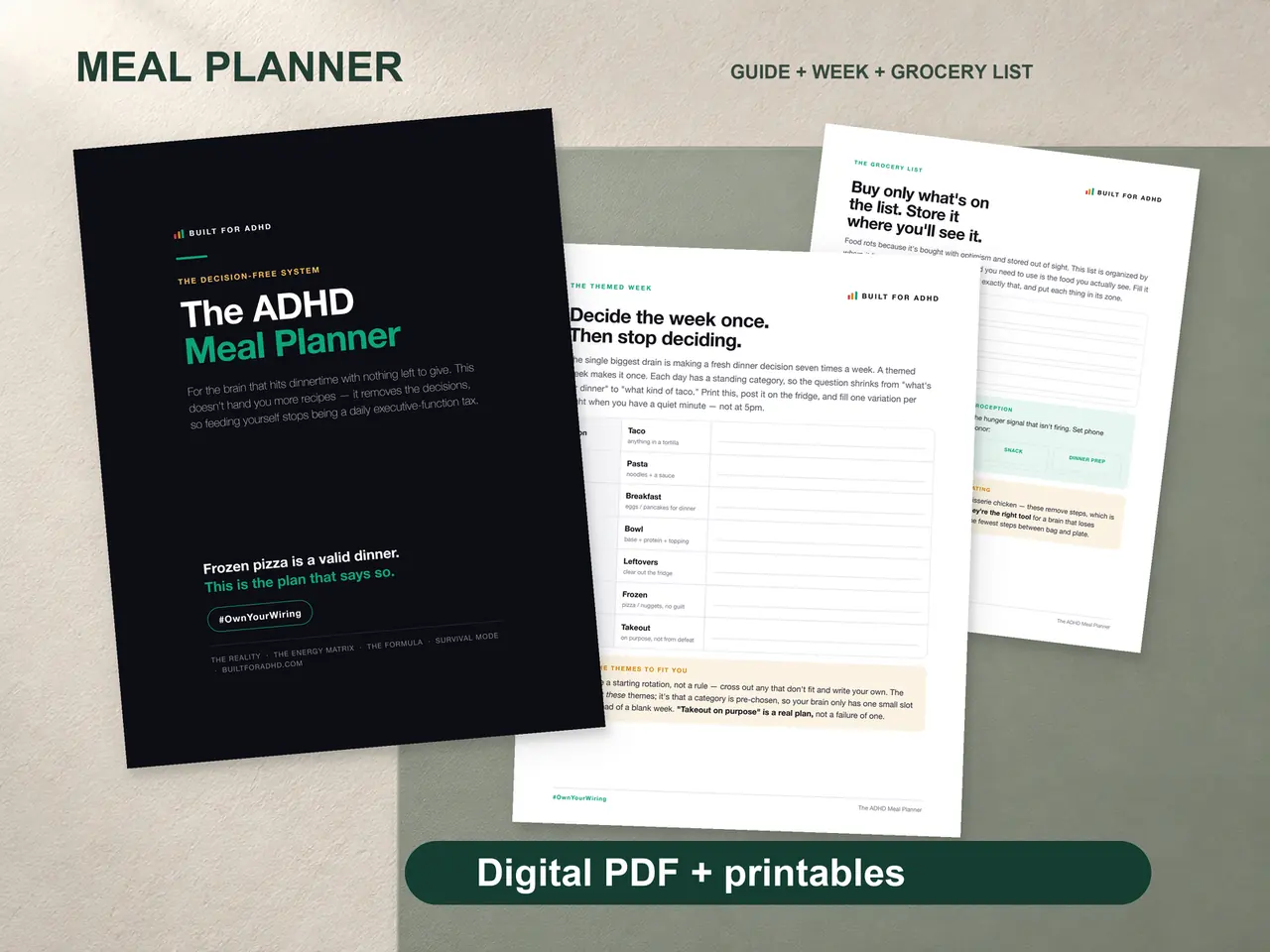
The biggest drain in meal planning is deciding what to eat from scratch every single week. The favorites bank removes that problem entirely.
You build it once: a list of 15 to 20 meals your household actually eats. Not aspirational recipes from food blogs. Not the meals you think you should be making. The meals you actually make and your people actually eat. Spaghetti. Tacos. That chicken thing you do with the rice. Frozen pizza. Yes, frozen pizza counts.
Once the bank exists, weekly meal planning becomes a selection task instead of a creation task. You glance at the list, pick five or six meals for the week, and you’re done. No scrolling through recipes, no agonizing over whether everyone will eat it, no buying ingredients for a dish you’ve never attempted.
Selection is dramatically easier for ADHD brains than creation. Your brain doesn’t have to generate anything — it just has to pick from options that already exist.
Matching Meals to Energy
Here’s where the weekly overview changes the game. You’re not just picking meals — you’re placing them on days when you’ll actually have the energy to make them.
Monday after work and you’re completely drained? That’s a frozen pizza or leftovers night. Saturday afternoon with some energy to spare? That’s when you make the thing that takes 45 minutes. Wednesday when the kids have activities and you’re driving all evening? That’s the crockpot meal you started at noon.
Matching meal complexity to your energy blocks means you stop planning meals you’ll never cook. You know which nights are low-energy before the week starts. Plan for it instead of pretending every night is a cooking night.
Grocery Shopping Gets Simpler
When your meals come from a favorites bank, your grocery list practically writes itself. You already know the ingredients because you’ve made these meals before. There are no mystery items, no specialty spices you’ll use once, no produce you’ve never prepared.
Over time, your grocery trips become almost automatic. The same core ingredients show up week after week with minor variations. You know what aisle everything is in. You know how much you need. The cognitive load of grocery shopping drops dramatically because you’ve removed the novelty.
And for ADHD brains, reducing novelty in the boring tasks means saving your novelty-seeking energy for the things that actually benefit from it.
The 15-Minute Ritual
The weekly meal prep doesn’t require a Sunday afternoon cook-a-thon. It requires fifteen minutes of looking at your favorites bank, picking meals, matching them to energy blocks, and jotting down what you need from the store.
That’s it. No batch cooking (unless that’s your thing). No elaborate prep sessions. Just a clear answer to “what’s for dinner” every night this week, decided once, in a quarter of an hour.
Those fifteen minutes save you from twenty-one separate decision moments throughout the week. Each of those moments drains executive function. Each one carries the risk of decision fatigue, which leads to takeout, which leads to guilt, which leads to swearing you’ll plan better next week.
Break the cycle once. Fifteen minutes. Your favorites bank. A plan that matches your actual energy. Stop staring into the fridge hoping for inspiration, and start knowing the answer before anyone asks the question.