You’ve tried budgeting before. You downloaded the template, set up the categories, maybe even logged expenses for three whole days. Then you forgot. Then you felt guilty. Then you avoided the whole thing entirely because opening it reminded you that you failed at budgeting. Again.
Here’s the thing — you didn’t fail. The budget failed you.
Why Most Budgets Break ADHD Brains
Traditional budgets ask you to sort every purchase into one of 15 to 30 categories. Groceries. Dining out. Entertainment. Gas. Insurance. Subscriptions. Pet expenses. “Miscellaneous” (which is where everything actually ends up).
For an ADHD brain, that’s not budgeting. That’s a categorization exam with no reward at the end. Your brain looks at that spreadsheet and says, “Absolutely not.”
The problem isn’t discipline. It’s friction. Every category is a micro-decision, and ADHD brains have limited decision-making energy. By the time you’ve decided whether that Costco run counts as “groceries” or “household supplies,” you’ve burned through the willpower you needed to actually track the next ten purchases.
The 3-Category Fix
A simple ADHD budget needs exactly three buckets:
- Needs — rent, utilities, groceries, gas, insurance, medication
- Wants — restaurants, streaming, clothes, hobbies, fun stuff
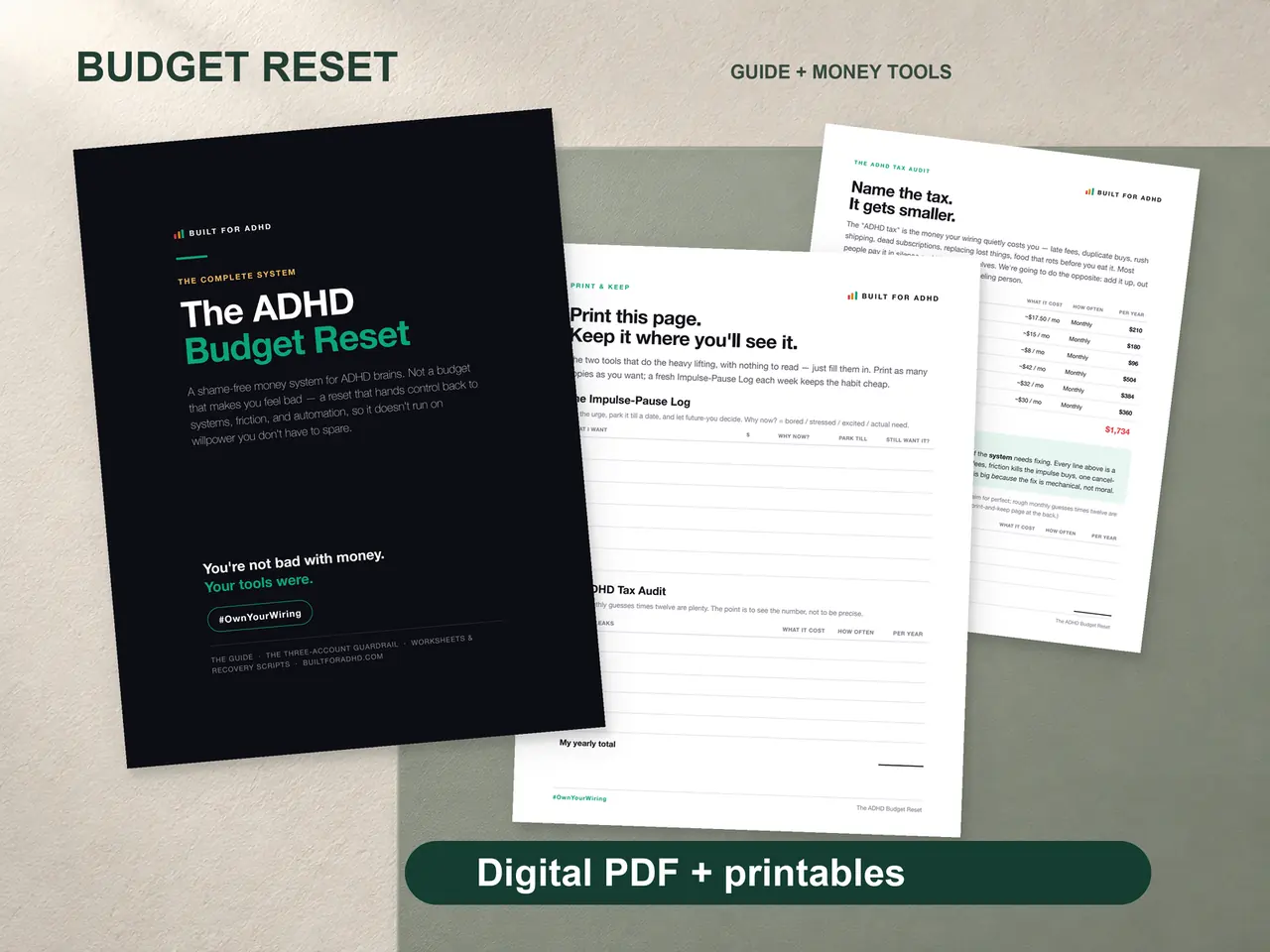
- ADHD Tax — impulse buys, late fees, forgotten subscriptions, duplicate purchases you made because you forgot you already owned the thing
That’s it. No sub-categories. No agonizing over whether coffee is a “need” or a “want.” You write the expense down, drop it in a bucket, and move on with your life.
Why the ADHD Tax Category Changes Everything
Most budgets hide your ADHD-related spending across a dozen categories. A late fee lands in “bills.” An impulse Amazon purchase goes into “shopping.” A forgotten subscription auto-renews under “entertainment.”
When you pull all of that into one category — the ADHD Tax — you can finally see the real number. Not to feel bad about it. To shrink it.
Seeing “$340 in ADHD Tax this month” is the kind of concrete, visual feedback that actually motivates an ADHD brain. It’s not abstract. It’s not a lecture. It’s a number you can beat next month.
How to Start a Simple ADHD Budget Today
Step 1: Pick one place to dump expenses. Not three apps. Not a notebook AND a spreadsheet. One place — like a printed Money Dump page on your desk.
Step 2: Log without categorizing in the moment. Just write what you spent and how much. Don’t worry about sorting it yet — drop it in a bucket later when you have a second.
Step 3: Look at it once a week. Not daily (too much friction). Not monthly (too late to adjust). Weekly check-ins hit the sweet spot for ADHD brains — frequent enough to course-correct, infrequent enough to not feel like homework.
Step 4: Celebrate the ADHD Tax shrinking. Even $20 less than last month is a win. Your brain needs that dopamine hit to keep going.
What Makes This Work for ADHD
The reason this approach sticks is that it removes every barrier that makes traditional budgets fail:
- No categorization decisions — three buckets, that’s the whole system
- No perfection required — logging 60% of expenses still gives you a clearer picture than 0%
- Physical and visible — print-and-keep pages live where your eyes already go
- The ADHD Tax is visible — you can’t fix what you can’t see
The Budget Reset was built around this exact philosophy. Three categories. Print-and-keep pages. And an ADHD Tax category that turns shame into a game you can win. It’s an instant-download PDF — no app, no spreadsheet, no subscription. Yours forever.
You don’t need a more complicated budget. You need a simpler one that you’ll actually use.