Payday hits and for about six hours, everything feels fine. Money in the account, bills technically not due yet, and your brain doing that thing where the present moment is the only moment that exists. So you fill the gas tank, grab lunch out, stop at Target “for one thing,” and suddenly the paycheck that was supposed to last two weeks has a serious dent in it before the first day is over.
By day ten, you’re doing math in the grocery store. By day thirteen, you’re transferring from savings — again. By day fourteen, you’re counting the hours until the next direct deposit, promising yourself that this time will be different.
It never is. Not because you lack discipline, but because the paycheck-to-paycheck cycle exploits every weakness the ADHD brain has. Time blindness makes two weeks feel like forever. Impulse control issues make “just this one thing” happen twelve times. And emotional regulation problems turn financial stress into revenge spending — buying something to feel better about being broke.
Why the Paycheck Cycle Traps ADHD Brains
The paycheck-to-paycheck cycle is a trap, and ADHD is the bait. Here’s how it works.
On payday, your bank balance is the highest it’ll be for two weeks. Your brain reads this as abundance. The anxiety of last week’s empty account is already fading because ADHD struggles with emotional object permanence — if you’re not feeling the pain right now, it’s as if it never happened.
During week one, spending feels fine because the balance is still “high.” Each purchase seems reasonable in isolation. Your brain isn’t tracking the cumulative total because that would require holding numbers in working memory — an ADHD weak point.
During week two, reality arrives. The balance is low, bills are due, and the anxiety spikes. But now your emotional regulation system is stressed, which makes you more likely to impulse-spend for comfort. The cycle feeds itself.
Four Steps to Break the Cycle
1. Split your paycheck in the first hour. Not the first day. The first hour. Set up automatic transfers that fire the moment your direct deposit hits. Fixed costs go to one account. Savings go to another. What lands in your checking account is your actual spending money — and nothing else. You can’t accidentally spend rent money when it’s physically somewhere else.
2. Budget per paycheck, not per month. Monthly budgets require you to mentally track spending across 30 days, which is asking your ADHD brain to run a marathon in a discipline it can barely sprint. Per-paycheck budgets give you a clear, short timeline: this money needs to last until this date. That’s it. Concrete, bounded, manageable.
3. Use visual progress tracking. A progress bar you shade in from left to right as you spend is infinitely more useful than a number in a cell. When the bar is at 60% on day four, your brain immediately understands “I’m spending too fast” without any calculation. Visual systems bypass the working memory problem entirely.
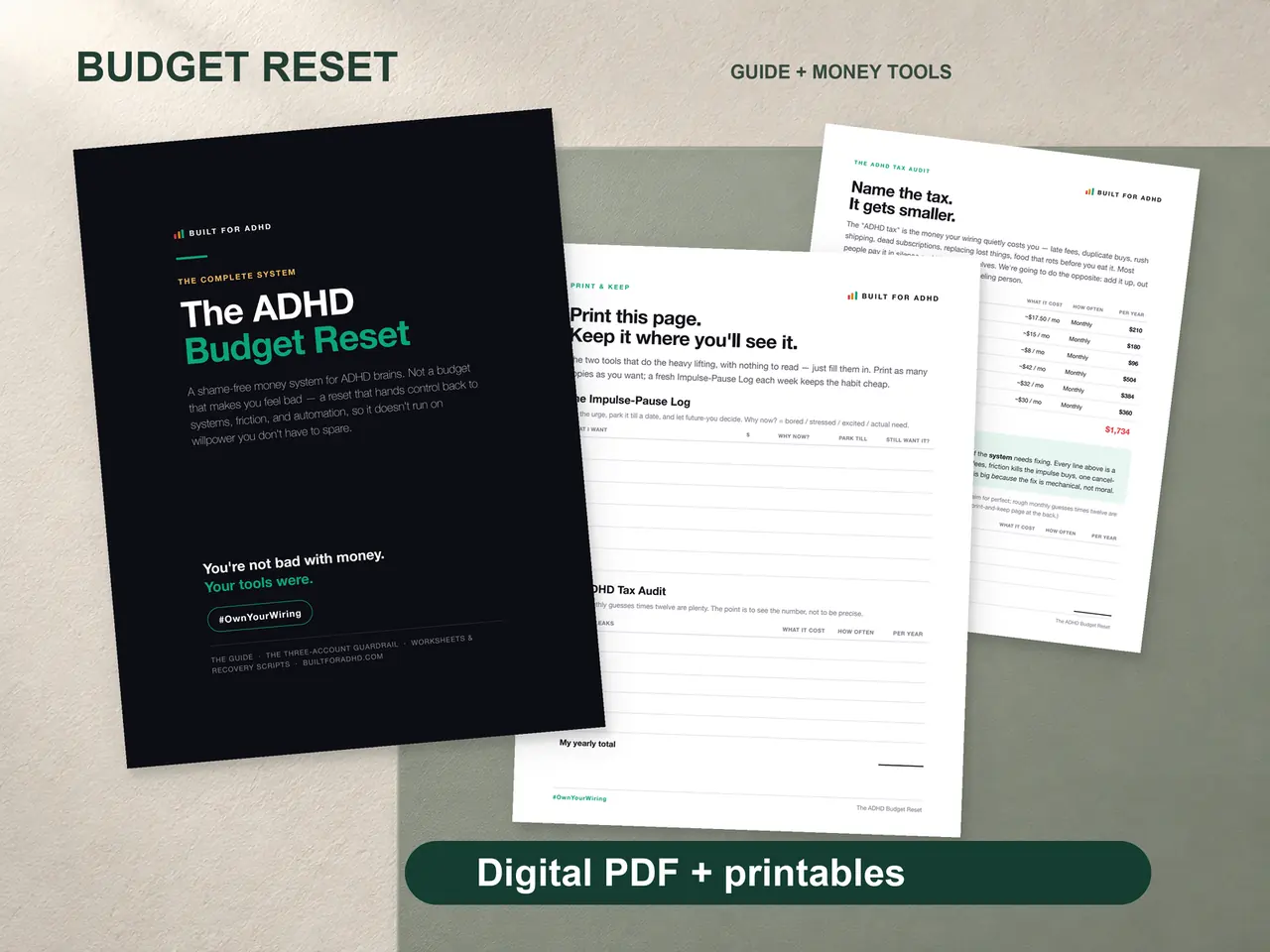
4. Log your “almost” purchases. The Impulse Log captures every purchase you considered but didn’t make. This serves two purposes: it gives you a dopamine micro-hit for resisting (your brain registers the act of logging as “doing something”), and it builds a data set over time that shows you exactly how much money you’re saving by pausing.
The “Fun Money” Necessity
Here’s counterintuitive advice that actually works: build fun money into every paycheck. Not “if there’s anything left over.” A designated amount, moved to its own account or tracked as its own category, that you can spend on absolutely anything without guilt.
ADHD brains rebel against deprivation. If your entire paycheck is spoken for by bills and necessities, your brain will find ways to spend anyway — it’ll just do it sneakily, guiltily, and destructively. Sanctioned fun money prevents this. It gives your brain a playground within boundaries.
Ten to fifteen percent of your take-home pay is a reasonable fun money allocation. Adjust up if your fixed costs are low, down if they’re high. But never zero. Zero fun money is a budget that will break within the first week.
The Template That Thinks in Paychecks
The Budget Reset is designed to work on a per-paycheck basis. When your direct deposit lands, you sort it into Needs, Wants, and ADHD Tax categories immediately. The Money Dump feature lets you log spending in seconds — no categorization decisions, just amounts and notes.
The Monthly page with fill-in progress bars gives you the visual feedback your brain needs. You can see in one glance whether you’re on pace or burning too fast. And the Impulse Log turns resisted purchases into visible victories instead of invisible willpower exercises nobody sees.
At $7, it’s less than what most ADHD adults spend on a single impulse purchase. But this is the purchase that helps you keep the rest of your paycheck where it belongs — lasting until the next one.
You’re not bad with money. You just need a system that matches your paycheck rhythm to your brain’s rhythm.