You know the exact moment you stopped opening your credit card statements. It wasn’t a conscious decision. It was a survival response. The numbers made your chest tight, the shame made your brain shut down, and not looking became easier than looking. So the statements pile up — digital or physical — and the debt grows in the dark, and every once in a while the reality breaks through and you feel a wave of panic that lasts for hours before you push it back down again.
ADHD and debt are old friends. Not because you’re bad with money — you’re actually probably quite smart about money in theory. You understand interest rates. You know you should pay more than the minimum. You’ve probably even started a debt payoff plan before, maybe more than once. But ADHD takes everything that makes debt payoff possible — sustained attention, delayed gratification, consistent behavior, and emotional regulation around money — and undermines it at the neurological level.
The result isn’t financial ignorance. It’s financial paralysis. You know what you should do. You can’t make yourself do it consistently. And the gap between knowing and doing fills up with shame.
Why Debt Hits ADHD Brains Harder
Debt payoff is the ultimate delayed gratification challenge, and ADHD brains are clinically impaired at delayed gratification. Making a $200 payment on a $5,000 balance provides zero immediate reward. The balance barely moves. The interest keeps accruing. And your brain, which needs visible progress to stay motivated, sees no progress and checks out.
Meanwhile, the same $200 spent at Target provides an immediate dopamine hit. Your brain literally processes “pay $200 on credit card” and “spend $200 on something fun” through the same reward circuitry, and the spending wins every time because the reward is instant.
Add in the emotional component — the shame, the anxiety, the avoidance — and you’ve got a self-reinforcing cycle. Shame about debt leads to avoidance. Avoidance leads to more debt (late fees, continued spending, missed optimization opportunities). More debt leads to more shame. The cycle continues.
Breaking it requires removing shame from the equation and replacing it with visible, reward-generating data.
The ADHD Debt Payoff Approach
Forget everything conventional debt advice tells you about spreadsheets, amortization schedules, and optimal payoff order. Those tools are built for brains that can delay gratification and maintain focus over months. Your brain needs something different — something you can print, write on, and see.
Start by looking. The hardest step isn’t making payments — it’s looking at the numbers honestly. Before you create any plan, just look. Write down every debt: the balance, the minimum payment, the interest rate. Don’t judge it. Don’t calculate how long it’ll take. Just get the numbers out of the darkness and onto a page. This is the financial equivalent of a brain dump — you can’t solve what you can’t see.
Use the snowball method. List your debts from smallest balance to largest. Make minimum payments on everything except the smallest. Throw every extra dollar at the smallest balance until it’s gone. Then roll that payment into the next smallest. The snowball method is mathematically inferior to the avalanche method, and it doesn’t matter. The snowball gives you a win — a fully paid-off debt — faster. That win creates momentum. That momentum keeps you going. For ADHD brains, momentum is worth more than optimized interest savings.
Track visually, not numerically. A progress bar going from 0% to 15% paid off is dramatically more motivating than a spreadsheet showing $4,250 remaining. Your brain responds to visual progress. It triggers the same reward circuitry as a game. Print your debt progress bar and put it somewhere you see it every day — on the fridge, on your bathroom mirror, taped to your desk. When your brain can see the bar fill in, debt payoff stops feeling like punishment and starts feeling like winning.
Name your ADHD Tax. Calculate how much your ADHD costs you each month in late fees, impulse purchases, forgotten subscriptions, and overdraft charges. This isn’t about shame — it’s about data. When you can see that ADHD-related costs add $150/month to your debt, you can target those specific leaks. Cancel the subscriptions you forgot about. Set up autopay for everything. Delete saved cards from shopping sites. Each plugged leak is money that now goes toward debt reduction.
The Micro-Payment Strategy
Here’s a tactic that works remarkably well for ADHD debt payoff: instead of one large monthly payment, make multiple small payments throughout the month. Pay $50 every week instead of $200 once a month. This does two things. First, it creates more frequent “I made a payment” dopamine hits. Second, it reduces the chances of spending the money before payment day arrives, because the amount per transaction is small enough that it doesn’t feel like a sacrifice.
Some people with ADHD take this further and make a small payment every time they resist an impulse purchase. Didn’t buy the $30 item? Immediately transfer $30 to the credit card. The impulse energy gets redirected into debt reduction, and your brain gets the satisfaction of taking action.
A Tracker That Replaces Shame With Data
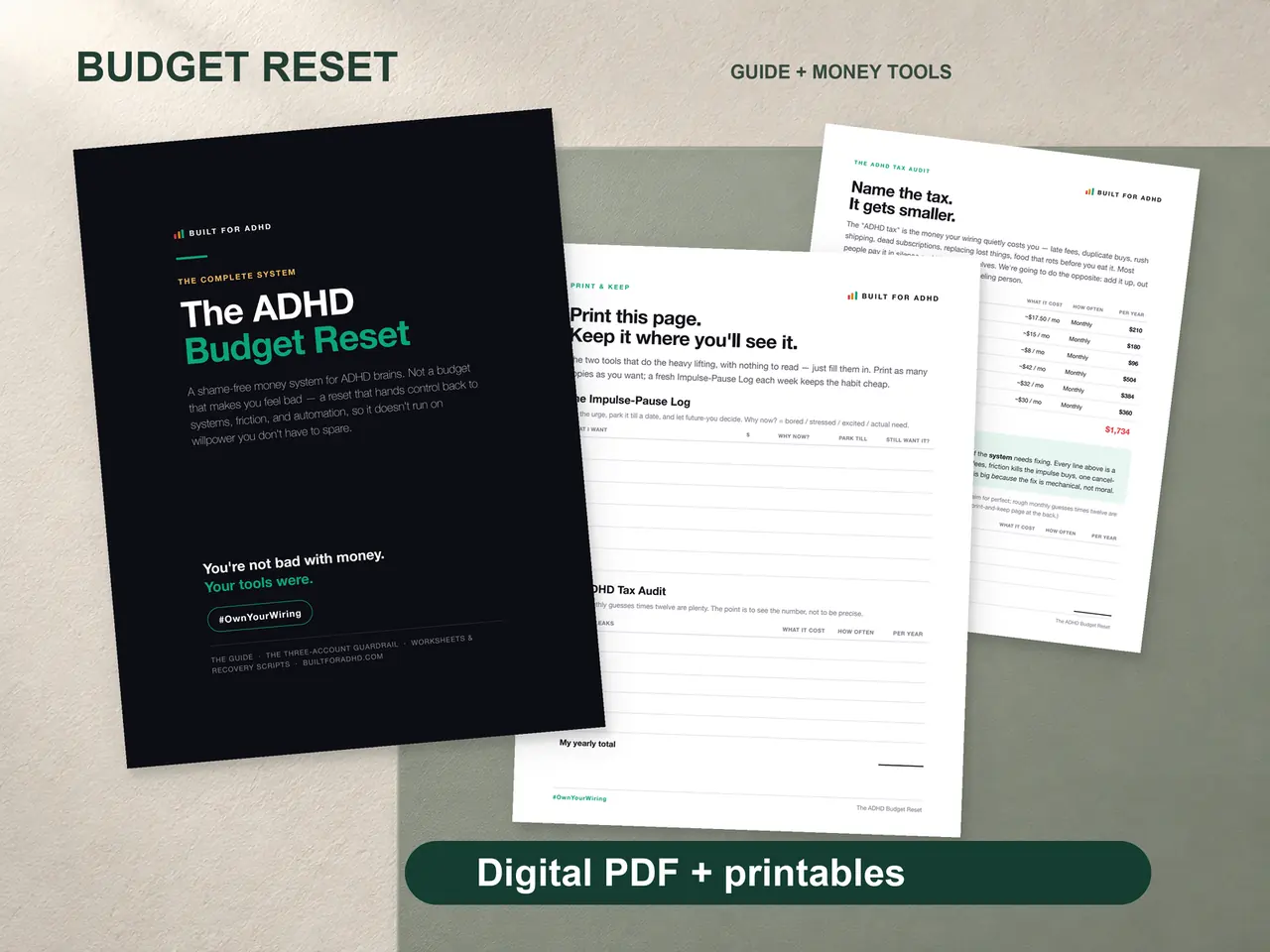
The Budget Reset was designed to make financial visibility painless. It’s an instant-download PDF — a guide, a workbook, and print-and-keep pages. The Money Dump page lets you write down expenses without categorizing them — just capture. The category worksheets give you a place to sort everything into Needs, Wants, and ADHD Tax when you’re ready. The monthly view spread gives you fill-in progress bars that show your debt going down and your spending patterns becoming clear.
The ADHD Tax page is especially valuable for debt payoff because it isolates the costs that are uniquely ADHD-driven. When you can see exactly how much impulse buys, late fees, and forgotten subscriptions are costing you each month, those become specific, targetable leaks instead of vague, shameful patterns.
It’s yours forever, works on any device, and there’s no app, login, or subscription — print what you want and start. At its price, it costs less than most late fees. And it might be the last financial tool you buy impulsively that actually pays for itself.