It’s 11:47 PM. You opened Amazon to reorder dog food. Now it’s 12:30 AM, your cart has $187 worth of stuff in it, and you’re genuinely convinced that a countertop herb garden is going to change your life.
Amazon and ADHD is one of the most expensive combinations in modern life. The platform is literally engineered to do the one thing your brain can’t defend against — remove every pause point between wanting and buying.
Why Amazon Is an ADHD Trap
Amazon didn’t accidentally become the world’s biggest store. Every feature is designed to reduce friction:
Your payment info is saved. Your address is stored. One-click ordering exists. Recommendations are tailored to your exact browsing history. Delivery is so fast that the dopamine hit of anticipation barely has time to fade before the package arrives.
For a neurotypical brain, these are conveniences. For an ADHD brain, they’re an open door to the reward center with no locks, no guards, and a big “Welcome” sign.
Your brain already struggles with the gap between impulse and action. Amazon compressed that gap to zero. You can go from “huh, that’s interesting” to “order confirmed” in literally seconds. There’s no friction point where your logical brain can step in and ask, “Do we actually need this?”
The Late-Night Amazon Problem
If you’re reading this, you probably have a pattern. Maybe it’s late-night browsing. Maybe it’s stress shopping during work. Maybe it’s the post-dinner scroll that somehow always ends with a purchase.
Late-night shopping is especially dangerous for ADHD brains because your executive function — already running on fumes — is at its lowest point. Your impulse control is basically offline, but your dopamine-seeking system is wide awake and looking for entertainment.
Amazon is entertainment. The browsing, the comparing, the reviews, the “other people bought” rabbit holes — all of it is stimulation. And the purchase at the end is the grand finale. Your brain gets a full evening of dopamine from what feels like “just looking around.”
Adding Friction Back Into the System
You don’t need to delete Amazon. You need to add one layer of friction back into the process. One moment of structured thought between “I want this” and “I bought this.”
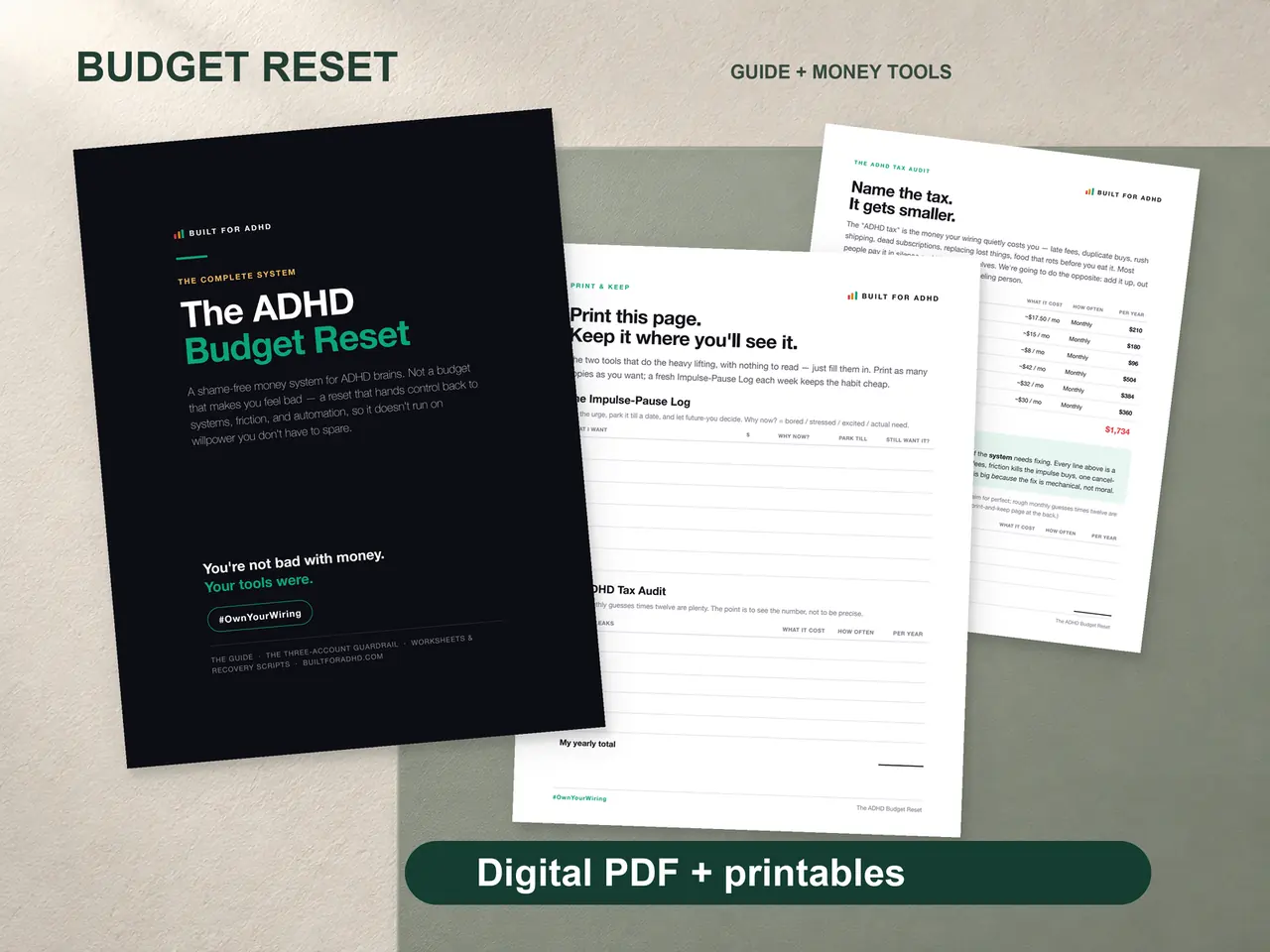
The Budget Reset is phone-friendly by design. Screenshot it, keep it in your photos, set it as a shortcut — whatever makes it accessible in the exact moment your thumb is hovering over “Buy Now.”
The 60-second gut check asks you four questions. Not deep philosophical questions. Fast, honest questions that your ADHD brain can handle even at midnight:
Do I know I need this, or did I just discover it? Would I leave the house to go buy this in person? Will this matter to me in seven days? Am I buying this thing, or am I buying the feeling of buying this thing?
Those four questions, answered honestly, will catch the majority of your Amazon impulse buys. Not all of them. But enough to make a real difference in your monthly spending.
The Packages Test
Here’s a reality check that most people with ADHD find illuminating: go through your recent Amazon orders and categorize each one. Things you still use or are glad you bought go in one pile. Things you forgot about, never opened, or returned go in another.
For most ADHD adults, the second pile is significantly larger. That’s not a judgment. That’s data. That’s your brain’s dopamine-seeking pattern laid out in brown cardboard boxes.
The savings tracker turns that data into motivation. Every time you pause and decide not to buy something from Amazon, the price gets logged. After a month, you’ll have a clear picture of how much your impulse brain was trying to spend — and how much you kept.
Practical Steps for Tonight
Before your next Amazon session, pull up the checklist. Keep it next to your phone or on your second screen. When you find something that triggers the “I need this” feeling, run through the four questions before you add it to your cart.
If it scores green, buy it without guilt. If it scores yellow, add it to your cart but don’t buy it tonight — check back in 48 hours. If it scores red, close the tab.
You’ll probably still buy some things you don’t need. That’s fine. Progress isn’t perfection — it’s catching more impulse buys than you used to. Even stopping two or three Amazon purchases a week adds up to hundreds of dollars a month.
Your brain and Amazon aren’t a fair fight. But with one simple tool, you can make it a lot less one-sided.