You started working for yourself because the traditional workplace wasn’t built for your brain. The rigid schedules, the pointless meetings, the fluorescent-lit open office plan — all of it grated against the way you actually think and work. Self-employment was supposed to be freedom.
And it is. Until you realize that freedom means you’re also the HR department, the accounting department, the project manager, the receptionist, and the janitor. Nobody tells you what to do, which sounds great until 2 PM hits and you’ve spent four hours answering emails, color-coding a calendar you’ll never look at again, and watching a webinar about productivity — without doing a single piece of client work.
Being self-employed with ADHD is like being handed the keys to a race car with no steering wheel. You’ve got the engine. You’ve got the fuel. You just can’t keep it on the road.
The Self-Employment ADHD Trap
When you worked for someone else, the structure was provided. Deadlines were set by your boss. Priorities were determined in meetings. Your calendar was populated by other people. You may have hated all of it, but it served a critical function — it gave your ADHD brain the external scaffolding it needed to produce consistent output.
Self-employment rips that scaffolding away. Suddenly every decision is yours. When to start work, what to work on first, when to invoice, when to stop for the day, whether that new tool is worth buying, whether to take on that new client. Each decision costs executive function, and ADHD brains have a limited daily budget.
By noon, you’ve made fifty small decisions and you’re cognitively bankrupt. The actual work — the stuff that earns money — gets pushed to the evening or the weekend or next week. Then guilt compounds. You’re your own boss and you can’t even get yourself to work. The shame spiral starts, and productivity drops even further.
The Brain Dump Is Your Morning Reset
The first guide in the Starter Bundle is the Brain Dump, and for self-employed ADHD adults, it’s the most important one. Every morning — or whenever you start your work day — you print the page and dump everything in your head onto the grid. Client deliverables, admin tasks, business ideas, that thing you need to buy, the email you forgot to send, the invoice that’s overdue.
No sorting. No prioritizing. Just dumping. Get it all out of your head and into a visible space.
Then you sort. Four buckets: Do Today, This Week, Someday, Delete. The sorting takes less than five minutes because you’re not analyzing each item — you’re making a gut-level call on urgency and importance. Each item you put in “Do Today” gets copied onto an Action Card, where you write the specific starting action and a quick time estimate.
This process separates the self-employed chaos into manageable categories. Instead of a swirling mass of competing demands, you have a short list of today’s tasks, a holding pen for this week, a parking lot for future ideas, and a trash can for the things that felt important at 11 PM last night but aren’t.
Money Without the Meltdowns
Self-employed ADHD money management is its own special challenge. Your income is irregular. Expenses are mixed between business and personal. Tax obligations are quarterly instead of automatic. And your impulse control is tested every time a new tool, course, or software subscription promises to transform your business.
The Budget Reset handles irregular income with a dead-simple three-column layout. You write down expenses when they happen — the amount, what it was, done. No agonizing over categories, no formulas to build. You drop each expense into Needs, Wants, or ADHD Tax as you log it. The ADHD Tax column is particularly revealing for self-employed people — it shows you exactly how much you’re losing to forgotten subscriptions, late fees, and impulse purchases.
The Impulse Buy Pause
Self-employed ADHD adults are uniquely vulnerable to impulse buying because business purchases feel justified. That $200 course is an investment. That new software subscription will definitely save time. That equipment upgrade is tax-deductible anyway. Your brain wraps dopamine-driven purchases in a business justification, and the spending adds up fast.
The 60-second Budget Reset interrupts this pattern without making you feel restricted. Four quick questions, answered honestly, that create just enough space between “I want this” and “I bought this” for your rational brain to catch up. For self-employed people managing tight margins, that pause is what keeps a “justified” business purchase from quietly draining your runway.
Your Business Needs Structure, Not More Hustle
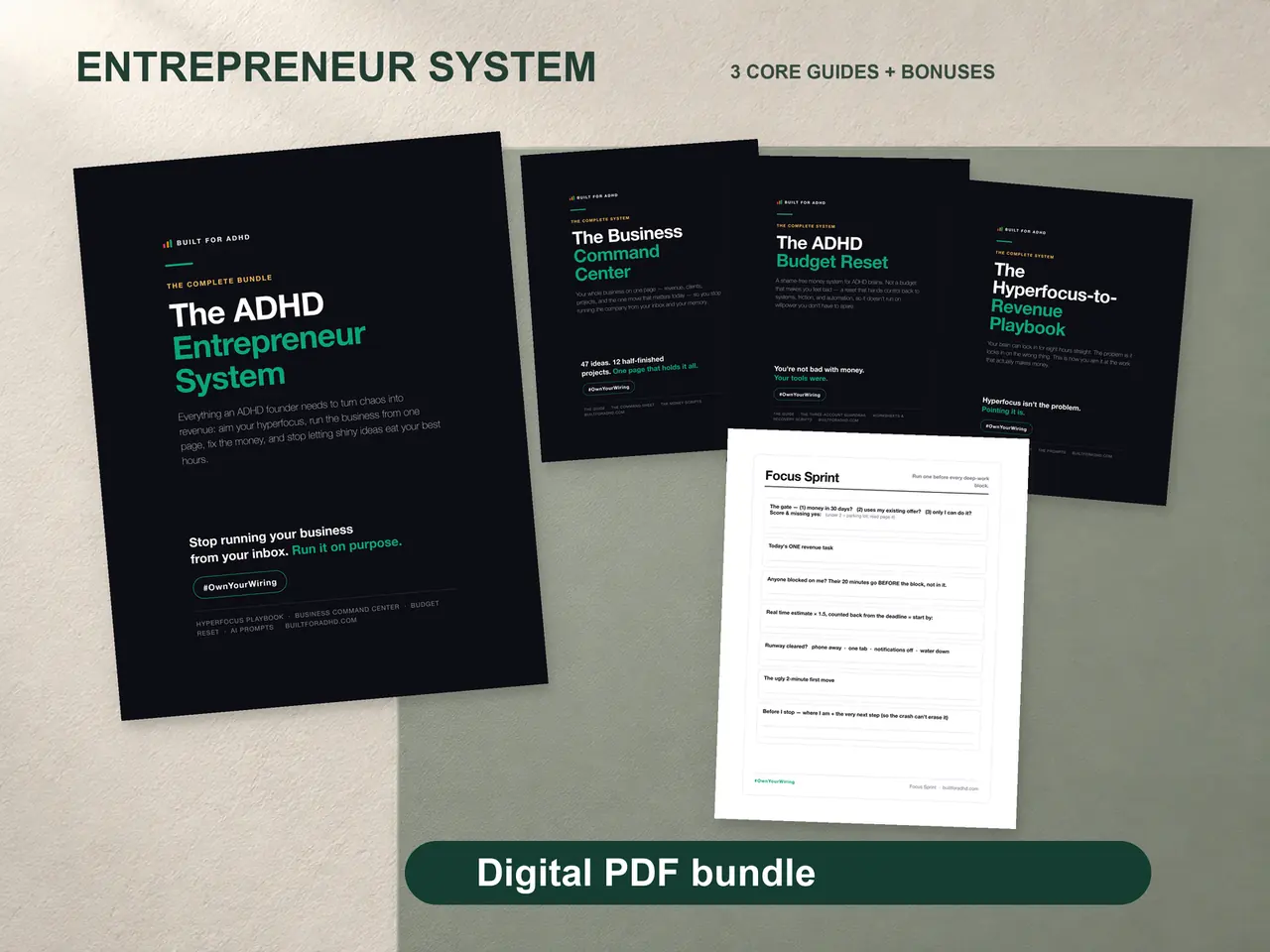
You don’t need another motivational podcast about entrepreneurial grit. You need three systems that actually work together — one for organizing your thoughts, one for managing your money, and one for stopping the spending leaks. The Starter Bundle is those three systems, built specifically for the ADHD brain that chose self-employment and now needs to make it sustainable.
The engine is already there. These guides are the steering wheel.