It’s March. You just realized taxes are due next month. And somewhere in your house, car, email inbox, and phone camera roll are eleven months of business receipts, invoices, and expense records scattered across at least six different locations. Your accountant sent you a checklist of what they need. You read the first three items, felt your chest tighten, and closed the email.
Welcome to ADHD self-employment tax season. It’s exactly as bad as you think.
Being self-employed with ADHD is a paradox. The independence, flexibility, and novelty-seeking that ADHD enables can make you exceptional at the work itself. But the administrative infrastructure that self-employment demands — tracking expenses, paying quarterly taxes, maintaining records, filing on time — is pure executive function work. And executive function is the thing your brain does worst.
The result is a yearly cycle: earn money, forget to track it, panic in March, dump everything on an accountant, pay a premium for rush filing, swear you’ll do better next year, and then don’t. Sound familiar?
Why Self-Employed ADHD Brains Struggle With Taxes
Self-employment taxes require you to be your own accounting department, and that’s a department your brain never staffed. The specific challenges break down like this.
The daily tracking problem. Expense tracking needs to happen at the point of purchase — the moment you buy something for your business, it should be logged. But your ADHD brain is already engaged in the work itself, the meeting you just finished, the client you need to follow up with. Stopping to log a $12 Uber receipt feels trivial in the moment. Multiply that by 300 unlogged receipts and it’s a crisis in April.
The categorization wall. Even when you do save receipts, categorizing them requires a type of sorting that ADHD brains find genuinely painful. Is this meal a business expense or personal? Is this software subscription a cost of goods sold or an operating expense? Each decision is small, but making 200 small decisions in a row is executive function hell. So the receipts pile up, uncategorized, waiting for a day that never comes.
The quarterly tax trap. Self-employed people owe estimated taxes four times a year, but ADHD brains struggle with recurring future obligations. January 15, April 15, June 15, September 15 — these dates approach invisibly until suddenly they’re here and you haven’t saved the money. Late quarterly payments mean penalties, which are literally an ADHD tax you’re paying because your brain can’t hold future dates.
The Two-Step System That Actually Works
The core insight for ADHD expense tracking is this: separate capture from categorization. These are two different cognitive tasks, and trying to do them simultaneously is why you fail at both.
Step one: Capture at the speed of impulse. When you spend money, log just the amount and a few words. “$47 — design software.” “$12 — Uber to client meeting.” “$6 — coffee with collaborator.” Ten seconds per entry. No categories. No filing. No deciding whether it’s deductible. Just capture the raw data before your brain forgets the transaction exists. The Money Dump approach lets you log expenses the moment they happen without any cognitive overhead.
Step two: Batch-sort on your schedule. Once a week — or honestly, once a month if that’s what you can manage — sit down with your dumped expenses and sort them. Business or personal. Which category. Deductible or not. When you’re doing this in a batch, you get into a sorting rhythm that makes each individual decision faster. And because you captured the raw data in step one, you’re not trying to remember what you spent three months ago.
Quarterly Tax Survival Guide
The quarterly tax problem has one solution, and it’s not “remember to save money four times a year.” It’s automation.
Set up an automatic transfer that moves 30% of every client payment into a separate tax savings account. Not into your regular savings — a completely separate account that you don’t touch. When quarterly tax day arrives, the money is already there. You’re not scrambling to find it. You’re not borrowing from next month. You’re just paying what you already set aside.
For the tax filing itself, keep it simple. Your monthly expense pages from the tracker, sorted into categories, are what your accountant needs. Hand over the filled-in pages quarterly — or snap photos of them — and you’re done. The less you try to understand the tax code yourself, the better. Your job is to capture data consistently. Your accountant’s job is to turn that data into a tax return.
The Subscription Audit You’re Avoiding
Self-employed ADHD brains accumulate business subscriptions like neurotypical brains accumulate unused gym memberships. That project management tool you tried for two weeks. The stock photo site you used once. The premium tier of a service whose free tier would be fine. These charges hit your card monthly, and you’ve stopped noticing them.
A quarterly subscription audit takes fifteen minutes and can save hundreds of dollars per year. List every recurring charge, what it’s for, and when you last actually used it. If you haven’t used something in 30 days, cancel it. You can always re-subscribe if you actually need it. But you probably won’t, because you weren’t using it in the first place.
A Tracker That Does the Hard Part
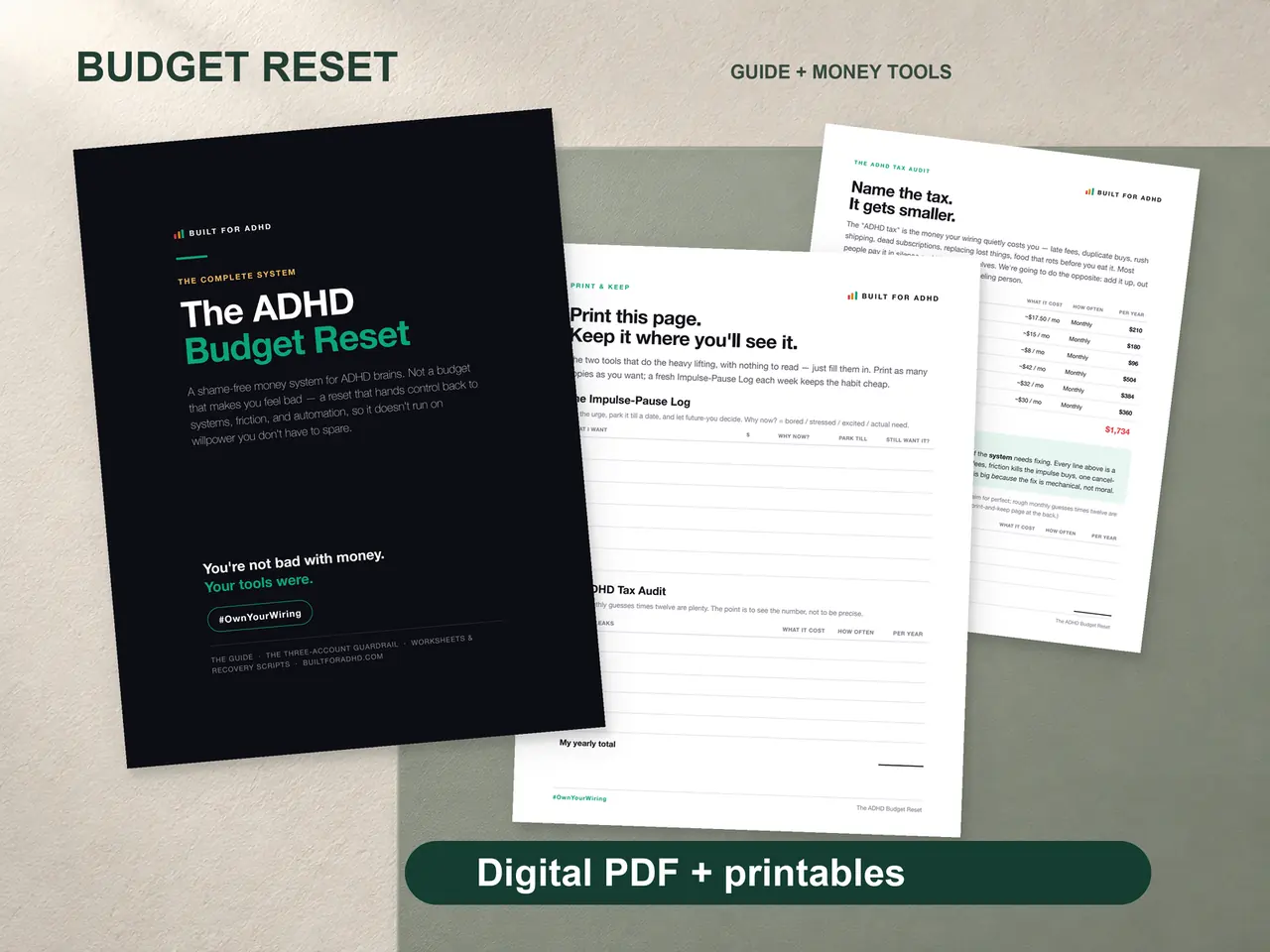
The Budget Reset makes expense capture as easy as the purchase itself. It’s an instant-download PDF — guide, workbook, and print-and-keep pages. The Money Dump page lets you write down expenses the moment they happen — just the amount and a note, no categories required. The category worksheets give you a place to sort into Needs, Wants, and ADHD Tax when you’re ready, so you can see where your money is actually going.
The monthly view spread gives you fill-in progress bars showing your spending patterns across the month — not buried in spreadsheet rows, but laid out as a page your brain can read at a glance. And the subscription audit page gives you one place to list every recurring charge with its annual cost, making the audit painless.
It’s yours forever, works on any device, no app or login required. As a business expense, it pays for itself the first time it prevents a late filing penalty.
Your Business Deserves Better Than a Shoebox
You built a business with an ADHD brain. That took creativity, risk tolerance, and an ability to see opportunities that other people miss. The administrative side doesn’t require those strengths — it requires a system that handles the parts your brain wasn’t built for. Give it that system, and let your brain do what it’s actually good at.