You don’t need another individual template. You’ve tried those. A planner from one creator, a budget tracker from another, a brain dump printable from Pinterest. None of them talk to each other, and managing five separate systems takes more executive function than just winging it.
That’s why you keep ending up back at square one — not because you can’t use tools, but because your tools don’t work as a team.
The Problem With Piecing It Together
ADHD adults are collectors. We collect apps, templates, systems, and methods. We research for hours, bookmark everything, download thirty free resources, and then feel more overwhelmed than when we started. That’s not a personal failing. That’s decision fatigue and information overload doing exactly what they do to ADHD brains.
Even when you find individual templates that work, they create a new problem: context switching. Your brain dump lives in one place. Your budget lives in another. Your planner is somewhere else. Every time you switch between them, you lose momentum. For ADHD brains, momentum is everything. Once it’s gone, getting it back costs ten times the energy it took to build.
The solution isn’t finding better individual tools. It’s finding a system where everything lives together, designed by the same brain, using the same logic.
What’s Inside the Ultimate Bundle
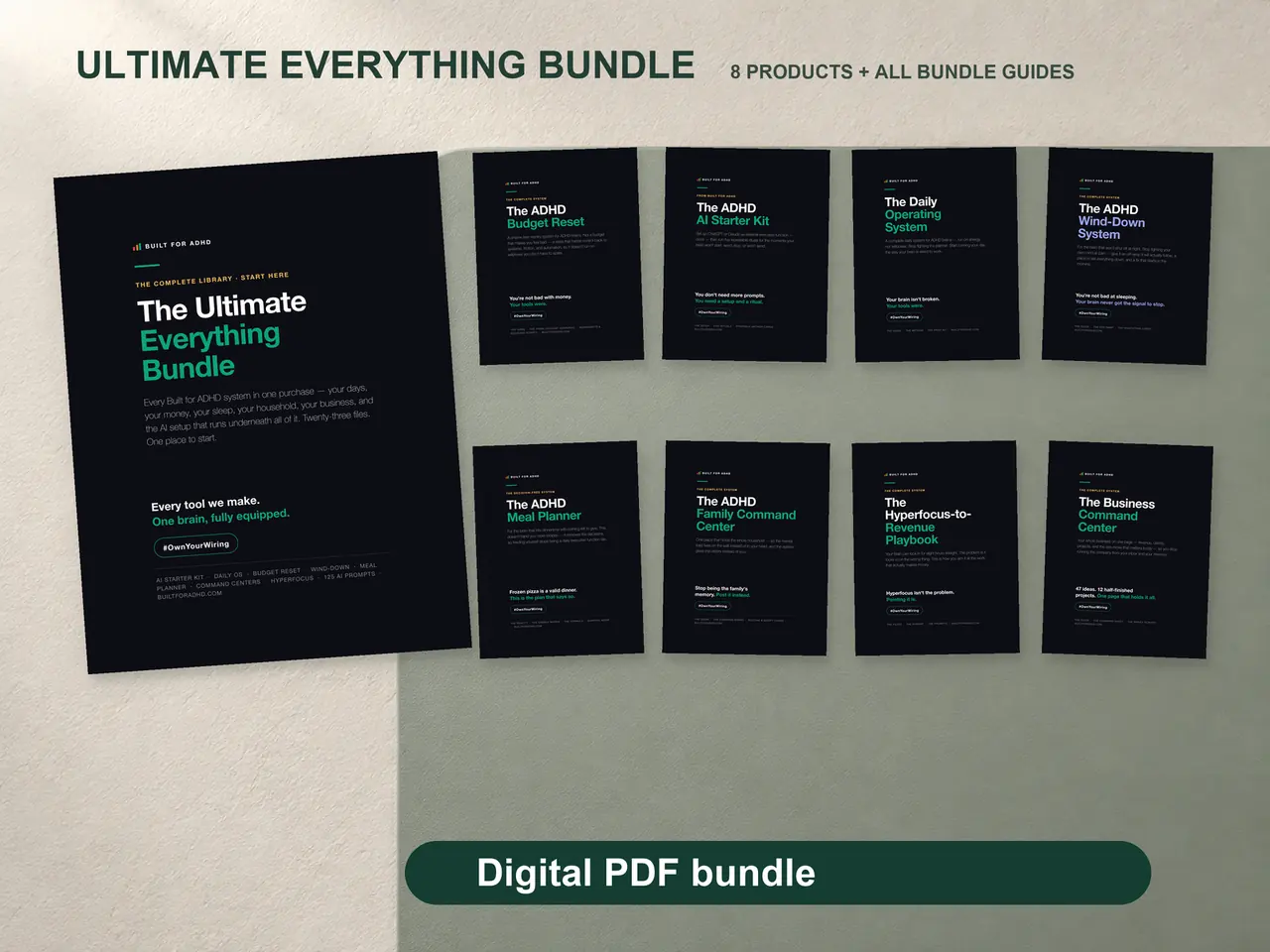
Seven designed PDF systems — guides plus workbooks with print-and-keep pages. Each one handles a different area of ADHD life. All using the same design principles, all in one instant download.
Daily OS (20 pages). This is where everything starts. Brain dump every thought, task, worry, and random idea onto an open page, sort into Do Today / This Week / Someday / Delete, then plan your day around energy blocks instead of hour slots. Tiny first steps and a Done List page you fill in by hand give your brain a reason to start and proof that you finished.
Budget Reset (11 pages). Money and ADHD are a rough combination. Simple categories so you can see where your money goes without agonizing over whether that Target run was “household” or “personal.” A quick weekly review — not daily input — makes the numbers feel real without feeling shameful.
Wind-Down System (9 pages). For the brain that won’t shut off at night. A structured evening routine with brain dump space, so tomorrow’s worries land on paper instead of looping in your head at 1 AM.
Meal Planner (9 pages). Decide what to eat once a week instead of three times a day. Fill-in weekly plans and grocery pages that remove the nightly “what’s for dinner” spiral.
Hyperfocus Playbook (13 pages). Catch hyperfocus when it shows up and aim it at work that pays off, with 12 AI prompts included.
Family Command Center (14 pages). One place for the household — schedules, kids’ routines, and the running list of things that otherwise live in your head.
Business Command Center (12 pages). For the self-employed ADHD brain: clients, projects, and money in print-and-post pages instead of nineteen browser tabs.
Plus every bonus from all three smaller bundles — 125 AI prompts across the three bundle guides, on top of the 12 built into the Hyperfocus Playbook — and the Reset Cards, which come free with every purchase.
Why These Seven
These systems weren’t chosen randomly. They cover the areas where ADHD creates the most daily friction: thought management, time planning, money, meals, evenings, family logistics, and work. Research on ADHD executive function consistently points to these domains as the primary sources of stress and underperformance.
By covering all of it in one unified system, you eliminate the gap between “I know what I should do” and “I actually do it.” The brain dump captures the thought. The planner schedules the action. The budget tracks the cost. The deadline tracker keeps the timeline honest. And the impulse checklist keeps you from sabotaging progress with unplanned spending.
The Real Value of a Bundle
Beyond the practical convenience, a bundle solves the deeper ADHD problem of continuous searching. Every hour you spend evaluating templates is an hour you’re not using one. Every new tool you add to your stack is another thing to maintain. The bundle draws a line and says: this is your system, it’s complete, stop looking.
That permission to stop searching is worth more than any individual template. Because the best system for ADHD isn’t the most sophisticated one — it’s the one you actually use. And you’re far more likely to use a system you chose once than five separate tools you have to choose every day.
Your brain doesn’t need more options. It needs fewer decisions and more doing. The Ultimate Bundle is the last template search you need to do.