The cash envelope method is one of the most recommended budgeting systems out there. And honestly? The core idea is brilliant for ADHD brains. Divide your money into categories. When an envelope is empty, stop spending.
But there’s a problem: nobody uses cash anymore.
You can’t stuff a debit card swipe into a paper envelope. You can’t divide an online Amazon purchase across three physical envelopes. And you definitely can’t carry around a purse full of labeled envelopes in 2026 without feeling like you’re cosplaying a 1950s housewife.
The concept is ADHD-friendly. The execution is not. So let’s fix that.
Why Envelopes Work for ADHD Brains
Before we digitize it, let’s understand why the envelope method clicks with ADHD brains when other budgets don’t.
It’s visual. You can see how much money is left. Not buried in a spreadsheet cell — as a bar on the page that’s clearly running out. ADHD brains respond to visual cues way better than abstract numbers.
It’s concrete. “You have $47 left for dining out this month” is infinitely more useful than “you’ve spent 68% of your dining budget.” One is actionable. The other requires mental math your brain doesn’t want to do at 7 PM on a Tuesday.
It creates natural stopping points. When the envelope is empty, you stop. There’s no negotiating, no “I’ll make it up next month.” Empty means done. That kind of hard boundary is exactly what impulsive ADHD spending needs.
Making It Digital Without Losing the Magic
The key to digitizing the envelope method for ADHD is keeping what works and removing what doesn’t.
Keep: Visual progress bars. Each spending category gets a progress bar you shade in as you spend. Most of the bar empty means plenty left. Getting full means watch it. Full means stop. Your brain processes this in half a second — no math required.
Keep: Hard category limits. Write a monthly cap at the top of each envelope worksheet. When the bar fills, you’ve hit it. No willpower needed — the boundary is right there on the page.
Remove: Carrying cash. You don’t haul around a purse full of labeled envelopes. The whole system lives on a few printed pages, or on the PDF on your phone.
Remove: Physical cash limitations. This works with credit cards, debit cards, Venmo, whatever you use. You log the purchase on the right envelope page and subtract — that’s it.
Setting Up Your Digital Envelopes
Here’s how to set up a digital envelope system that an ADHD brain will actually maintain:
Start with 3-5 envelopes max. Not 15. Not 10. Pick the categories that matter: Needs, Wants, Food, Fun, and ADHD Tax. You can always add more later, but you probably won’t need to.
Set limits based on last month’s actual spending. Don’t guess. Don’t set aspirational numbers. Look at what you actually spent and set limits slightly below that. Achievable targets build momentum.
Log expenses on the Money Dump page. Don’t sort as you go. Just capture the amount and what it was for on one running list. You move it to the right envelope when you check in — capture first, sort later.
Check your envelopes every Sunday. One quick look at the progress bars tells you everything: which categories are on track, which are getting tight, and whether the ADHD Tax envelope is bigger than you’d like.
The ADHD Tax Envelope
This is the game-changer. Traditional envelope systems don’t have a category for ADHD-specific spending — impulse buys, late fees, duplicate purchases, forgotten subscriptions.
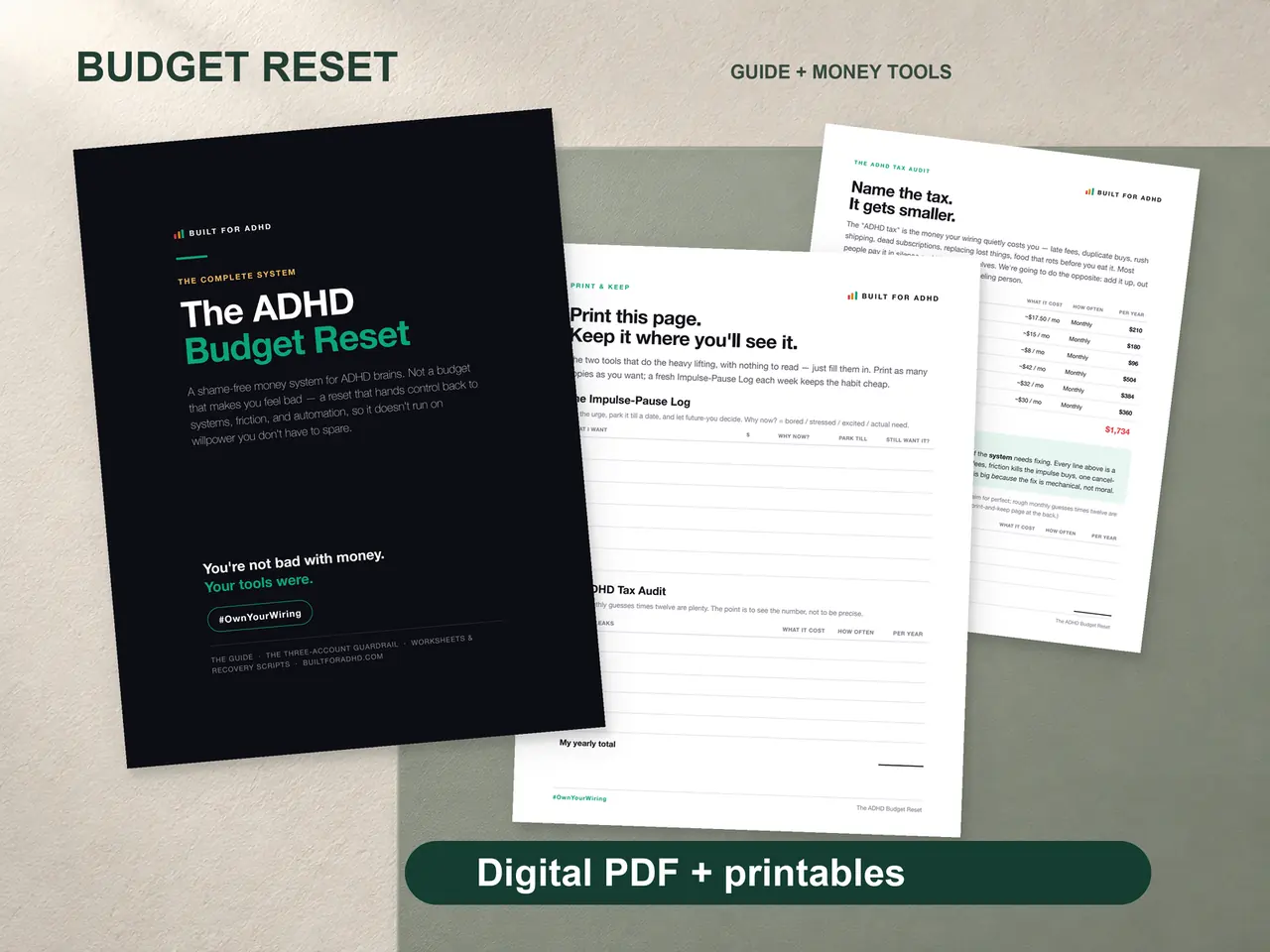
The Budget Reset does. The ADHD Tax category gets its own envelope worksheet, where you log all the spending that happens because of how your brain works. Watching that number shrink month over month gives you the dopamine hit of visible progress. It’s an instant-download PDF — guide, workbook, and print-and-keep envelope pages — so you can print the envelopes you want and start today. No app, no login, no Google Drive. Yours forever, works on any device.
You don’t need physical envelopes. You need a system you can see and write on — one that gives you visual feedback and doesn’t make you carry cash like it’s 1997.