You already know the brain dump works. That is not the problem. The problem is that somewhere around line three you stop writing and start deciding — is this really urgent, does this even count, should this go under work or home — and eight seconds later you are staring at a half-empty page feeling worse than when your head was just full.
That is not a discipline failure. You accidentally asked your brain to do two incompatible jobs at the same time.
Capture and Sorting Are Two Different Modes
Getting things out of your head is a speed job. It wants no filter, no punctuation, no categories, no judgment. The only thing that matters is throughput.
Sorting is the opposite. It wants comparison, prioritization, and holding several items side by side in working memory to decide which one wins. That is executive function doing its most expensive work (ADDitude).
Trying to run both at once means every item you write triggers an instant micro-decision, and micro-decisions are the exact tax an ADHD brain pays badly. Twelve open loops and a working memory built for about four is already why you are overwhelmed. Adding a sorting decision to every line is why the page stays blank.
So separate them. Dump with zero organizing. Then let something else do the sort.
Step One: Dump It Ugly
The rules here are almost aggressively low.
Everything goes in. Tasks, worries, the thing you said in a meeting that you are still replaying, the dentist, the tab you have had open for six weeks, the business idea, the birthday you nearly missed. If it takes up space in your head, it counts.
No categories. No headings. No complete sentences. No punctuation if you do not feel like it. One long unfiltered run of things is not a worse dump than a tidy one — it is a better one, because tidiness costs time you would rather spend emptying.
And keep the bar on the floor. Five items is a dump. Time blindness means this feels like it will take twenty minutes and it usually takes ninety seconds.
Step Two: Let AI Do the Sort
This is the part worth handing off, because sorting is the step that requires the exact function you are low on when your head is full.
We built a free tool for it: paste the dump into the ADHD Brain Dump Sorter and it comes back sorted into four buckets — Now (today, three items maximum), Later (this week), Someday (parked, guilt-free), and Drop (permission to let go) — plus one tiny first step you could start in about two minutes. It is free, there is no account, and what you paste is not stored anywhere.
That three-item cap on Now is deliberate. A sorted list of nineteen “urgent” things is just the original swirl with better formatting.
Why Drop Is the Category That Actually Matters
Now and Later are the useful buckets. Drop is the one people react to.
Every ADHD backlog carries items that are not really tasks anymore. The favor from four months ago that everyone has moved on from. The hobby you bought supplies for. The half-project that only survives because deleting it feels like admitting something. They cost you a small tax every time your eyes pass over them, and they will never be done.
Naming them and letting them go is not quitting. Nothing on a list is a promise you made under oath, and an item you have carried for a year without acting on it was never going to be completed by carrying it for another one. Rejection sensitivity makes dropping things feel like a verdict on you. It is not. It is maintenance.
Someday does the gentler version of the same work — parked is not failed. Between those two buckets, most people find half their list evaporates, and the relief is instant.
One First Step Beats a Full Plan
The other reason to end a sort with a single tiny step: a full plan is a beautiful object that changes nothing.
An ADHD brain does not stall because the plan is unclear. It stalls at initiation — the gap between knowing and moving. A ten-step plan does not shrink that gap. “Open the email and reply with one line” does, because it is small enough that starting feels faintly ridiculous rather than impossible, and once you are moving, hyperfocus can take it from there.
Being honest about it: sorting your dump is not the same as doing the work. It is entirely possible to spend a satisfying hour producing an immaculate sorted list and end the day exactly where you started. The sort earns its keep only if something gets started afterward. That is what the first step is for.
Prefer to Do It Yourself in ChatGPT
Reasonable. If you have an assistant open already, use it. Two prompts that work:
- “Here is my brain dump, unedited. Sort every item into: now (today, max 3, only real deadlines or consequences), later (this week), someday (parked, no guilt), drop (permission to let go). Then give me one physical first step for the top item that takes under two minutes.”
- “Read this dump and tell me which items I have been carrying so long they should probably be dropped.”
If those land, the free ADHD AI Prompt Pack has 25, and the full guide to AI tools for ADHD covers where AI helps and where it very much does not.
Paper and AI Are Not Competing
The AI sort is best when your head is already full and you need it emptied now. The paper version is best as a routine — same page, same time, no screen, no tab full of other distractions waiting behind it. Most people who stick with this end up doing both: the printable ADHD brain dump template as the daily habit, the sorter on the days the swirl gets ahead of them.
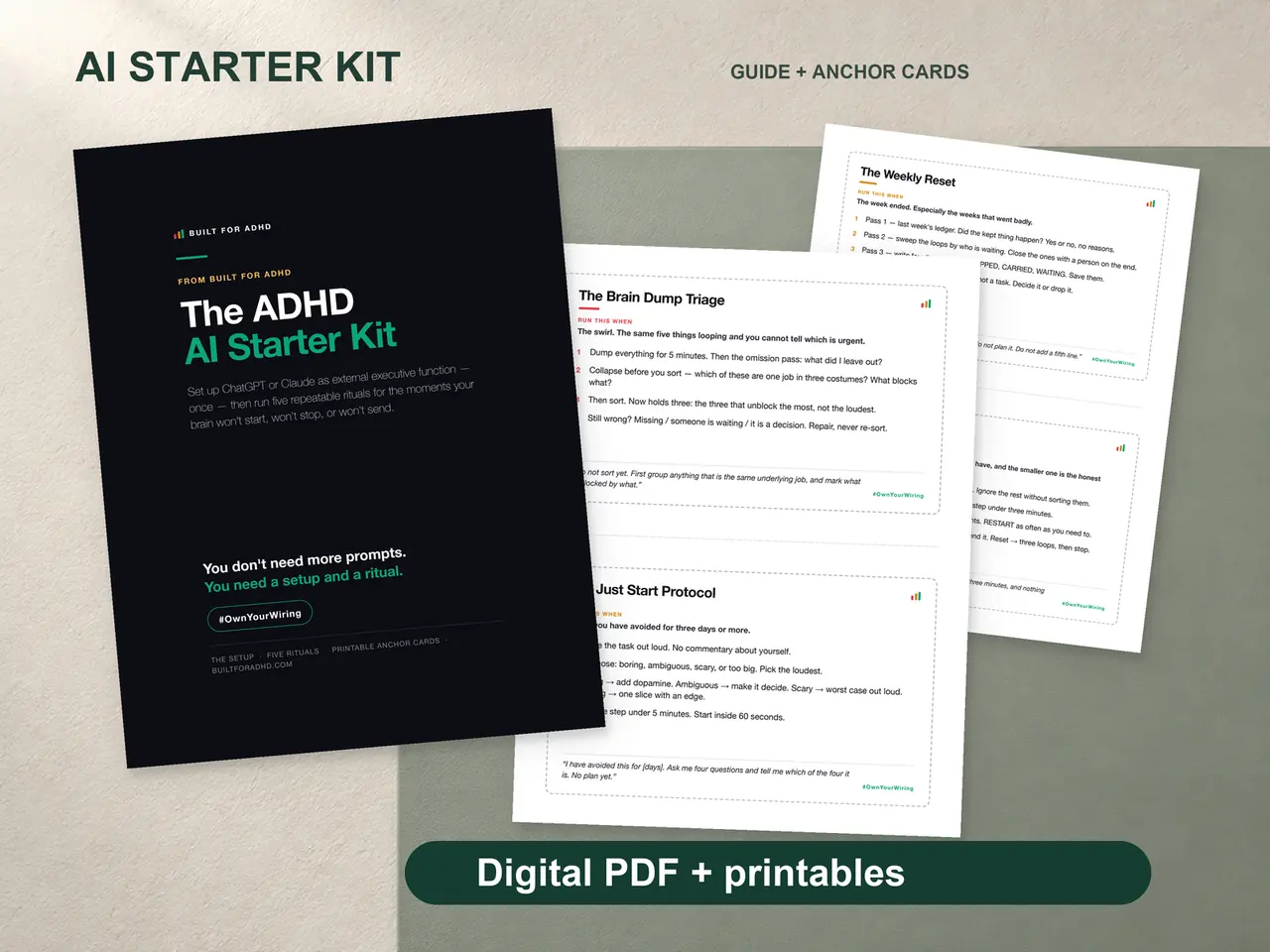
If you want the triage to become a ritual you run without thinking, that is the ADHD AI Starter Kit — the paste-once setup, five repeatable rituals including this one, and printable anchor cards that keep them off-screen. Designed PDFs and print pages, not an app; one purchase, no subscription. The free sorter above is genuinely enough to start with today.
One last note. This is a productivity tool, not treatment. It does not diagnose anything and it does not replace a conversation with a qualified healthcare provider. If things feel heavier than a full to-do list, talk to one.
Dump it ugly. Let something else sort it. Do the two-minute thing.
More setup guides, techniques, and honest tool reviews live on the AI for ADHD hub.
Sources
- ADDitude, “Why Getting Started Is So Difficult for Adults with ADHD” — https://www.additudemag.com/getting-started-adhd-challenges/