Almost everyone with ADHD has had the same experience with ChatGPT. You heard it was life-changing. You opened it. You looked at the blank box, could not think of a single useful thing to type, felt slightly stupid about that, and closed the tab.
That is not a you problem. A blank box is the worst possible interface for a brain that struggles with task initiation — it asks you to supply the exact thing you are short on, which is the starting push. It is the same reason blank planners stay blank.
So this page is not a list of reasons ChatGPT is amazing. It is the specific setup, the specific conversations, and the honest limits. (the limits are the useful part)
For the wider view of AI and ADHD generally, that lives on the pillar page: AI tools for ADHD. This page is ChatGPT specifically.
Set Your Custom Instructions Once
This is the highest-leverage ten minutes you will spend, and almost nobody does it.
ChatGPT has a custom instructions setting (under your profile menu, sometimes called personalization). Whatever you put there applies to every new chat automatically. So the context you would otherwise retype forever — and eventually stop retyping, and therefore stop using the tool — becomes permanent.
The principle is simple: tell it the constraints it cannot guess, and tell it once. At minimum, that means naming three things — that your focus is unpredictable so rigid schedules will not survive, that the first step of anything needs to be under five minutes, and that you want short answers rather than essays. Something as basic as this already changes every future reply:
I have ADHD. My focus is unpredictable, so do not give me rigid schedules. Keep answers short. Give me one first step I could do in under five minutes.
Write it in your own words — it does not need to be elegant, it needs to be true about your brain. Everything after that gets better with no further effort from you, which is the only kind of improvement that survives an ADHD week.
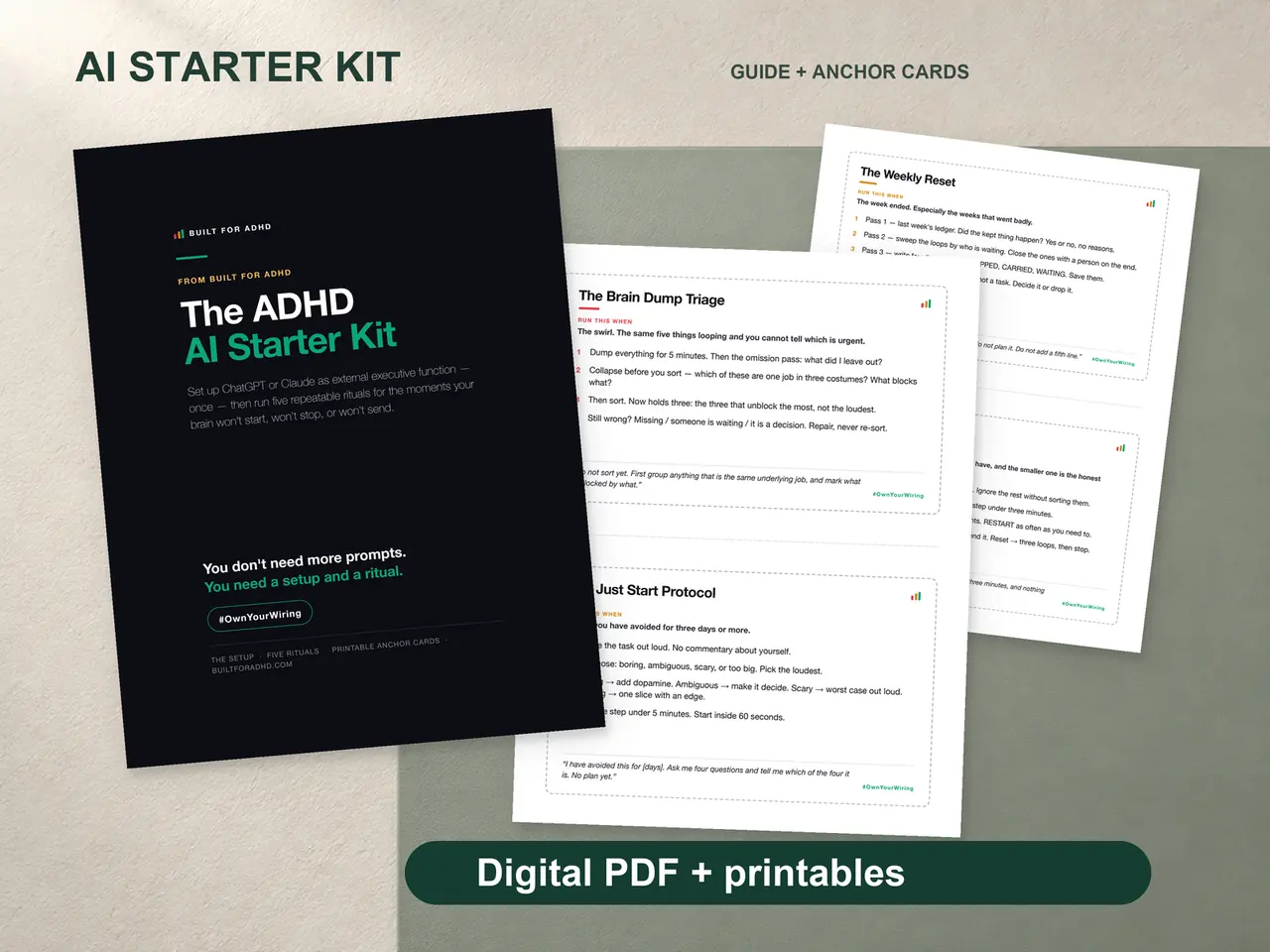
Tuning it further is where most of the gain is, and it is fiddly: how you get it to stop asking clarifying questions that derail you mid-task, how to keep it from drifting back into pep talks, and the one line that pulls a session back when the answers get too long. The fully tuned block, written out to paste straight in, is in the ADHD AI Starter Kit.
The Blank Box Is the Enemy — So Save Your Prompts
The second thing that changes everything is embarrassingly simple: stop composing prompts and start reusing them.
Pick five that work and keep them somewhere you can copy-paste without thinking — a note on your phone, a pinned chat, a printed page by your desk. Where matters less than this: you should never have to invent language at the moment you are already overwhelmed. Writing a good prompt takes exactly the executive function you do not have on the day you most need help.
These reliably earn their place:
- “Here is my brain dump. Sort it into: actually today, can wait, parked guilt-free, safe to drop. Then pick the one that would make today feel like a win and give me a first step under two minutes.”
- “I have been avoiding this for [X] days. Ask me three questions to figure out what specifically I am avoiding about it, then give me a way in that skips that part.”
- “Rewrite this so it is polite, brief, and does not sound anxious.”
- “I have about 40 minutes and low energy. Here is my list. What is the one thing worth doing right now?”
- “Explain this like I have already read it twice and it did not stick.”
If those work, there is a whole page of them — ChatGPT prompts for ADHD, written out in full and organised by the situation you are actually in. And there are 25 in the free ADHD AI Prompt Pack. It is a PDF, it costs nothing, and it exists because the barrier was never access to ChatGPT — it was not knowing what to say to it.
And if your head is too full right now to even do that, the free Brain Dump Sorter runs the first prompt for you. Paste the swirl, get it back sorted, with one tiny first step. No account, no cost.
The Conversations That Actually Work
Four kinds of chat consistently pay off, and all four are narrower than the way ChatGPT gets marketed.
Shrinking a task until starting feels stupid rather than impossible. “Sort out the garage” is not a task, it is a mood. Ask it to keep making the first step smaller until you would be embarrassed not to do it. “Put on shoes” counts.
Triaging a brain dump. The problem is not that you lack information — it is holding twelve open loops in a working memory built for about four. Dump all of it out, ask for it sorted, and the noise becomes a list. (the relief is instant)
Drafting the thing you are flinching from. The email you have not sent in nine days. The message to your landlord. RSD makes some messages disproportionately expensive to write, and handing off the first draft removes the part your brain was avoiding. You still edit it — you just do not start from nothing.
Deciding when time blindness has you stuck. Tell it honestly what you have left in the day and let it pick. Outsourcing a low-stakes decision stops you burning fuel on something that does not deserve it.
What ChatGPT Will Not Do
This part matters more than everything above.
It does not supply activation energy. It will produce a beautiful plan and then sit there while you do not start. The quality of the plan does not change the difficulty of beginning.
It enables plan-forever paralysis. This is the real danger, and it is specific to ADHD. ChatGPT is endlessly willing to help you research, refine, and restructure — all of which feels productive while nothing moves. If you have had four excellent conversations about a project and still not touched it, the tool has become the avoidance. The only prompt that helps then is the one that makes the first step two minutes long.
It does not remember your life. Custom instructions help. It still does not know what you did yesterday unless you tell it.
It is not there at the moment of doing. It cannot sit beside you at 7am when the day has not been decided, or at 11pm when your brain will not shut off. That is not a flaw you can prompt your way out of — it is a different job.
That last gap is why the output has to leave the screen. Write the one next action on paper and put it where you actually work. A page on the desk has no notifications and cannot get buried under seventeen tabs.
One Honest Note
ChatGPT is a productivity tool, not treatment. It does not diagnose, it is not therapy, and it does not replace a conversation with a qualified healthcare provider. If you are struggling, talk to one.
And if you want the setup and the rituals written out properly rather than assembled yourself, that is the ADHD AI Starter Kit — the paste-once instructions, five repeatable rituals, and printable anchor cards that keep each one in front of you. Designed PDF guides and printable pages, not an app. One purchase, yours forever.
You do not need it to start. Set your custom instructions today. Save five prompts. That is genuinely the whole on-ramp.
More setup guides, techniques, and honest tool reviews live on the AI for ADHD hub.
Sources
- OpenAI Help Center, “ChatGPT Custom Instructions” — https://help.openai.com/en/articles/8096356-chatgpt-custom-instructions