Most “ChatGPT prompts for ADHD” lists are the same twenty productivity prompts with the word ADHD added. So here are prompts that were actually written for the way this brain stalls — task initiation, decision paralysis, time blindness, the email you have been rewriting in your head for nine days. Copy them. They work on the free tier of ChatGPT, and identically in Claude or Gemini.
First, the one rule that matters more than any individual prompt.
Give It Your Constraints, Not Just Your Task
This is the whole difference between a generic answer and a useful one.
“Help me plan my week” gets you a color-coded timetable built for someone whose energy is a straight line. ChatGPT has no idea your focus is unpredictable, that you will not follow a rigid schedule, or that a first step longer than five minutes will simply never get started. It cannot infer any of that. You have to say it.
So say it once, at the top of the chat, and reuse it forever. (If you would rather set this permanently instead of pasting it each time, that is what custom instructions are for — covered in using ChatGPT for ADHD.)
“Context for everything in this chat: I have ADHD. My focus is unpredictable — roughly two good hours a day and I can’t schedule when. I will not follow a rigid time-blocked plan. Every first step you give me must take under five minutes and require zero decisions from me. Do not lecture me about consistency or discipline. If I give you a list, make the decisions for me rather than handing back options.”
Paste that first, then paste any prompt below. The output changes immediately — it stops sounding like a productivity blog and starts sounding like something you can actually do.
The Prompts
1. Brain dump triage. Use this when your head is too full to pick anything and everything feels equally urgent. It works because holding twelve open loops in a working memory built for about four is the actual problem — not laziness, capacity.
“Here is my brain dump, unsorted and messy. Sort it into four buckets: actually today, can wait, parked guilt-free, and safe to drop entirely. Be aggressive about the last two. Then pick the ONE item that would make today feel like a win and give me a first step for it that takes under two minutes.”
2. Shrink the first step. For the task that has been on the list so long it has become furniture. The trick is asking it to go smaller than feels reasonable — the step should feel almost embarrassing.
“I need to [task] and I have not started it in [X] days. Break it down, then keep shrinking the first step until it takes under two minutes and requires no decisions and no supplies I’d have to go find. If the first step is ‘open the document,’ that’s correct — don’t make it bigger.”
3. Find out what you are actually avoiding. Executive dysfunction is rarely about the whole task. It is usually one buried step — a phone call, a number you do not want to see, a person you have to disappoint. Naming it often dissolves it.
“I have been avoiding [task] for weeks and I don’t fully know why. Ask me three short diagnostic questions, one at a time, to find the specific part I’m flinching from. Then give me a way in that skips or defers that part.”
4. The avoided email. Rejection sensitivity makes certain messages wildly expensive to write. Handing off the first draft is a legitimate accommodation, not cheating.
“Write a short, warm, professional email doing this: [what you need to say]. Context: it’s [X] days late and I’ve been avoiding it. Do not over-apologize, do not grovel, do not explain more than one sentence’ worth. Keep it under 120 words. Give me two versions — one that acknowledges the delay briefly and one that doesn’t mention it at all.”
5. Decision paralysis. When two options have been rattling around for a week, the cost of deciding has already exceeded the difference between them.
“I’m stuck between [option A] and [option B] and I’ve been stuck for [X] days. Don’t give me a pros and cons list — I’ve already made it in my head twice. Ask me the two questions that actually determine the answer, then just tell me which one to pick and why. Assume the cost of staying undecided is higher than picking wrong.”
6. Time blindness reality-check. Where the twenty-minute task quietly ate the afternoon. Ask for the honest number before you commit.
“How long does [task] realistically take, start to finish, including setup, transitions, and the parts people forget? Give me a range, not an average, and assume I’ll get distracted at least once. Then tell me what actually fits in the [X] minutes I have — and what to cut.”
7. Body doubling structure. ChatGPT is not a person and will not hold you accountable in the way another human does. It can still hold the structure so you do not have to.
“Be my body double for the next 45 minutes on [task]. Start by asking me one question to define what ‘done’ looks like. Then give me a 25-minute block with a specific target, check in when I report back, and give me a second block. Keep your messages to two sentences. No pep talks.”
8. The weekly reset. Sunday-night dread, handled in one paste. Loose ends are heavier when they are vague.
“Here’s everything from my week — finished, unfinished, and dropped. Tell me what actually got done (be generous, I under-count). Then give me the three things for next week that genuinely matter, with a first step for each. Everything else, tell me explicitly that I have permission to let go.”
Where These Come From, and What They Don’t Fix
There are 25 more of these in the free ADHD AI Prompt Pack — a PDF organized by the situation you are actually in, covering getting unstuck, home and life admin, money, work, and rest and boundaries. No cost, no credit card. If you would rather see the approach run itself, the free Brain Dump Sorter executes prompt #1 for you automatically: paste the swirl, get it back sorted.
For the wider picture of where AI helps an ADHD brain and where it does nothing, read the pillar: AI tools for ADHD.
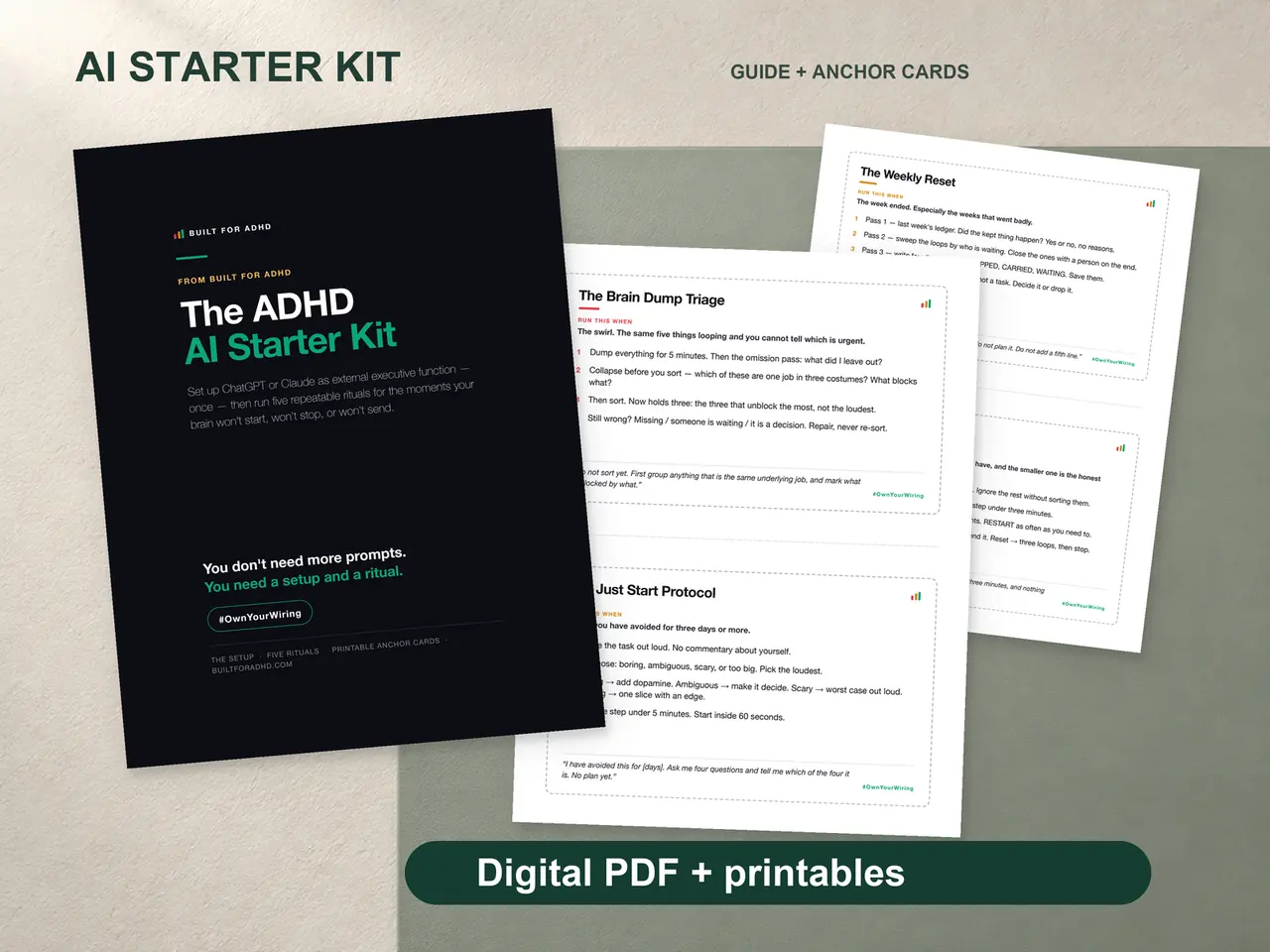
And if you want these to become rituals rather than prompts you hunt for each time, that is the ADHD AI Starter Kit — the paste-once setup, five repeatable rituals, and printable anchor cards so each one lives off-screen where the work happens.
Now the honest part. These prompts do not supply activation energy. Nothing typed into a chat box does. A brilliant answer you never act on is exactly as valuable as no answer, and AI is very willing to help you plan and research and optimize forever — which feels productive while nothing moves. If you have had four excellent conversations about a task and still have not begun, the prompt you need is #2, and then you need to close the tab.
The other failure is quieter: the plan evaporates when the tab does. Get the good output onto paper and put the paper where the work happens. Thinking on screen, doing on paper.
One last note. This is a productivity tool, not treatment. ChatGPT does not diagnose anything, it is not therapy, and it does not replace a conversation with a qualified healthcare provider. If you are struggling, talk to one.
Start with one prompt today. Not all eight.
More setup guides, techniques, and honest tool reviews live on the AI for ADHD hub.
Sources
- ADDitude, “Why Getting Started Is So Difficult for Adults with ADHD” — https://www.additudemag.com/getting-started-adhd-challenges/