In this article
It’s 2:30 on a Tuesday and you hate everyone. Not for a reason — for a frequency. The HVAC hum you can’t unhear. Two coworkers laughing three desks over. The overhead lights that everyone else apparently finds fine. Your shirt tag. Slack pinging like a smoke detector with a dying battery.
By 3:00 you can’t form sentences. By 5:30 you get home, and the person you live with says something completely normal, and you snap at them — and then feel terrible, because the day did this, not them.
That’s sensory overload, and if you have ADHD you’re likely running it on the regular. It isn’t you being dramatic, and it isn’t a personality flaw. It’s a filtering problem — and filtering problems have fixes. (Some of those fixes are tools, and the complete guide to ADHD tools for adults covers them.)
Why work is the perfect storm
Most brains have a doorman. Background noise, flickering light, the feel of clothes — the doorman quietly turns those away before they reach the part of you that’s trying to think. An ADHD brain’s doorman keeps waving everything through. Every input arrives at full volume and you have to do the sorting, manually, all day.
That sorting is executive function work. The same budget you’re spending on the actual job — plus masking, plus the forty tiny decisions everyone else automates. So the math is brutal: same office, same eight hours, but your brain is running the meeting and the doorman’s shift simultaneously. Of course it hits empty by mid-afternoon.
The signs are sneakier than “it’s too loud in here”:
- Irritability that climbs all day and detonates on someone who didn’t cause it
- The 3 PM shutdown — reading the same email four times, words not landing
- Physical escape behaviors — extra bathroom trips, the long way to the printer, “I’ll take this call walking”
- End-of-day mutism — getting home with zero words left for the people you actually like
- Snapping at textures and small sounds you handled fine that morning (capacity, not the sound, is what changed)
The fixes — cut input, then cut load
You can’t renovate the office. You can do two things: reduce what’s coming in, and reduce what your brain is juggling while it comes in. Both matter, and the second one is the one everybody skips.
1. Cut the input you can cut. Loop earplugs or noise-canceling headphones are the single highest-ROI purchase in ADHD work life — and one brown-noise track can wallpaper over an entire open plan. Kill the overhead fluorescents at your desk if you can; a warm lamp is a $20 fix. Cut the tags out of your shirts. None of this is being precious. It’s turning the volume down on a channel you were never able to mute.
2. Book your hard work into your quiet windows. Every office has low-stim hours — before 9:30, lunch, after 4. Deep work goes there, and the tolerance-required work (email, pings, meetings) goes in the loud middle. That’s energy-based scheduling: matching the task to the capacity you’ll actually have, instead of pretending 2 PM you and 8 AM you are the same person.
3. Dump the open loops so noise has less to knock over. Here’s the skipped part: overload isn’t just input — it’s input colliding with everything you’re holding in working memory. The seven half-remembered tasks, the thing you must not forget to say in the 3:00 meeting. A brain juggling all that gets knocked over by a hallway conversation. Get it onto one page at the start of the day, and the same hallway is annoying instead of catastrophic. The page holds it so your head doesn’t have to.
4. Take the recovery break before you need it. Five minutes somewhere genuinely low-stim — stairwell, car, outside, a bathroom stall with your eyes closed (zero shame; it’s the only door that locks). Scrolling your phone is not this; it’s more input wearing a break costume. Put one at 11 and one at 2:30, on an alarm, because the whole problem is that you don’t notice the meter until it’s empty.
5. Say the sentence. You don’t need a diagnosis disclosure to say: “I focus best with headphones on — if you need me, ping me and I’ll pop them off.” One sentence, said once, buys back hours a week. Most coworkers accept it without a blink, because half of them wish they’d said it first.
The part that isn’t about the office
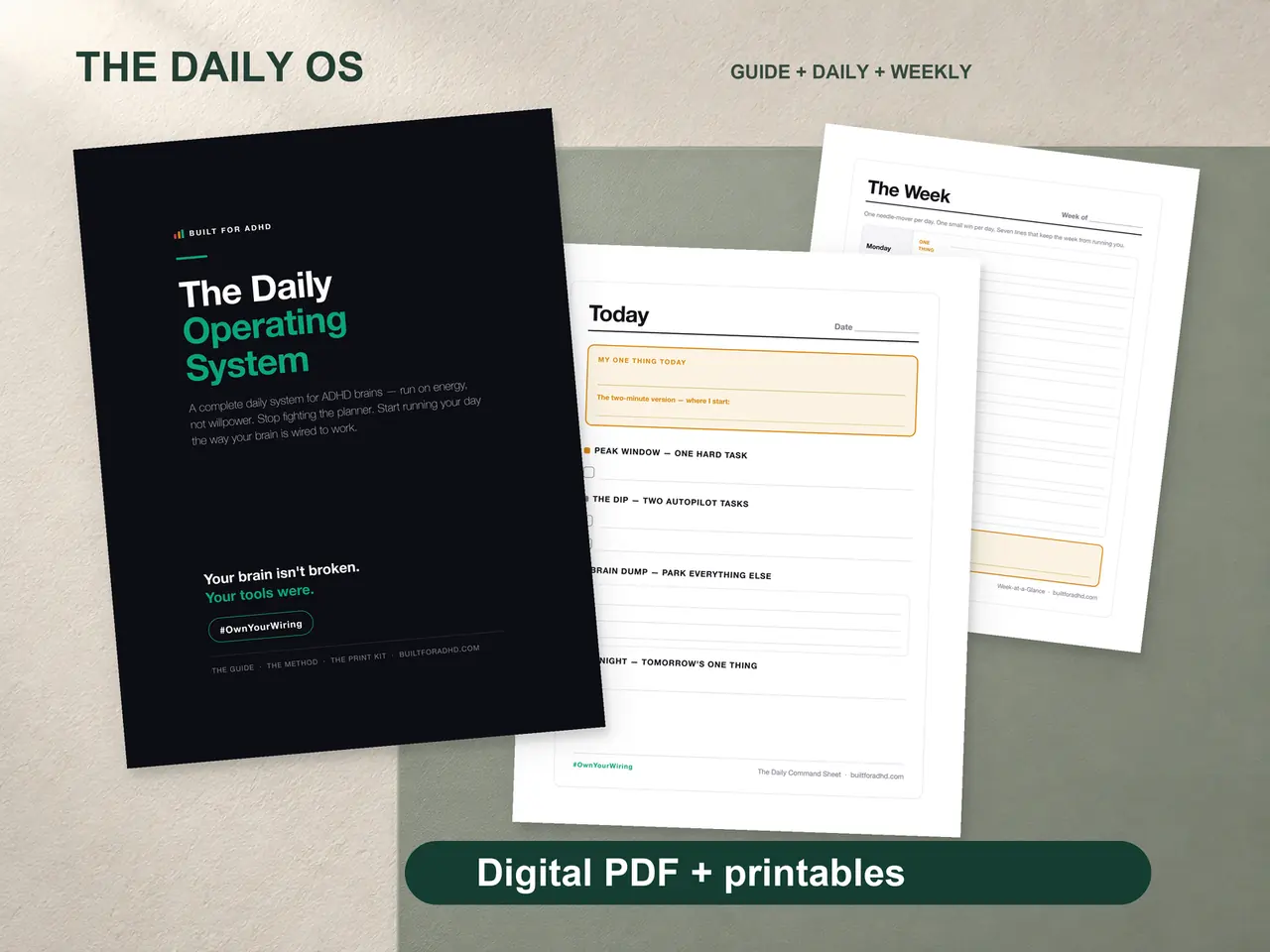
The overload that ruins evenings is rarely one loud room — it’s a loud room on top of a day with no structure absorbing any of the load. That’s the system the ADHD Daily OS is built to be: the morning brain dump, tasks sorted by energy instead of the clock, a 3-max rule so the day has a shape your brain isn’t holding up by hand. $17, printable, and it lives on paper — the one surface in the office that doesn’t ping.
Start free: the brain dump sheet is the first ten minutes of the system, and it’s the piece that takes the most weight off the doorman.
Related tools
- Free ADHD brain dump sheet — one page that holds the open loops for you
- ADHD Daily OS — $17: the energy-based daily system
- ADHD tools for adults — the full toolkit, compared
- ADHD decision fatigue — the other thing draining the same battery