In this article
The year I finally filed on time, I did exactly one clever thing, and it happened in November.
Every year before that went the same way. Sometime in March I would sit down to do taxes, and the actual work was never the filing. It was the hunt. A 1099 somewhere in an email thread. A mortgage statement that had gone into the pile by the door in January. A charity receipt I was sure existed. Four hours of searching, two hours of filing, and eight weeks of low background dread before I started.
Here is what took me far too long to see. Tax documents are not one task in March. They are eleven small arrivals between early January and mid-February, through six different channels, while your attention is somewhere else entirely. Mail, email, a bank portal, a payroll portal, an app notification, a brokerage site that emails to say a document is ready and then makes you log in to get it.
Nothing about that is a filing problem. It is a capture problem, and capture problems are solved before the thing arrives, not after. (The rest of the money system lives in the ADHD money management guide.)
So the clever thing was this: in November, before a single document existed, I made the folder.
The folder, both kinds, same name
Make two containers and give them the identical name: Tax 2026.
One is physical — a folder, an envelope, a shoebox, anything with edges. It goes wherever your mail actually lands, not where you wish it landed. If the pile lives on the kitchen counter, the folder lives on the kitchen counter.
One is digital — a folder in your email, or a folder in your phone’s files, or a note. One place, same name, so there is never a decision about which one.
That is the whole infrastructure. Do not shop for a better one tonight. (the hunt for the perfect folder is avoidance in a productive costume)
The reason the name matters more than the container: when a document shows up and you are mid-something-else, you have about four seconds of willingness. “Put this in Tax 2026” survives four seconds. “Decide where this goes” does not.
Last year’s return is the checklist
You do not have to remember what should arrive. You already have the list, and it is last year’s return.
Pull it up and write down every document it was built from — every W-2, every 1099, the mortgage interest form, the student loan interest form, the childcare statement, the brokerage summary. One line each. That list is about 90% accurate for this year, and it takes four minutes.
Tape that list inside the physical folder. Now the folder is not just a container, it is a scoreboard — and a scoreboard is checkable, which is the part your brain will actually cooperate with.
If something changed this year — new job, a side income stream, a house, a kid — add those lines by hand. Then stop. You are not trying to be complete in November. You are trying to be 90% complete now instead of 100% frantic in March.
What lands, and roughly when
Most of it shows up in a tight window, which is good news: the season is short.
- Early-to-mid January: mortgage interest, student loan interest, charity receipts from year-end giving, HSA paperwork.
- Late January: W-2s, most 1099s. This is the heaviest week.
- Early-to-mid February: brokerage and investment summaries, which are the usual stragglers and the ones most likely to arrive as “your document is ready, log in” rather than as an actual attachment.
The specific dates do not matter and they shift. What matters is the shape: a six-week flood, starting roughly four weeks from now, right when the holidays have already emptied the tank. November and December already run on a smaller tank than the calendar thinks, and January is where the bill for that arrives.
Which is exactly why the folder gets built now, while building it costs almost nothing.
The five-minute sweep
One recurring block, weekly, through February. Five minutes. Not a money session — a sorting session.
Three moves, in order:
- Mail. Anything that looks official and tax-shaped goes in the folder. Do not open it. Do not read it. Opening it is where this turns into a forty-minute feelings event.
- Email. Search your inbox for
1099,tax document,tax statement, andyear-end. Anything that hits gets dragged to the Tax 2026 folder. Thirty seconds. - The scoreboard. Check off what arrived. That is it — close the folder.
The “do not open it” rule is load-bearing and I will defend it. Opening a tax document in November does nothing except hand you a number you can’t act on yet, and the dread of the number is almost always worse than the number. Sorting is a low-energy task. Reckoning is a high-energy one. Doing them in the same sitting means the low-energy task inherits the high-energy task’s activation cost, and then it stops happening at all.
If you’re self-employed, two extra lines
If any of your money came from your own work this year, add two rows to the scoreboard.
First, the invoices that never got sent. Unsent invoices are not just unpaid — they quietly distort what this year even looks like. If invoicing is the thing that keeps slipping, the end of the year is the forcing function to clear the backlog while it still belongs to this year.
Second, the expense pile. If business and personal money run through the same account, December is when that decision gets expensive, and separating them is a one-evening fix that pays for itself every January. If they’re already separate, one export of the business account is most of your answer.
A plain note here, because it should be plain: none of this is tax advice, and I am not the person to give you any. This is a system for getting the paper into one place. What happens to it after that is between you and whoever files.
What to let go of
Categorizing anything. Not in November, not in January. The folder is unsorted on purpose. Sorting is a March job and it takes twenty minutes when everything is already in one place.
Catching up on last year. If a previous year is a mess, that is a separate project with its own block, and dragging it into this one is how both fail.
The guilt about the pile. The pile is not a character flaw, it’s the predictable output of eleven arrivals and no container. That whole category of cost has a name, and the fix for every version of it is the same: catch it earlier, cheaper, with less deciding.
What to expect, honestly
Something will still be missing in March. Probably the brokerage one, probably because it never actually arrived as a document, just as an email saying it was ready. The folder does not prevent that. It makes it one missing document instead of eleven, and it turns four hours of hunting into ten minutes of logging into one site.
The other thing changed too, and I didn’t expect it: the dread went quiet in January. Not because taxes got easier, but because “am I going to lose something important” stopped running in the background. Late fees and missed deadlines are all the same cost in different clothes — a thing that stayed invisible until it was urgent.
Do this today
One folder, physical. One folder, digital. Same name. Last year’s return copied out as a checklist and taped inside. A five-minute weekly sweep on the calendar through February.
Twenty minutes tonight, and almost all of it secretarial — no decisions, no numbers, no reckoning.
If you want the tracking side already drawn up, the ADHD tax and expense tracker is the running log that makes next November’s version even shorter.
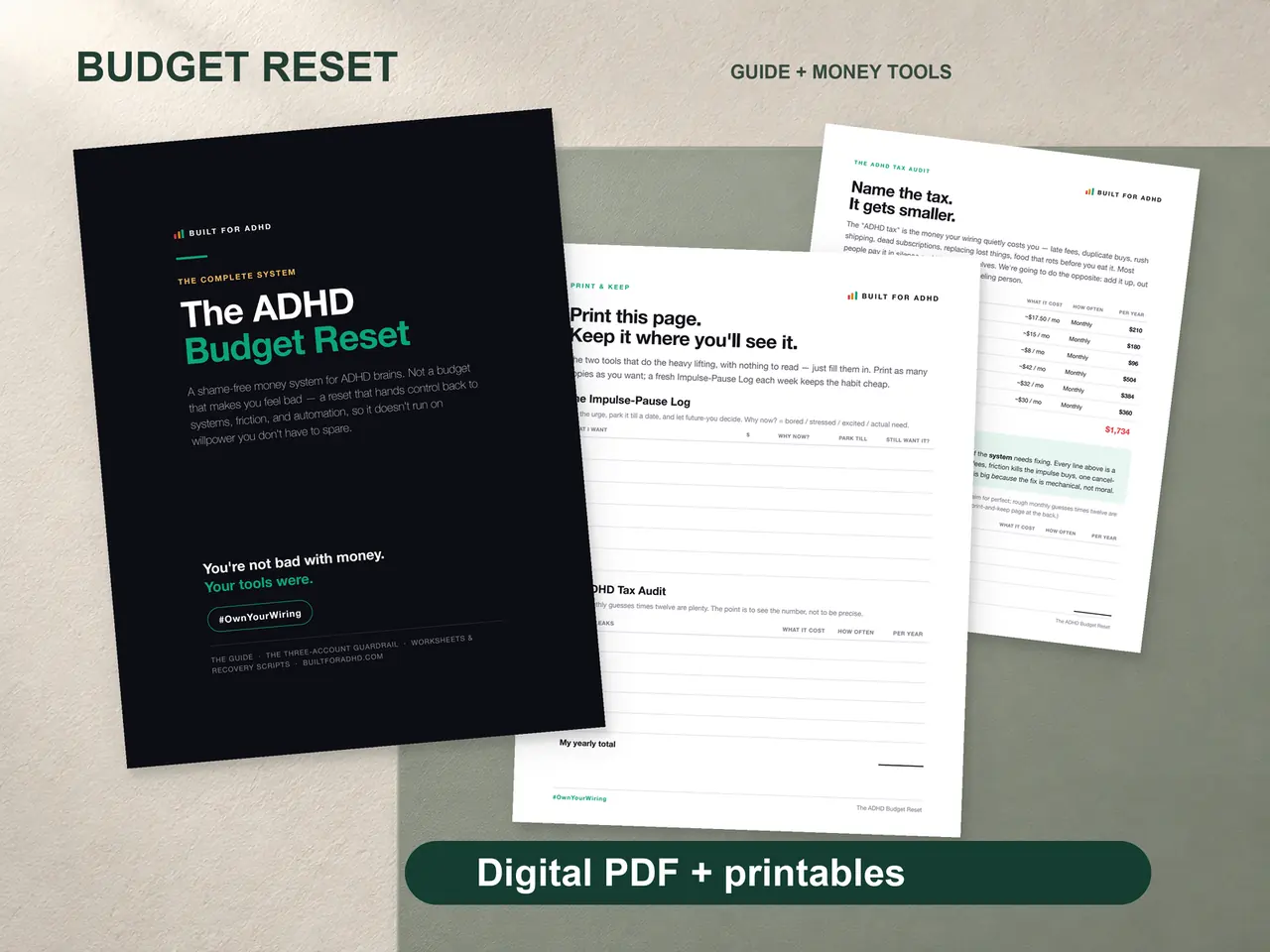
If opening the folder in March is the part you’re actually dreading, the underlying fix is the ADHD Budget Reset, $7 — the ADHD tax audit, the three-account guardrail, named fun money, and the ten-minute weekly money date. Honest note: there is no tax worksheet in it and it will not file anything for you. It’s the everyday money system that makes the March number a known quantity instead of a verdict. The folder above is free and it is the part that matters most.
Related tools
- The ADHD tax and expense tracker — the running log behind next year’s folder
- The free adults starter — a one-page capture sheet to write the checklist on tonight
- ADHD money avoidance and the ostrich effect — why “do not open it” is the rule
- Why you keep forgetting to invoice clients — the self-employed backlog to clear before December 31
- Separate business and personal money with ADHD — the one-evening fix that pays off every January
- What is the ADHD tax — the broader category this belongs to
- ADHD late fees and forgotten bills — the same invisible-deadline cost
- The ADHD winter energy routine — the smaller tank this is planned against