In this article
For the first two years I ran anything on my own, every dollar landed in the same checking account. Client payments, my mother’s birthday gift, a domain renewal, groceries, a piece of gear I bought at 1 a.m. because it felt like a business expense. One account, one card, one undifferentiated pile.
It worked fine right up until every April, when I would sit down with a year of statements and try to reconstruct which of four hundred transactions belonged to the business. That took a full weekend and produced numbers I did not trust. And the rest of the year I could not have told you what the business actually earned, because the balance in front of me was never the business’s balance. It was just the balance.
The fix is not bookkeeping discipline. I have never once had bookkeeping discipline. The fix is that the separation gets built into where the money physically sits, so that staying separate is the default and mixing them takes effort.
Why mixing happens specifically with an ADHD brain
It isn’t that we don’t know business and personal money should be apart. Everybody knows that. It’s that every standard method of keeping them apart is a decision made at the moment of spending — the worst possible time to ask an ADHD brain for a decision.
Categorizing later is a task with no deadline and nobody waiting on it. “I’ll sort it out at tax time” is the same invisible future date that kills every other deferred admin job. Nothing external corrects it. No one emails you asking why your expenses aren’t categorized.
Choosing a card at checkout is a decision point, and decision points leak. Two cards in a wallet means a small judgment call on every purchase — is this business or not? — and after about the ninth of those in a day, the deciding part is just gone and you grab whichever card is in front. That’s not a discipline failure. That is what happens when you put a decision somewhere a decision doesn’t need to be.
A single balance hides the truth in both directions. When business and personal live together, a good month reads as more spending money than you have (the tax money is in there, and the tax money is not yours). A slow month reads as a personal crisis. Neither is real, and both of them affect how you behave.
And it makes the business feel imaginary. Not an accounting problem, but the one I’d name first. If revenue disappears into the account that also buys the groceries, you never get to see what you built — you just have slightly more money sometimes. That’s a demoralizing way to run something you care about, and it makes the work of billing for it feel less worth doing.
The setup: four accounts, one rule
Four accounts. They can all live at the same bank, they can be free checking accounts, and setting them up takes about an hour, once.
1. Business income. Every dollar the business earns lands here. Nothing else ever does. Nothing is ever spent from here directly — this is a receiving dock, not a wallet.
2. Taxes. A holding account you do not touch. When money comes in, a fixed percentage moves here immediately and stays. Use whatever percentage your accountant gave you, and if you don’t have one, use the number your tax software estimated last year — the point of this account is not the percentage, it’s that the money is somewhere you cannot casually spend it.
3. Business spending. The one card you use for business. Software, gear, contractors, the subscriptions. This is the account whose balance tells you what the business can actually afford right now.
4. Personal. Your existing checking account, unchanged. Business money reaches it exactly one way — a transfer you make on purpose, which is your pay.
The rule that makes all four work is a single sentence: money moves from income to the other three on a fixed day, and never in the other direction.
That’s it. You are not categorizing transactions or maintaining a system. You made a routing decision once, on a day you had the energy to make it, and now the accounts do the sorting — the money is already in the right place before you ever spend it.
Routing day: fifteen minutes, attached to something that already happens
Pick the day you already do money things — the same day you do billing, or the 1st and the 15th, or Friday afternoon. Same day, permanently.
Open the income account. Whatever is in there splits three ways: the tax percentage to the tax account, a set amount to personal as your pay, the remainder stays as business spending. Income account ends at or near zero. Fifteen minutes, no judgment calls — the percentages were decided in advance by a version of you who had capacity to decide things.
If your bank will do the tax split automatically, set it up and remove the step entirely. The parts of a money system that survive are the parts that don’t require you — the same reason a savings goal you have to remember to fund never actually accumulates anything.
The four things that break it
Using the personal card “just this once.” It’s never once. The repair is not vigilance, it’s physical: whichever card you use less often lives in a drawer, not the wallet. If both are equally reachable you will keep making the decision, and you will keep losing it. Different colors help more than they should.
Paying yourself by feel. Transferring “some” money when the personal balance looks low re-mixes everything you just separated, and it puts you back to never knowing what the business earned. Pick a number. It can be a boring, too-low number. A fixed pay you occasionally supplement on purpose is still separation; a variable trickle is just one account with extra steps.
Treating the tax account as a buffer. Borrow from it once and it stops being a tax account — it becomes a slow-motion version of the April problem. If you genuinely need it, that’s a conversation about pricing or timing, not a transfer you make quietly on a Tuesday.
Opening the accounts and then never routing. The most common failure and the least discussed. The setup hour feels like the accomplishment, and it isn’t — the routing day does the work. If you do one thing from this post, make it the calendar event, not the bank paperwork.
What the separation actually gets you
Three things, and I noticed all of them within about two months.
Tax season stopped being a reconstruction project, because the business account is the record. Nobody has to remember which transactions were which — they were never in the same place.
The balance in the business spending account became a number I could decide from. Can I afford the contractor? Look at the account. That used to take an hour and a spreadsheet.
And the money stopped feeling like weather. This is the ADHD tax in a form nobody bills you for — not late fees, just years of running something profitable while feeling perpetually broke, because the profit was never visible anywhere. Separating the accounts is the cheapest way I know to make the business real to yourself.
What to do in the next ten minutes
Not all four accounts. Two steps.
Open one new checking account and label it taxes. That’s the account that prevents the worst version of this problem, and it’s the one that works even if you never do anything else on this list.
Then put routing day on the calendar as a repeating event, this week, before you close the tab. An empty system on the calendar survives; a perfect system you meant to start does not.
The printable version of the business side — where the day’s actual revenue tasks live so admin isn’t the thing you do by default — is in the self-employed organization tools, and the free entrepreneur starter set takes about ten minutes if you want the layer above this one.
You don’t need to be better at tracking expenses. You need the tracking to have already happened, at the moment the money arrived, in a place you didn’t have to think about.
Related tools
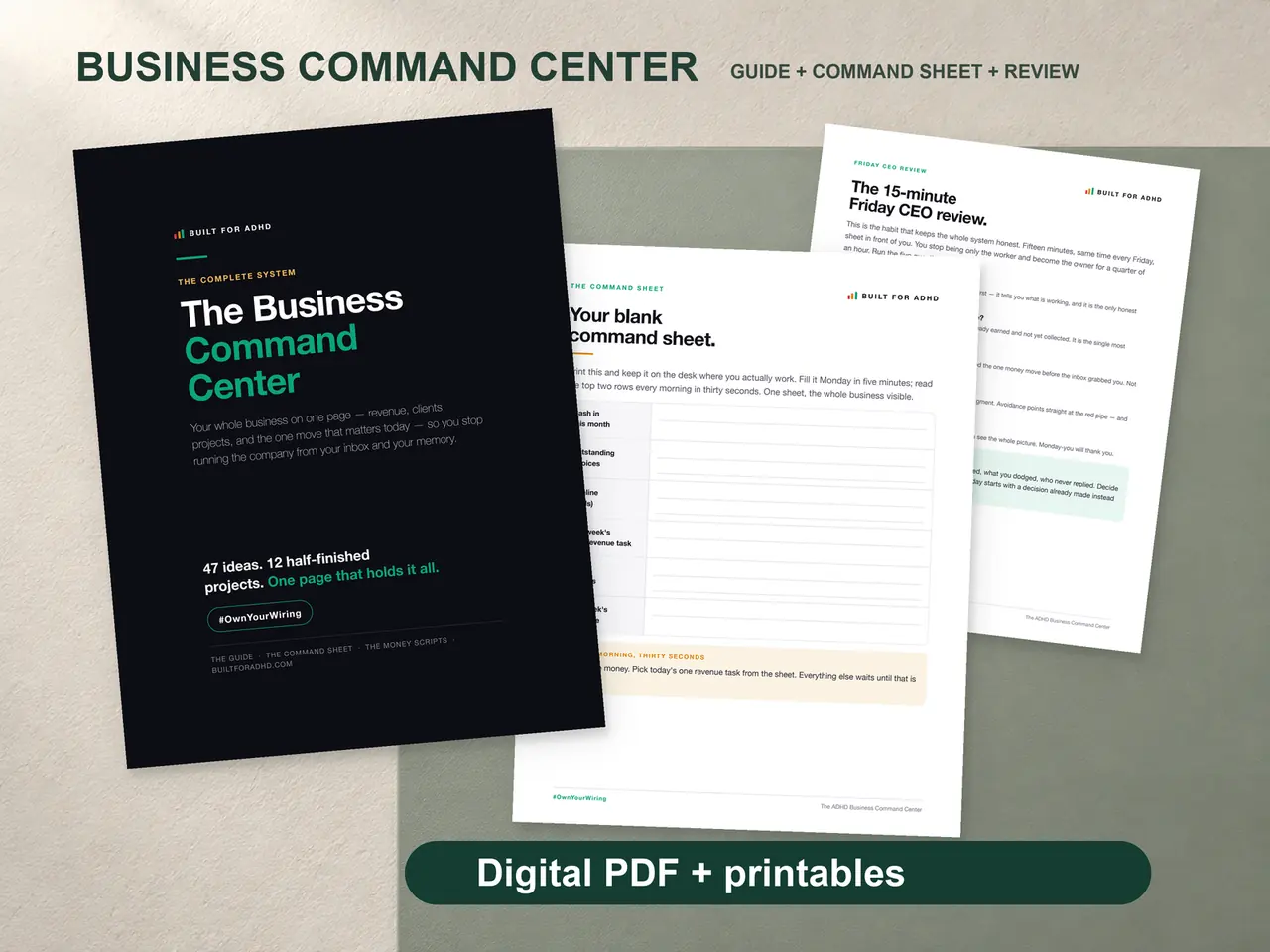
- ADHD Business Command Center — $19: the one-page business cockpit, the five zones, and the money scripts
- The ADHD entrepreneur’s productivity system — the layer this sits inside
- ADHD and forgetting to invoice clients — how the money gets into account one in the first place
- Why the savings account never sticks — the personal-side version of the same routing problem
- Budgeting with ADHD without hating every second — once the accounts are separate
If you want the whole solo-business version — the Command Sheet, the five zones, the Friday review, and the money pages as actual printables — that’s the ADHD Business Command Center. $19, one page, entire business, no willpower required.