In this article
Count the savings accounts you’ve opened in your life. Not the ones you have — the ones you’ve opened. If you’re anything like me, the number is somewhere between three and seven, and every one of them followed the same arc: opened with real intention, funded for six weeks, quietly drained during one bad month, and then avoided out of embarrassment until it held $4.17 and a service fee.
Here’s the thing nobody says out loud: the advice you followed was fine — for a brain it wasn’t written for. “Pay yourself first.” “Just put away 10%.” “Build the habit.” All of it assumes the money you set aside will feel set aside. With ADHD, it doesn’t. And once you understand why, the fix is almost embarrassingly mechanical. (It’s one piece of a bigger money management setup for ADHD brains.)
Why savings evaporate with ADHD
Money you can’t see doesn’t exist — and neither does money you can. ADHD brains run on what’s in front of them. A savings balance inside the same banking app as your checking account isn’t “savings” — it’s a second spending balance with a nicer name. You see it every time you open the app, and your brain quietly files it under available. (The same object-permanence quirk that makes you lose your keys every morning works on dollars too.)
The transfer back is one tap. The entire protection of a savings account is supposed to be separation. But when moving money back takes four seconds at 11 PM — the exact hour your impulse control clocks out — there is no separation. There’s a speed bump painted on flat road.
Future-you is a stranger. Saving is a trade: present-you gives something up so future-you has options. ADHD time blindness makes that trade feel like giving money to a stranger. Not because you don’t care — because “three months from now” has roughly the same emotional reality as “the year 2140.”
One raid ends the whole thing. This is the killer. A neurotypical saver who dips into savings goes “oops” and resumes. The ADHD pattern is different: one raid breaks the streak, the broken streak triggers the all-or-nothing switch, and the account stops being “my emergency fund” and becomes evidence in the case against yourself. Then you avoid looking at it — the same avoidance loop that builds debt spirals, running in reverse.
None of this is a discipline problem. It’s a design problem. So change the design.
The setup that actually holds
The principle behind every piece of this: make saving automatic and raiding annoying. Not impossible — annoying. ADHD impulses are strong but short; a 24-hour delay defeats a surprising percentage of them (the same reason the 24-hour impulse rule works at checkout).
1. Different bank. Not a different account — a different bank. Open the savings account at an institution your checking isn’t at, ideally an online-only one. No debit card attached. Don’t install the app, or if you must, don’t save the login. Now raiding your savings takes a real transfer with a 1–2 business day delay — which means the impulse has to survive two nights of sleep. Most don’t.
2. Automate the deposit on payday, and make it insultingly small. The transfer happens the day money lands, before you see it, without a decision. And here’s the part that feels wrong but is load-bearing: set the amount low. Twenty dollars, not two hundred. The number that survives your worst month is worth infinitely more than the impressive number, because the impressive number gets paused “just for this month” — and with ADHD, paused automations don’t get unpaused. A $20 transfer that runs for two years beats a $200 transfer that runs for six weeks, and it isn’t close.
3. Name the account something concrete. “Savings” is an abstraction, and abstractions lose to dopamine every time. “MARCH CAR REPAIR.” “DO NOT TOUCH: FUTURE DISASTER.” “CAMPING TRIP, SEPTEMBER.” Banks let you rename accounts; use it. When the raid impulse hits, you’re no longer taking money from a category — you’re taking it from a thing, and the thing talks back.
4. Put progress somewhere your eyes are. The account lives out of sight on purpose — so the progress has to live in sight. A paper tracker on the fridge, one box colored in per deposit. Hand-marking progress is a real dopamine event in a way that a number changing inside an app you never open will never be. (Paper beating apps is a recurring theme for ADHD brains — it’s why the printable systems work when the seventeen productivity apps didn’t.)
5. Pre-authorize the raid. You will need the money someday — that’s literally what it’s for. So write the rule now, while you’re calm: “I can take money out for a genuine emergency, one sleep after I decide it’s one.” Taking money out under that rule isn’t failure; it’s the system working. This single reframe kills the all-or-nothing collapse, because there’s no streak to break. There’s just a buffer doing its job, and a $20 automation that keeps refilling it, unbothered.
6. Give impulse spending its own lane. A savings account dies fastest when it’s the only pool of “extra” money — every want becomes a raid vote. Guilt-free fun money in its own separate stash (yes, a third place) means the $40 impulse has somewhere to go that isn’t your buffer. Restriction fails ADHD brains; routing works.
Why this is worth doing at all
Because the buffer is the single highest-return purchase an ADHD adult can make. The ADHD tax — the late fees, the emergency same-day shipping, the duplicate purchases, the subscriptions you forgot — exists mostly because everything urgent hits an account with no slack in it. A few hundred dollars of slack converts emergencies back into inconveniences. It’s not “wealth building.” It’s buying back every future late fee at a discount.
You don’t need to feel like a person who saves. You need one automation, one annoying transfer delay, one concrete name, and one piece of paper on the fridge. The feeling shows up later, somewhere around the third colored-in box.
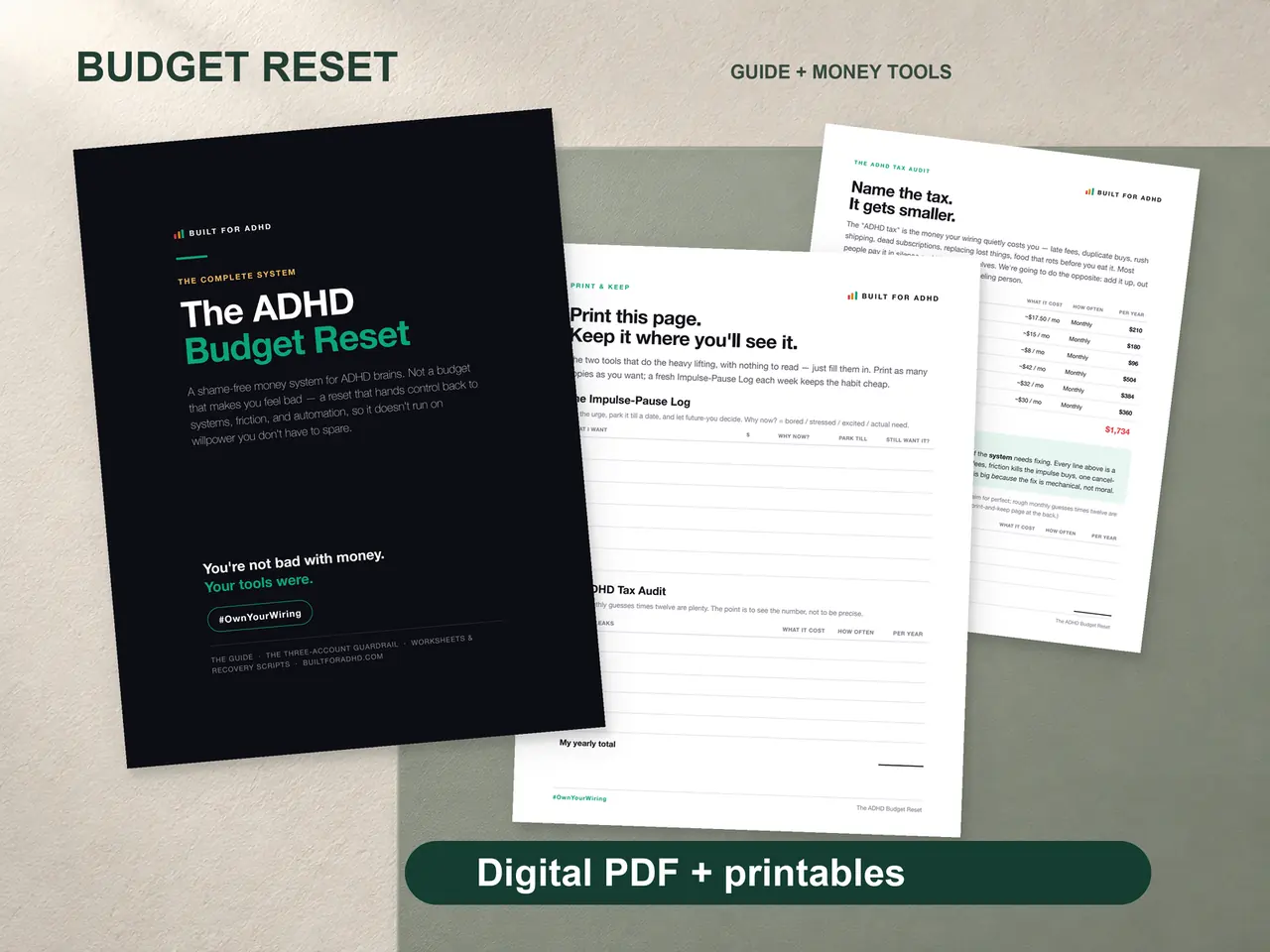
Want the full money system this comes from — impulse-pause log, fun-money routing, the ADHD Tax audit? That’s the Budget Reset, and it starts at the same place this post does: zero shame, all mechanics.