In this article
I offered someone a ride last year and heard myself say “give me two minutes” while I sprinted out and shoveled everything off the passenger seat into the back. (there were four water bottles. one of them was not water.)
My apartment was fine that week. The car was a landfill. That gap is the thing worth understanding: the car gets worse than the house because of how the car works, not because you care less about it. Three mechanisms are running, and naming them turns the cleanout back into a job instead of a character test.
Why the car gets worse than any room in your house
You close the door and the car stops existing. Every room you live in gets looked at a hundred times a day, so the mess at least nags you. The car is sealed and out of your visual field within four seconds of arriving anywhere. It’s the same object permanence problem that eats your keys and wallet, except here the whole container disappears.
Nothing in a car has a home. Your kitchen has drawers. Your desk has a tray. The car has two cupholders and a glovebox full of expired insurance cards. So every single item that enters — the receipt, the jacket, the mail you meant to open, the half-finished drink — stays exactly where it landed, because there is nowhere for it to go. Items without homes become piles, and the pile grows by deferral, not by mess. It’s the doom pile mechanism in a smaller box with worse lighting.
Nobody is coming over. The house gets reset by the threat of a guest. The car has no guest trigger at all — until someone needs a ride, and then it’s an emergency. An urgency-only trigger means the job only ever happens in panic mode, which is the worst mode for deciding what to keep.
So “clean out the car this weekend” fails predictably. It isn’t one task. It’s a hundred small sorting decisions with no bins to sort into and no clear line where it’s finished, and a job with a fuzzy finish line is a job an ADHD brain will not start.
The three-bag cleanout
This is for the car that’s already bad. The point of the three bags is that they remove the decisions — you’re not deciding what to keep, you’re just naming which bag.
Step 1: Open everything, sort nothing
Park, open all four doors and the trunk, and walk around it once. Don’t pick anything up yet. The open-doors move turns a sealed box back into a space you can see, and it makes the job feel bounded instead of infinite.
Step 2: Set up the three bags
One trash bag. One bag labeled Goes Inside. One bag labeled Lives Here. That’s it — three, and no fourth.
The missing fourth bag is the important part. There is no “I’ll decide later” bag, because a decide-later pile is what built the mess in the first place. Every item gets a bag name said out loud and goes in. Receipt — trash. Hoodie — goes inside. Charger — lives here. You will mis-sort a few things and it will not matter.
Step 3: One surface at a time, in this order
Floors, then seats, then the door pockets and console, then the trunk. Finish one surface before moving to the next, because finishing a surface is a visible win and visible wins keep you going.
Size it to the tank you actually have. If the driver’s footwell is all you’ve got today, the footwell is the whole job — and it counts. Starting embarrassingly small is still starting.
Step 4: Done is “three bags out of the car”
Carry the trash to the bin. Carry Goes Inside into the house and set it down anywhere — hallway, floor, chair, doesn’t matter. Put Lives Here back in the car.
The finish line is the bags leaving the car. Unpacking the Goes Inside bag is a different task on a different day. Make the cleanout depend on putting away a hoodie and three bowls and it won’t happen, because now it’s two jobs wearing one name. Let the bag sit. The car is done.
The one bin that stops it refilling
Here’s the part that actually held for me past week two: put a permanent open bin in the car.
A cheap plastic bin or a sturdy tote, in the back seat footwell or the trunk, that lives there forever. Everything that isn’t trash goes in the bin instead of on a seat. The bin is the landing zone the car never had — you’re not asking yourself to be tidier, you’re giving items somewhere to be.
It attacks the mechanism instead of the symptom. A pile needs a surface to start on. The bin is a better surface than the seat, it takes the same one motion, and when it’s full the job is “empty the bin” — one clear task instead of a sorting project.
Then add the smaller rule: nothing leaves the car empty-handed. When you park, grab one thing on the way out. One cup, one bag, one jacket — no quota, no streak to break, and nothing happens on the days you forget.
Both of those need a moment that already exists, because nothing in a car beeps to tell you it’s time. Use the fuel or charging stop: you’re standing there doing nothing, there’s a trash can right next to you, and it’s pre-built for a quick sweep of the cupholders. Same logic as a cleaning rotation that runs off triggers instead of willpower.
The expensive part nobody mentions
The mess isn’t really the problem. The problem is what gets buried in it.
The parking ticket that went under the seat before you read it. The library book quietly accruing fees in the trunk for five months. The rebate form, the thing you had to mail. The car is one of the biggest contributors to the ADHD tax precisely because it’s the one container in your life nobody ever audits.
So add one rule to the cleanout: anything paper goes inside in your hand, not in the bag. Paper in a car is almost always either trash or money.
Make it survivable on a bad day
Match it to your energy, not to a schedule. Low tank is the cupholders. Medium is the footwells. Actually-have-something-left is the trunk. Sorting by energy instead of by day is what gets a car through a rough week instead of abandoning the whole idea on the first tired evening.
Borrow company. A car cleanout with someone sitting in the driver’s seat talking to you is a completely different task than the same cleanout alone. If nobody’s around, body doubling for cleaning covers the ways to fake it.
If the car isn’t only yours
Shared cars fail in a specific way: everyone contributes to the mess and nobody owns the reset. One bin per kid, with the rule that what’s in the bin goes inside at the end of the day, moves ownership to whoever generated it. For two adults, the car is a zone like any other — and a chore split built around who owns the noticing ends the standoff about whose turn it was.
Start today
Don’t clean out the car. Go put one empty bin in the back seat, and bring one cup inside on your way in tonight.
If you want the rest of the house running on the same logic — landing zones instead of surfaces, triggers instead of memory — the ADHD household systems hub lays out the whole setup, and the free parent starter set is a printable that lives on the fridge instead of in your head.
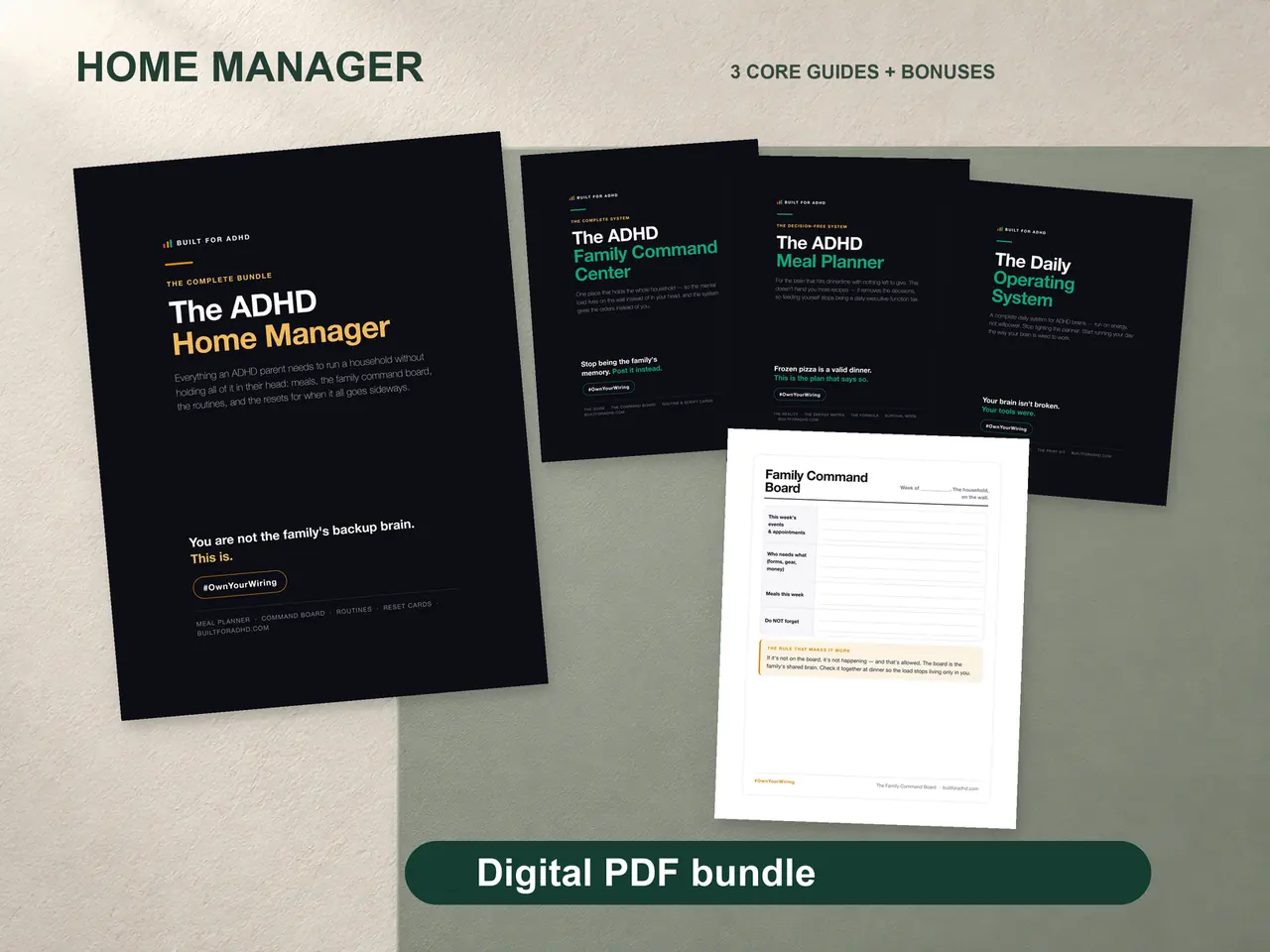
If you’d rather have the household side built for you, the ADHD Home Manager is where I’d point you. $47. Honest note: there’s no car-specific worksheet in it. What it has is the Family Command Center for giving recurring jobs an owner and a trigger, the Launch Pad for the one spot by the door everything passes through, and the Reset Cards for the weeks when the car wins anyway. The three-bag cleanout above is free and works on its own.
Related tools
- ADHD household systems — the hub for the chores that never stay done
- The free parent starter set — a printable for the fridge, not your head
- ADHD doom piling — why the pile stays invisible until it’s urgent
- An ADHD cleaning schedule that holds — one zone a day, sized to your tank
- Why you keep losing your keys and wallet — the object permanence underneath all of this
- The ADHD chore split — who owns the noticing, not just the doing