In this article
The relief lasted about nine days.
For nine days everything made sense in a way it never had. Twenty-odd years of evidence reorganized itself around one explanation, and the explanation was not you were lazy and you hid it well. I told people. I read everything. I bought three planners (of course I did).
Then on a completely ordinary Tuesday I was loading the dishwasher and I started crying about a job I lost in 2014.
Nobody warns you about that part. The relief is loud and it gets all the coverage. The thing standing behind it is quieter and it shows up late, and because it shows up late, most people assume it means something has gone wrong. (The practical side of what comes next is in the complete guide to ADHD tools for adults; this post is the other side.)
It hasn’t. What arrives after the relief is grief, and it is grief for a specific thing: every version of yourself that got written off for a reason that turned out not to be true.
What the grief is actually about
It is not sadness about having ADHD. That framing is the one that keeps people stuck, because having ADHD is just true now and there is nothing to do with sadness about a fact.
The grief is about the gap. Somewhere in you there is a running tally of things you were told, or told yourself: that you didn’t care enough, that you had potential you were wasting, that you were inconsistent, dramatic, scattered, too much. You believed that tally. You built a self-image on it and then you spent years trying to out-discipline it.
And now you’re holding a different explanation, and the tally doesn’t get retroactively deleted. It just sits there, suddenly unjustified, with twenty years of interest on it.
That’s the thing being mourned. Not a diagnosis. A verdict you served time for.
Why it hits weeks later and not in the room
Because the relief uses up all the available bandwidth first.
The first stretch is admin and adrenaline — reading, explaining yourself to people, reorganizing your whole autobiography in real time. That is genuinely a lot of processing, and it’s interesting, which means it holds attention easily. Hyperfocus will carry you through that stretch and make it feel like momentum.
Then the novelty runs out, the tank is lower than you noticed, and the quieter thing walks in through the door the adrenaline was holding shut. On a Tuesday. At the dishwasher.
That sequence is so common it’s almost boring. It isn’t a setback and it isn’t you handling this badly.
The two-column page
Here is the actual move, and it is deliberately small, because grief does not respond well to a project plan.
Take one sheet of paper. Draw a line down the middle. Head the left column What I believed about myself and the right column What was actually happening.
Then write one line. Just one.
Left: I was a flake who cancelled on people. Right: I said yes six days out with no sense of what Saturday would cost me, and then Saturday arrived and the tank was empty.
Left: I wasted my twenties. Right: I was running an unmodified brain on borrowed executive function and no instructions, and I was still showing up.
Left: I never finished anything. Right: I finished a lot of things in three-day bursts and then got no credit for the shape of it, including from me.
That’s the whole artifact. Two columns, one line at a time.
The rules that keep it from becoming another failed project
One line a day, maximum, and only on days with something in the tank. This is the single most important rule. The temptation is to sit down on a Saturday and do all twenty years in one sitting. Do not. An ADHD brain is extremely good at turning a page like this into a six-hour excavation that leaves you wrecked and no further along. One line is a complete success.
It’s a list, not an essay. No paragraphs, no narrative, no explaining. The left column is a sentence you actually said to yourself. The right column is the mechanism, in plain words. If you’re writing a third sentence, you’re writing an essay and the page is turning into homework.
It stays somewhere ordinary. Inside a notebook, in a drawer, on the fridge if your household is the kind where that works. Not on your phone. The whole value is that it is a physical object you wrote by hand, which is a different kind of real than a note you typed.
You don’t show it to anyone yet. This isn’t a conversation starter and it isn’t evidence for a case you’re building. It’s yours.
Nothing on it is a to-do. The right column is not a list of problems to go fix this month. It is only a record of what was actually going on. Fixing comes later and it comes from a system you can run on a low-energy day, not from a reckoning.
What not to do with this
Do not go re-litigate your history with other people. The urge is enormous and I understand it completely — you have new information and there are five conversations from 2019 you’d like to reopen with it. Almost none of those go the way you’re imagining, and the ones that do, go better in six months.
Do not turn the right column into a defense brief. The point isn’t to win the old argument. It’s to stop prosecuting it.
And the honest limit: this is a productivity-systems site and a two-column page is a sorting tool, not care. If the heavy end of this is where you’re living right now, that part belongs with a person, not a worksheet. The page is good at the backlog of small verdicts. It is not built for the big ones.
It doesn’t close. It gets quieter
Nobody told me this either, so: the grief does not resolve into a tidy ending where you’ve made peace with it and you’re done.
What happens is that it stops ambushing you. The verdicts come up less, and when they do, the right column answers faster than it used to, because you’ve written it down enough times that it’s loaded and ready. That’s the actual outcome. Not closure — a shorter reaction time.
The other thing that happens is that it starts showing up as practical information. “I cancel on people when I say yes too far out” is a grief line on Tuesday and a scheduling rule by the following month. Masking at work is a left-column entry until it becomes the reason you stop scheduling three meetings back to back. The page quietly turns into a requirements document for how you actually run.
That’s the part worth waiting for. It is also the part you cannot rush, which is annoying and true.
Do this today
One sheet. One line down the middle. Two headings. One entry.
Then put it in a drawer and go do something undemanding. That is the entire assignment, and it is not a small one.
If you want the newer-diagnosis logistics instead — what to actually change first — that’s the next-steps version, and rebuilding the systems that didn’t survive is the one after it. A blank page to start tonight is in the free adults starter.
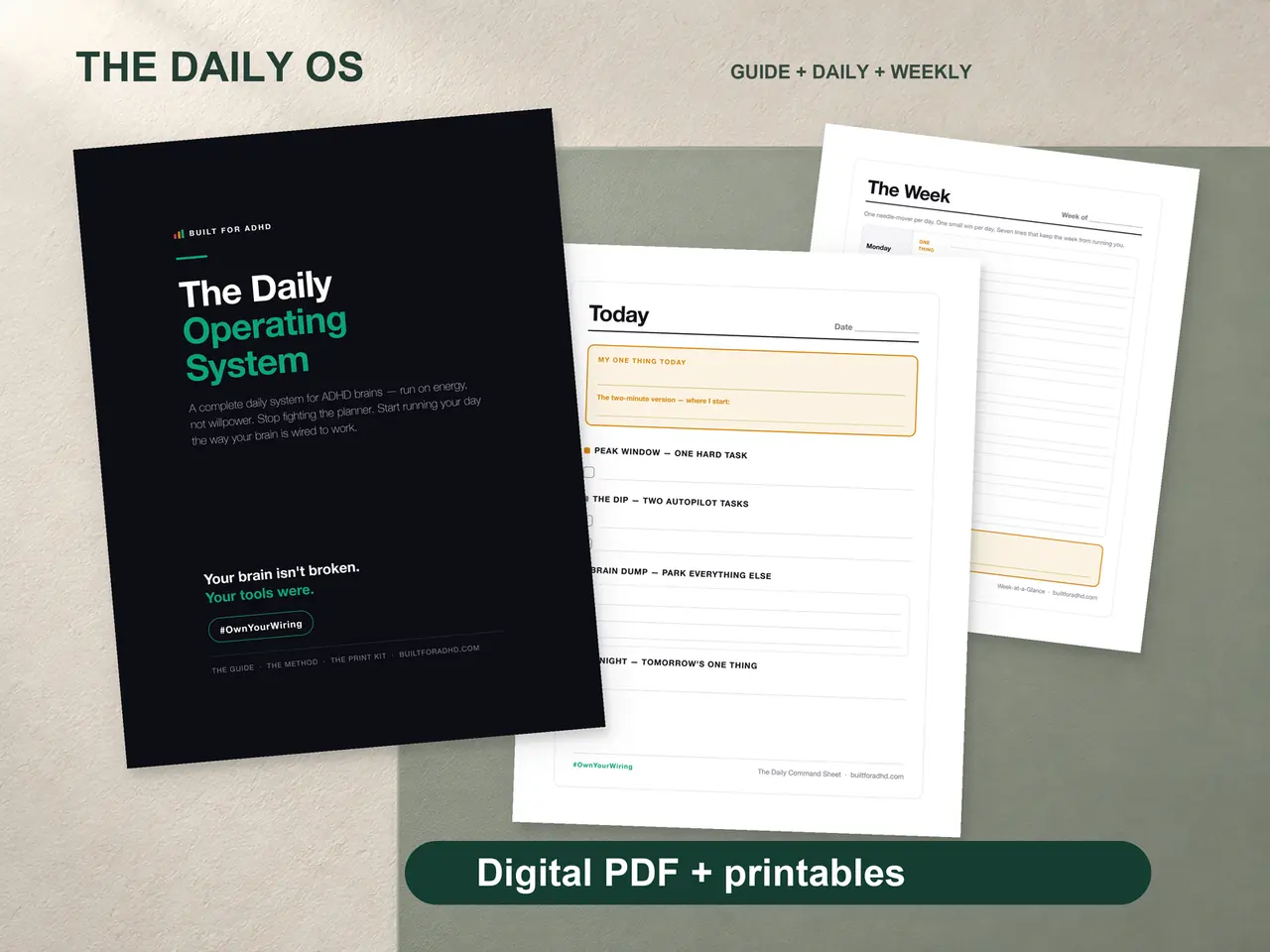
When the right column starts producing actual rules — energy-based scheduling, a brain dump that catches things, a restart that doesn’t require guilt — the ADHD Daily Operating System is where I’d put them, $17 once. Honest note: it is a paper day-planning system, not anything to do with the grief. It’s the thing you reach for a few weeks later, when the page has stopped being about the past and started being about Thursday.
Related tools
- Late diagnosed with ADHD, what now — the practical next steps version
- Rebuilding your systems after diagnosis — what to keep and what to let go
- ADHD masking exhaustion — the most common left-column entry
- ADHD imposter syndrome in high achievers — when the verdict survived the success
- Over-apologizing and rejection sensitivity — the habit the old tally built
- The free adults starter — a one-page sheet to write tonight’s line on
- ADHD tools for adults — the full toolkit once you’re past the first few weeks