In this article
There is a bin in my closet with a bread proofing basket, two lens filters for a camera I sold, a chess clock, and roughly forty dollars of embroidery floss still in the packaging. Each one was, at the time, the thing. Not a passing curiosity — the thing. Six hours of reading the first night. Opinions about brands within two days.
Then somewhere around week three the whole subject went gray. Not gradually — the color drains out overnight, and the next morning the bread basket on the counter is just an object you have to find a place for. (If hyperfocus also runs your work, organization tools for the self-employed is where I keep the business side of this.)
I spent a long time treating that bin as evidence about my character. It isn’t. It’s evidence that new interests were arriving through no process at all — showing up at full volume with unlimited access to my calendar and my card. That’s not a discipline problem. That’s a missing front door.
What’s actually happening in week one
The first days of a hyperfixation feel like being handed free energy, and that feeling is accurate. Everything is novel, every hour of reading pays out immediately, and for once you don’t have to negotiate with yourself to start. That’s rare enough that of course you say yes to all of it.
The problem is what you say yes to during that window. In week one you are an unreliable narrator about your own future — forecasting six months from inside the most interested you will ever be, and buying accordingly. The gear purchase is never a bet on the hobby. It’s a bet that the week-one version of you is the permanent one.
She isn’t. She never is. And naming that pattern out loud beats trying to out-willpower it in the moment.
Week three isn’t a failure event either. Novelty is the fuel, and novelty is a consumable. When it runs out, the interest drops to its real baseline — sometimes zero, sometimes a smaller sustainable thing you’d never have found otherwise. You can’t tell which from inside week one. Nobody can. That’s the whole reason for a front door instead of a verdict.
The intake checklist: six questions, ten minutes, before you buy anything
Run this the moment you catch yourself with eleven tabs open on it. It’s deliberately quick, because a long process is one you’ll skip at exactly the moment it matters.
1. What is the ten-dollar version? Every hobby has one. Sourdough: flour and a jar. Photography: the phone you already own. Guitar: a friend’s, borrowed for a month. Write it down before anything else. You’re not banned from the good gear — just not allowed to buy it in week one.
2. What does the first actual session look like? Not “learn photography” — “walk to the park Saturday and take fifty pictures of one tree.” If you can’t name a concrete first session, the fixation is still on reading about the hobby, which is its own separate and quite pleasant hobby.
3. Where does the time come from? Name what it displaces. It’s always displacing something, and the honest answer is usually “the evening block I said was for the other project.” Writing it down doesn’t stop you — you just find out on Monday instead of in three weeks.
4. Does this need storage? Some hobbies leave nothing behind. Some fill a closet. Not a rule against the second kind — just a question worth answering before the boxes arrive, because the pile is much harder to deal with than the decision that created it.
5. What’s the return date? Pick a day three weeks out. On it you answer one question: did I do the thing in the last seven days, yes or no. Not “do I still love it.” Just: did it happen.
6. Is there a version of this I already own? Check the bin. This one stings, and it saves the most money — a startling number of new fixations are old fixations in a slightly different hat.
Six answers, one page. Keep the page: it’s what makes week three legible instead of shameful.
The return date is the whole system
Everything above is setup. The return date is where the checklist earns its keep, because it converts a slow fade into a scheduled decision.
Without it, hobbies don’t end — they stop silently, and the gear sits there generating a small guilty feeling every time you walk past. That’s the part that actually costs you. Not the money. The forty small unresolved endings scattered around your house, each one quietly making the case that you don’t finish things.
So on the return date, you write one of three words next to the hobby.
Keep. You did it in the last seven days. It survived the novelty burning off, so it’s a real interest. Now you’re allowed the better gear — three weeks later, with evidence, at the exact moment it was never going to be an impulse.
Park. You didn’t do it, but you want to. It goes on a parking-lot list with the date, the gear stays in the bin, and you buy nothing further. Parked things are allowed to come back. Some of mine have, twice.
Close. You didn’t do it and the interest is gone. Close it on purpose: gear to the sell or give pile within the week, tabs closed, and write one line about what you actually liked about it. That line is more useful than the gear ever was — mine says I don’t want to bake, I want something to do with my hands at 9pm, and knowing that has saved me three future fixations.
A hobby you decided to close is a completely different object than one that just fizzled. Same outcome, opposite feeling — and the feeling determines whether you trust yourself the next time something exciting shows up.
Doing the backlog
If you have a bin of your own, do one pass. Not a purge weekend — that’s a project, and it’ll become its own three-week fixation.
Set a timer for twenty minutes. List what’s in there, one line each, and write keep, park, or close next to it. Most will be close, and closing forty in twenty minutes is far easier than closing one thoughtfully — at volume it stops being about your character and starts being about a bin.
Then clear the close pile within a week, at the lowest-effort exit available. Donation box beats selling. Selling five things is a hobby.
The parked list stays a plain page, same place as everything else, since a system living in six apps is one I won’t maintain. It’s the only artifact I have that makes the cycle look like a pattern instead of a personal failing.
What this is not
It’s not a way to stop having hyperfixations, and you shouldn’t want one. The fixation is the same machinery that lets you learn a subject in a weekend that takes other people a semester — pointed at work, it’s the most valuable thing an ADHD brain does. You don’t want to sand that off. You want a front door on it.
It’s also not a budget rule in disguise. The ten-dollar version isn’t there to save money, though it does. It’s there because starting cheap gets you to the first session faster, and the first session is the only part that was ever hard.
If you’d rather not draw the six questions yourself, the ADHD project starter template is the same intake shape built for projects — it works fine for a hobby, and already has the first-session box.
Do this today
If a fixation is live right now: open a page, answer the six questions, put the return date on the calendar. Ten minutes, before you open another tab.
If one just ended: write close next to it and pick where the gear goes. It takes a minute, and it changes the ending from something that happened to you into something you did.
The bin in my closet is smaller now — not because I stopped picking up new things. I picked up two this year. Both got a return date, and one got closed on purpose in June, and that one doesn’t live in the bin at all. It went to a coworker who’s still using it.
Related tools
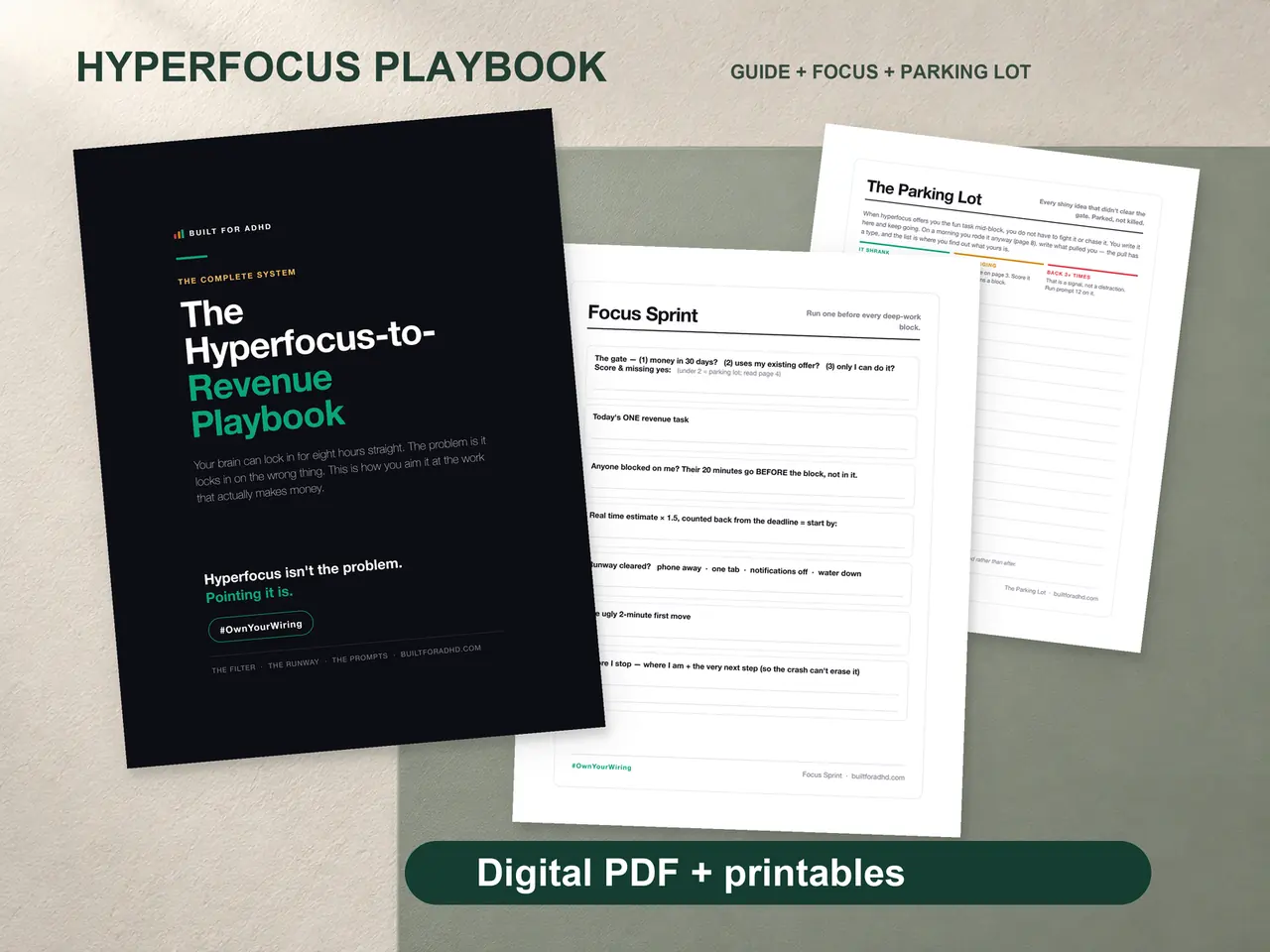
- Hyperfocus-to-Revenue Playbook — $9: the scored gate and parking lot, built for aiming focus at work
- Turning ADHD hyperfocus into revenue — the same machinery pointed at paid work
- The tiny first step method — how to build a first session small enough to happen
- The 24-hour impulse buy rule — the gap between wanting the gear and owning it
- ADHD doom piling and clutter — what to do with what the last four hobbies left behind
- Why every productivity system fails ADHD brains — why the parked list stays one plain page
- ADHD project starter template — the printable intake shape
If the fixations keep landing on hobbies while the work you actually get paid for sits untouched, the Hyperfocus-to-Revenue Playbook is the one to look at. $9. Honest caveat: it’s written for aiming hyperfocus at revenue, not at hobbies — but the scored gate and the parking lot are the same mechanic as the checklist above, with a worked example attached.