In this article
There’s a chair in your bedroom that hasn’t been a chair in months. There’s a corner of the kitchen counter that is legally its own ecosystem. There’s a tote bag by the door containing a phone charger, two pieces of mail from March, a single glove, and a receipt you kept for a reason you no longer remember.
The community named these doom piles — Didn’t Organize, Only Moved — and if you have ADHD, you probably have between three and thirty of them right now. You’ve also probably tried to fix them the normal way: a burst of shame, a Saturday, a trash bag, a beautiful empty surface… and a brand-new pile on it by Thursday. (The externalize-it toolkit this fix comes from lives in our guide to ADHD tools for adults.)
That cycle isn’t a willpower problem. Doom piles are a completely rational output of how an ADHD brain handles objects, and once you see the mechanism, the fix stops being “become a different person” and starts being a system.
A doom pile is not clutter — it’s deferred decisions
Every object in that pile is a question your brain asked and then declined to answer. Where does this go? Do I still need it? Is this trash or important? For a neurotypical brain, those micro-decisions cost almost nothing, so objects flow to destinations automatically. For an ADHD brain, every one of them draws from the same overdrawn account as every other decision you make all day — so the brain does the efficient thing: it defers. “I’ll deal with this later” isn’t a lie. It’s triage.
The pile is where deferred decisions go to wait. That’s why “just put things away as you go” advice bounces off you — it assumes the deciding is free. It isn’t. A doom pile is a hundred unpaid decision-debts stacked in physical form, and looking at it costs you a little every time, which is exactly why you’ve stopped seeing it at all.
There’s a second mechanism stacked on top: out of sight is out of existence. ADHD working memory doesn’t keep quiet background tabs on objects it can’t see. Put the important letter in a drawer and the letter stops existing — you know this, you’ve lost your keys to this exact physics. So the pile is also doing a job: it’s your brain keeping things visible on purpose, because visible is the only place things are real. The pile is a filing system. It’s just a filing system with one folder.
Why the Saturday purge always fails
The trash-bag Saturday fails for the same reason every productivity system built for neurotypical brains fails: it fixes the artifact, not the mechanism. You paid off one pile’s worth of decision debt in a single hyperfocus binge — but the rate at which your brain defers decisions didn’t change, so the debt starts accumulating again that afternoon. Worse, the purge usually ends with important things hidden in drawers “where they belong,” which your brain reads as gone, which triggers repurchasing, which is the ADHD tax with extra steps.
Stop aiming for “organized.” Aim for findable and contained. Those are different goals, and only one of them is compatible with your brain.
The containment system
1. Make the doom pile official. One basket, bin, or tray per room — a designated landing zone. Not hidden, not pretty, just bounded. When the deferring happens (it will), it happens into the container. This sounds like giving up; it’s actually the single highest-leverage move, because a bounded pile can’t metastasize across a counter, and “empty the basket” is a startable task in a way “deal with the corner” never is.
2. Triage by energy, ten minutes, timer on. Once or twice a week, take one container and sort into three piles only: trash, has-a-home, needs-a-decision. Trash leaves. Has-a-home items get walked home. Needs-a-decision goes back in the basket — that’s allowed. You’re not finishing; you’re keeping the debt serviced. Ten minutes on a timer, because the timer is what makes it a task instead of a doom of its own. Do it during a phone call or with a body double and it barely costs anything.
3. Store things where your eyes are. Open shelves beat cabinets. Clear bins beat opaque ones. Hooks beat closets. A “launch pad” by the door — keys, wallet, bag, the thing you must take tomorrow — beats every drawer you’ve ever owned. This feels like it should be the opposite of tidy, but visible storage is the compromise between your brain’s need to see things and your home’s need to not be one giant pile.
4. Kill piles at the source: fewer objects arrive undecided. The mail gets opened over the recycling bin, standing up, same spot daily. The Amazon box gets broken down when it’s opened, not archaeologically, later. You’re not becoming a tidy person — you’re moving a handful of decisions to moments when they’re cheap instead of letting them compound at 11 PM.
The part that isn’t about the stuff
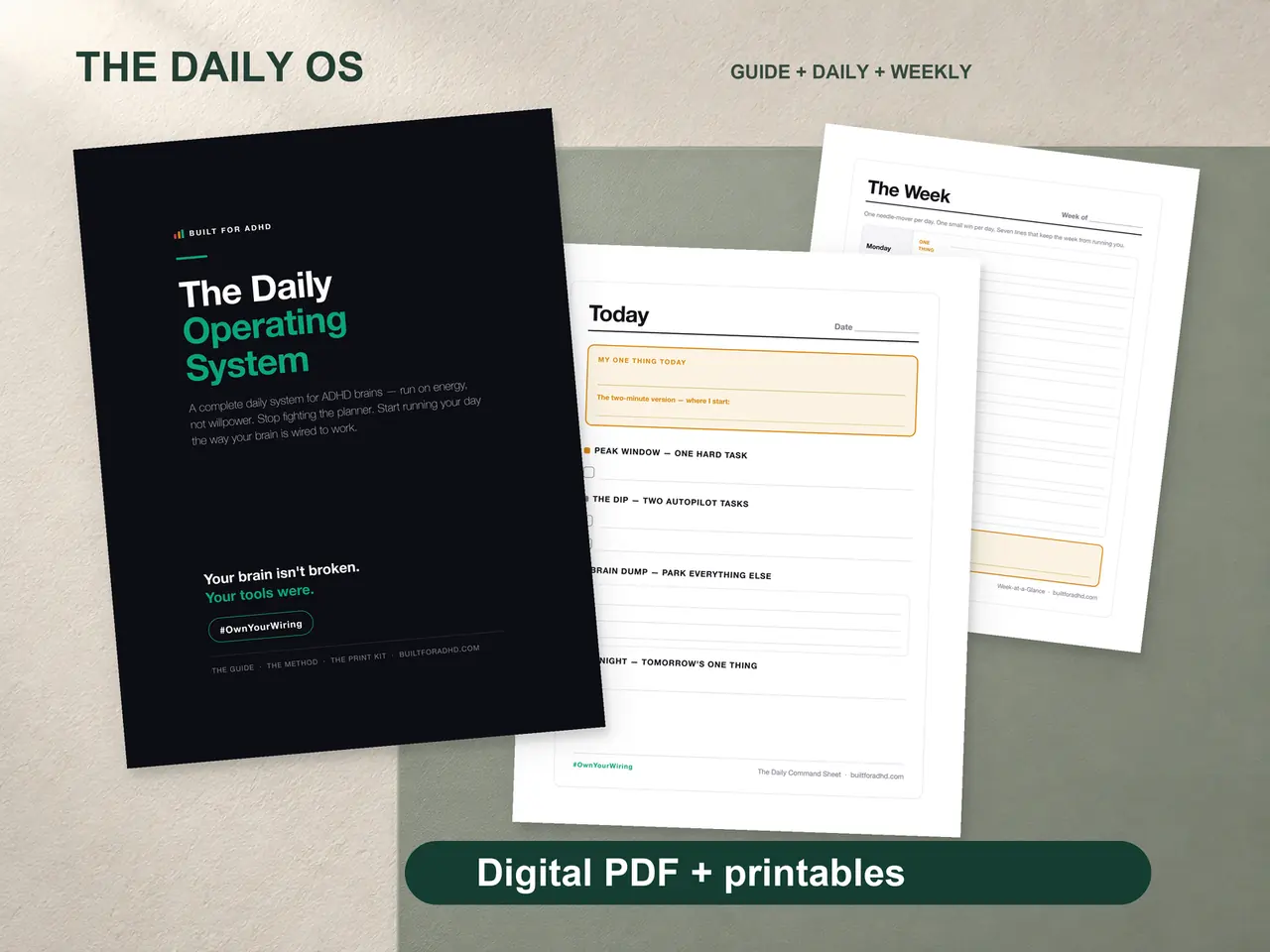
Doom piles are what deferred decisions look like on a counter. But the same mechanism is running on your calendar, your inbox, and the eleven half-remembered tasks you’re currently holding in your head — those are doom piles too, just invisible ones. The ADHD Daily OS is the container system for that side: a morning brain dump so the open loops land on one page instead of circling, tasks sorted by energy instead of guilt, a 3-max rule so the day itself stays bounded. $17, printable, and it works for exactly the reason the basket works — it gives the deferring somewhere official to go.
Start free: the brain dump sheet is the paper version of the launch pad. One page, every open loop, visible on purpose.
Related tools
- Free ADHD brain dump sheet — the landing zone for everything in your head
- ADHD organization templates — printable systems for the physical piles
- ADHD Daily OS — $17: the energy-based daily system
- Why you keep losing your keys — the object-permanence physics underneath all of this