In this article
The groceries you bought with real intentions, composting in the crisper drawer. The subscription for the app you used twice, quietly billing since March. The late fee on a bill you had the money for. The second phone charger. The third phone charger. The plane ticket that cost $220 more because booking it required a decision and decisions were sold out that week.
None of those are one story. They’re the same story, and it has a name: the ADHD tax — the ongoing cost of having a brain that struggles with exactly the tasks money quietly depends on. It’s the reason “just budget better” advice bounces off; the spending isn’t the root problem, the executive function load is. (That’s the premise behind every piece of ADHD money management we’ve written, and of the ADHD Budget Reset, which we’ll get to.)
What counts as the tax
If you’ve never itemized it, the scale is easy to miss, because it never arrives as one bill. It arrives as:
Late fees and interest — not from lacking money, but from the gap between knowing the bill exists and the bill existing in front of you. Out of sight is genuinely out of mind, and the credit card company charges for that. (This line has its own dedicated fix — the autopay-plus-visibility system.)
Zombie subscriptions — services that outlived their use by months because canceling is a boring multi-step task with no deadline, which is the exact task profile an ADHD brain deprioritizes forever. (There’s a full teardown of why subscriptions survive and the one-sitting sweep that kills them.)
Replacement purchases — the umbrellas, chargers, sunglasses, water bottles, and keys bought again because the original entered the void. Losing things isn’t carelessness; it’s what happens when object-permanence bookkeeping runs on a distracted brain.
Food waste and rescue meals — the produce that required a plan you didn’t have the energy to execute, plus the delivery order that replaced it. You pay twice for the same dinner.
The impulse line — dopamine is real, checkout buttons are one tap, and 2 AM is a vulnerable hour. Not every impulse buy is the tax, but the ones you can’t remember wanting by Thursday are.
Expired everything — gift cards, return windows, points, vouchers, the class pass. Value with a deadline attached is value your brain files under not now.
The upgrade toll — paying extra because the cheaper option needed advance planning: the last-minute flight, the full-price version of the thing that was on sale last week, expedited shipping as a lifestyle.
Some researchers and advocacy groups have tried to put annual figures on all this. The numbers vary too widely to quote honestly — but you don’t need a population average. You need your number, and yours is findable.
Why it isn’t a discipline problem
Every one of those line items traces back to the same three mechanics:
- Now vs. not now. Future costs aren’t felt, only current ones. The late fee lives in not now until it’s charged.
- Boring multi-step tasks don’t initiate. Canceling, returning, comparing, filing — all friction, no dopamine, no deadline. The brain’s start button doesn’t fire for them.
- Working memory drops the ball. The bill you meant to pay after dinner didn’t get rejected — it evaporated.
Notice what’s not on that list: caring, intelligence, effort. People pay the ADHD tax while trying hard, which is exactly why the shame spiral around it is both brutal and useless. You can’t shame a brain into a different working memory. You can build a system that doesn’t depend on it.
The fix: audit once, then automate the memory away
Step one: run the audit. One pass through three months of statements, tagging every charge that was late-fee, forgotten, duplicate, expired, or can’t-remember-wanting-it. It stings for about twenty minutes. Then something better than sting shows up: a number. A specific, personal, fixable number — and most people find the bulk of it comes from three or four recurring sources, not a hundred small sins.
Step two: kill the top sources structurally, not behaviorally. Autopay for every fixed bill, so paying stops requiring remembering. One cancellation sweep for the zombie subscriptions, done in a single sitting while the audit is open. A designated bowl-by-the-door for the losable items. Not “I’ll be more careful” — remove the step where careful was required.
Step three: give impulse a speed bump, not a wall. A pause rule for unplanned purchases over a threshold you pick — long enough for the dopamine to pass, short enough that you’ll actually honor it. (The 24-hour impulse rule is the deep dive.) Walls trigger rebellion; speed bumps just slow the tap.
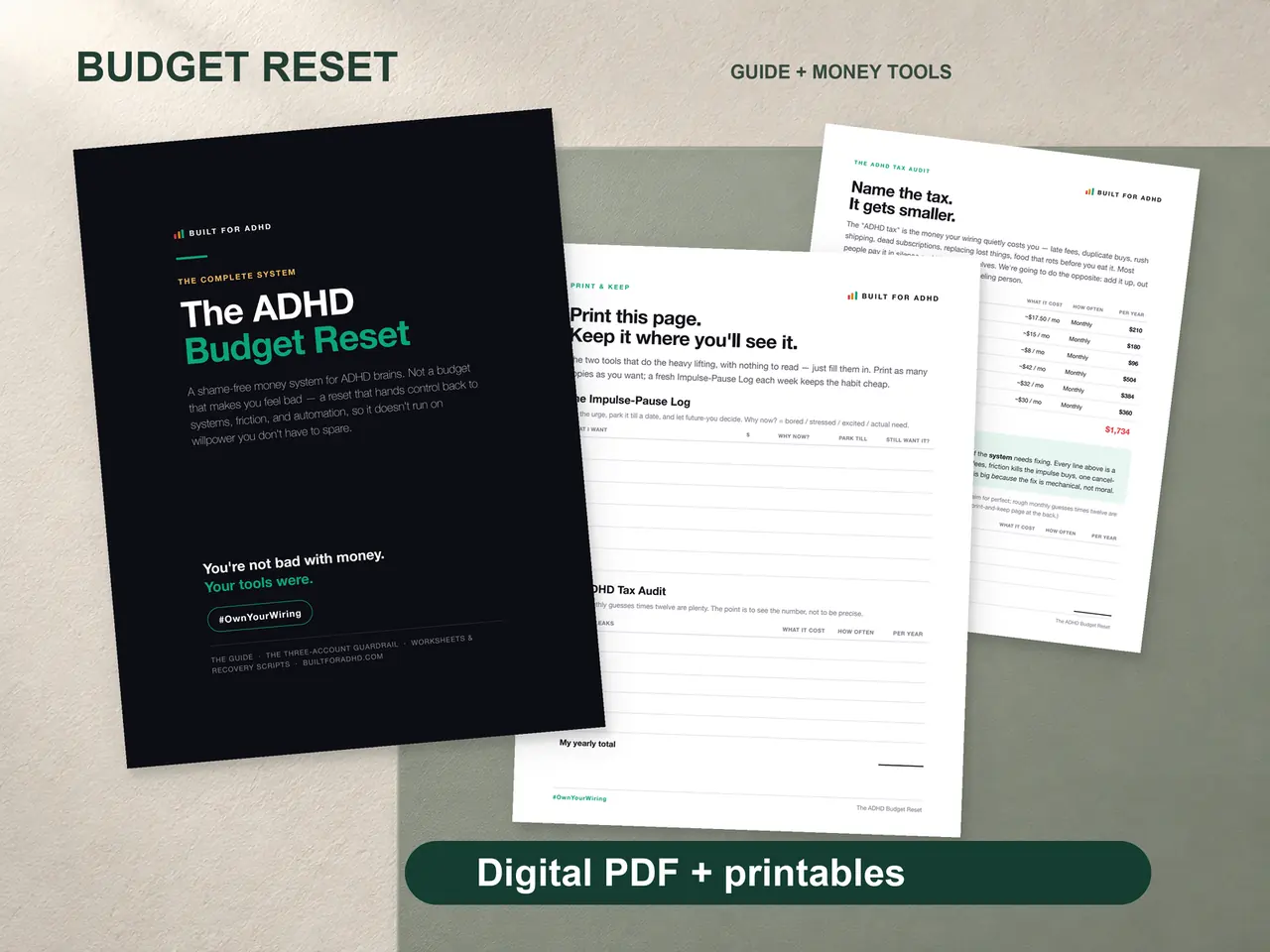
This three-step arc — the audit, the structural kills, the pause system, plus fun-money envelopes so spending stops being a moral event — is the ADHD Budget Reset, a $7 printable workbook with the ADHD Tax Audit as its centerpiece. It’s deliberately the cheapest thing on the site, because it’s usually the first one people need: it tends to find its own price in the first twenty minutes of the audit.
Start with the number
Don’t start with guilt, resolutions, or a budgeting app with 14 categories. Start by finding out what the tax has actually been costing you — this month, in your accounts, in dollars. If everything in your head is too loud to even start that, do a brain dump first and give the money-dread a page to live on.
The tax isn’t a verdict on you. It’s a bill your systems were quietly paying. Systems can be rebuilt. Verdicts can’t — which is lucky, because there was never a valid one here anyway.
Related tools
- ADHD Budget Reset — $7: the ADHD Tax Audit, the pause log, and fun-money envelopes
- The 24-hour impulse buy rule — the speed-bump system in detail
- How to budget with ADHD without hating every second — the 10-minute weekly money date
- The free ADHD Brain Dump sheet — for when the money-dread is part of a bigger swirl