In this article
The cruelest late fee is the one on a bill you could easily have paid.
The money was there. The intention was there — you saw the bill arrive, thought “after dinner,” and then the bill fell out of the world. Two weeks later it resurfaces wearing a $39 fee and a little note about your credit, and the shame does its familiar loop: how do I keep doing this? I’m not even broke.
Here’s the reframe that actually leads somewhere: you don’t have a payment problem, you have a visibility problem. Bills are designed for brains that feel time passing and remember unseen things. Yours doesn’t feel distant deadlines and deletes what it can’t see — so a due date three weeks out, buried in an inbox, is functionally invisible until it’s expensive. This is the single biggest line in the ADHD tax, and it’s also the most fixable one. (Visibility is the through-line of ADHD money management generally; the full system around this particular fix is the ADHD Budget Reset — we’ll get there.)
Why “set reminders” hasn’t worked
You’ve tried reminders. The reminder fires while you’re driving, or mid-task, or at dinner — always at a moment you can’t act — and a reminder you can’t act on gets swiped, and a swiped reminder is a deleted bill. The failure isn’t discipline. It’s that a notification is not a system: it demands you convert an interruption into an action, using exactly the initiation-and-memory machinery that dropped the bill the first time.
So the fix has two jobs, in strict order: make paying not depend on you wherever possible, and make the remainder impossible not to see.
Step 1: Autopay the fixed and the boring (one sitting)
Everything with a stable amount — rent, utilities, phone, insurance, minimum card payments, the subscriptions that survived the sweep — goes on autopay today, in one sitting, while the momentum from reading this exists. Same one-sitting rule as the subscription sweep, for the same reason: “I’ll set up autopay sometime” is a task with no deadline, and you know what your brain does with those.
Two honest caveats, because autopay advice usually skips them:
- Autopay needs a buffer. If the account sometimes runs close to zero, an autopull can become an overdraft fee — trading one ADHD tax for a worse one. Set autopay on a credit card where possible (then autopay the card’s minimum from checking so the floor is never missed), or keep a one-month cushion in checking if you can.
- Set minimums, not full balances, on anything variable until you trust the rhythm. The goal of this step is never miss, not optimize. Optimizing comes later, when the fees stop.
That’s most of the bleeding stopped with zero ongoing memory required. What’s left is the small, annoying category autopay can’t reach: the irregular, the variable, the paper.
Step 2: One visible date for everything else
The remainder — quarterly things, medical bills, the water bill that varies, anything that arrives on paper — gets one home with a date on it, where your eyes already go. Not five homes. Not an app. The kitchen wall or wherever your command center lives:
- The moment a bill enters the house (inbox counts), it gets written on the wall list: what, how much, due when. Ten seconds. The bill paper itself goes in one tray — the same single-landing-zone rule that works for keys.
- Bills get paid from the wall list at one weekly money moment — ten minutes, same day every week, attached to something that already happens (Sunday coffee works). Not “when I notice them.” Noticing is the broken step; the weekly moment replaces noticing with a rhythm.
That weekly ten minutes — check the list, pay what’s inside two weeks of due, glance at the account — is the entire maintenance load of this system. It’s deliberately small because a money ritual you dread is a money ritual you’ll skip.
Step 3: Close the loop on the fees you already paid
One more move, worth real money: call and ask. Banks, card issuers, and utilities waive late fees constantly for customers who ask, especially first offenses — the script is two sentences: “I’ve been a customer since X and I missed this by accident. Can you waive the fee?” Yes-rates are high, the call takes five minutes, and if phone calls are their own wall, this is a perfect AI-drafted script moment. Worst case is a no, and you were already living with the no.
Where this fits
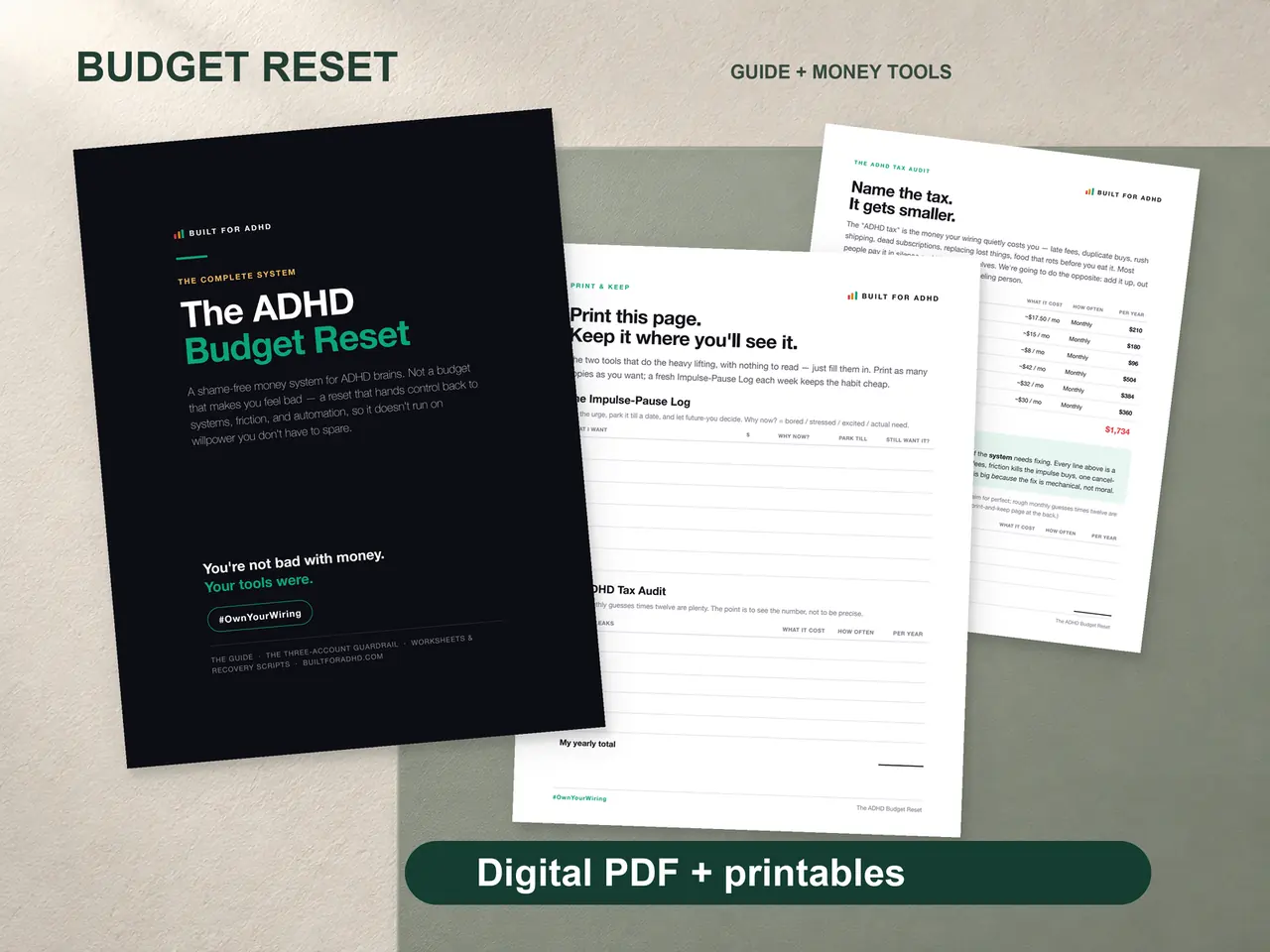
Autopay plus the wall list stops the late-fee line of the ADHD tax. The rest of the map — the impulse line, the audit that finds your total number, the fun-money envelopes that stop spending from being a moral event — is the ADHD Budget Reset, the $7 printable workbook this system comes from. Start there if money is the loudest problem; start with the free brain dump if money-dread is one thread of a bigger tangle.
You never needed a better memory. You needed bills that don’t rely on one.
Related tools
- ADHD Budget Reset — $7: the Tax Audit, the pause log, the weekly money date
- What is the ADHD tax? — the full map of the leaks
- The subscription sweep — the other one-sitting money fix
- Setting up a command center — the wall the bill list lives on