In this article
Every family has one person who functions as the household’s operating system — the one who knows the permission slip is due Thursday, that soccer moved to 5:30, that you’re almost out of the only granola bars anyone will eat, and that picture day is tomorrow.
If that person is you, and you also have ADHD (or your kids do, or — statistically likely — both), then the family’s entire logistics layer is running on the exact kind of memory that ADHD makes unreliable. When it drops something, it drops it publicly: the missed practice, the forgotten form, the 7:40 AM shoe crisis. And somehow it’s your fault, because you’re the calendar.
A command center is how you fire yourself from that job — one physical place on one wall that holds what the household needs to know, so nobody has to carry it in their head. The concept is simple. Making one that survives an ADHD household is a design problem, and this is the setup walkthrough. (For the what-and-why — and why paper beats another app for this — the ADHD command center guide is the companion page.)
Before you buy anything: the three failure modes
Most command centers die within a month, and they die one of three ways. Design against these first and the rest is assembly.
Death by beauty. The Pinterest version — matching frames, chalkboard calligraphy — fails because it punishes updating. When erasing your beautiful lettering feels like vandalism, the calendar stops being updated, and a stale command center is worse than none: the family learns to ignore the wall. Build for erasability, not admiration.
Death by location. Put it in the home office or a hallway nobody pauses in, and out of sight does what out of sight always does to ADHD brains — the wall stops existing. The command center must ambush the household’s eyeballs, not wait for a visit.
Death by complexity. Seven-zone systems with color codes per child and a laminating routine collapse the first week someone is sick. If maintaining it takes more executive function than the chaos it prevents, the math never works.
Step 1: Pick the wall the family can’t avoid
The right spot is wherever everyone already stalls daily — usually the kitchen (by the fridge is classic for a reason) or the wall beside the door everyone leaves through. The test: would a family member see it without turning their head during a normal morning? If you have to choose between the pretty spot and the high-traffic spot, high-traffic wins every time.
Step 2: Build the five zones
Five is the ceiling, not the target — start with the first three and let the system earn the rest.
1. The family calendar. One month-view, big, erasable. Everything with a date goes here — practices, appointments, picture day, the babysitter. One calendar for the whole family, not one per person: the entire point is a single source of truth, and split calendars quietly reinstate you as the merge conflict resolver.
2. The launch pad. Hooks and a shelf (or a bin per kid) directly below or beside the board: backpacks, keys, the signed form, library books, tomorrow’s things staged tonight. This kills the 7:40 shoe crisis at its source — the same landing-zone logic that stops you losing your keys, scaled up to the whole family.
3. The capture strip. A notepad or dry-erase column where anything gets written the moment it enters a head: “out of granola bars,” “field trip $ due Fri,” “call the dentist.” The rule that makes it work: if it’s not on the wall, it isn’t real. This is what actually offloads the mental load — the household’s brain dump, permanently open. (Your personal version of this is the free Brain Dump sheet — same move, your own head.)
4. Routine cards (add in week two or three). The morning and bedtime sequences as short picture-or-word checklists at kid height. The card is the boss, not you — “check your card” replaces the fourth repetition of “shoes, we talked about shoes,” and takes the nag-voice out of your day.
5. The drop zone (add when paper starts piling). One tray for incoming paper — school forms, mail, the stuff that otherwise colonizes the counter. One tray, emptied at the weekly reset. Not a filing system; a holding pen.
Step 3: Get buy-in without a family meeting nobody wanted
A command center only works if the family actually uses it, and family adoption follows one rule: the wall must give before it takes. Launch it with things the kids want to see there — the pizza night, the countdown to the trip, their game schedule. Once checking the wall pays off, adding their responsibilities to it meets far less resistance. Then let each kid own a piece — their own color, their own checklist card — because owned things get used and assigned things get ignored.
And model the capture rule out loud: “I’m putting it on the wall so I don’t have to remember it.” That sentence, repeated for a couple of weeks, is the whole training program.
Step 4: The five-minute rule that keeps it alive
Every command center drifts stale; the surviving ones have a reset ritual. Once a week — Sunday evening works for most families — five minutes: wipe last week, write this week, empty the drop zone, restock the capture strip. Tie it to something that already happens (right after Sunday dinner) rather than trusting anyone to remember a floating task, because a maintenance job that depends on memory is just the old system wearing a lanyard.
If a week gets skipped — it will — the system is designed to take the hit: nothing shames you, nothing streaks, you just do the reset a week late. Guilt-free restart is a feature, not a concession.
The shortcut version
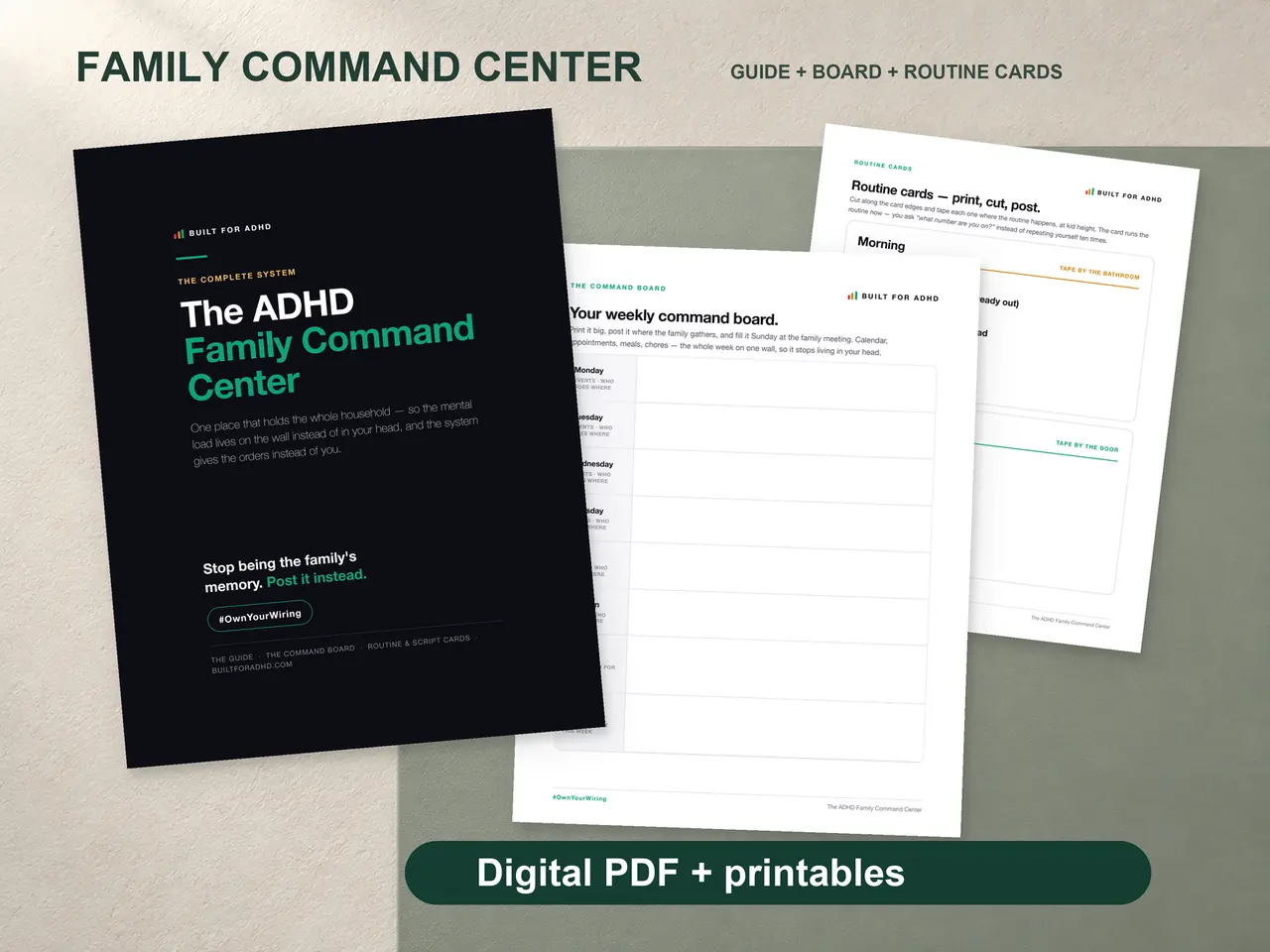
Everything above is buildable from scratch. If you’d rather skip the design phase, the ADHD Family Command Center is the $19 done-for-you kit: the printable command board, routine cards for the chaos points, the launch pad system, the weekly meeting agenda, and — honestly the underrated part — the nag-free scripts for getting kids to check the board without the fourth reminder. Print it, tape it up, run the five-minute reset. The design decisions in this post are already made in it.
Start this week with just the calendar and the capture strip on the least avoidable wall in the house. The household’s operating system deserves better hardware than your working memory — and so do you.
Related tools
- The ADHD command center guide — what it is and why paper wins
- ADHD Family Command Center — the $19 print-and-post kit
- Free printable tools for ADHD parents — start with the morning checklist
- Weekly planning that survives chaos — the planning layer on top