You’ve tried to keep it all in your head. You’ve tried the notes app, the shared calendar, the sticky notes on the mirror. And still — the appointment gets missed, the permission slip surfaces the morning it’s due, and the thing you swore you’d remember is simply gone. This isn’t carelessness. It’s what happens when a brain with a leaky working memory tries to be the place where information lives.
An ADHD command center fixes that by moving the information out of your head and into one place you can actually see.
What an ADHD Command Center Actually Is
Strip away the Pinterest photos and it’s simple: one visible spot — usually a single printed page you post somewhere you already look — that holds what your week is made of. This week’s schedule. Who needs to be where. The appointments, the deadlines, the running list of small things that would otherwise exist only in your memory, which is exactly where ADHD makes them disappear.
The magic isn’t the page. It’s the one. When information lives in seven places, none of them is ever completely true, so you don’t trust any of them, so you fall back on your head — the least reliable place of all. A command center gives your brain a single source of truth it can glance at instead of trying to reconstruct.
Why It Works for the ADHD Brain
Working memory is the thing ADHD taxes hardest. The moment something new grabs your attention, whatever you were holding onto slips. No amount of trying harder fixes a mechanism that’s wired to drop things — but you can stop asking it to hold things in the first place.
A command center works with that wiring instead of against it:
- It’s external. The information isn’t in your head, so a distracted brain can’t lose it.
- It’s visible. Posted where you already look, it uses the ADHD brain’s reliance on in-the-moment visual cues, instead of demanding you remember to check something.
- It’s low-upkeep. The versions that survive are the ones that need a five-minute weekly reset, not daily data entry — because anything that needs willpower to maintain is a system an ADHD brain will abandon.
(When you’re ready to build one, the step-by-step command center setup walkthrough covers wall choice, the five zones, family buy-in, and the maintenance rule.)
Why Paper Beats an App Here
Every organizing app assumes you’ll remember to open it and keep it updated. That assumption is exactly what ADHD breaks. An app that isn’t open isn’t reminding anyone of anything.
A printed board is always on. It needs no login, sends no notifications you’ll swipe away on autopilot, and asks nothing of you except a glance. You print it, write on it, and post it — and you own it forever, with no subscription quietly billing you for a tool you stopped opening in week two. For a brain that needs cues in the environment rather than one more thing to check, paper isn’t the low-tech option. It’s the one that works.
What a Built-for-ADHD Command Center Looks Like
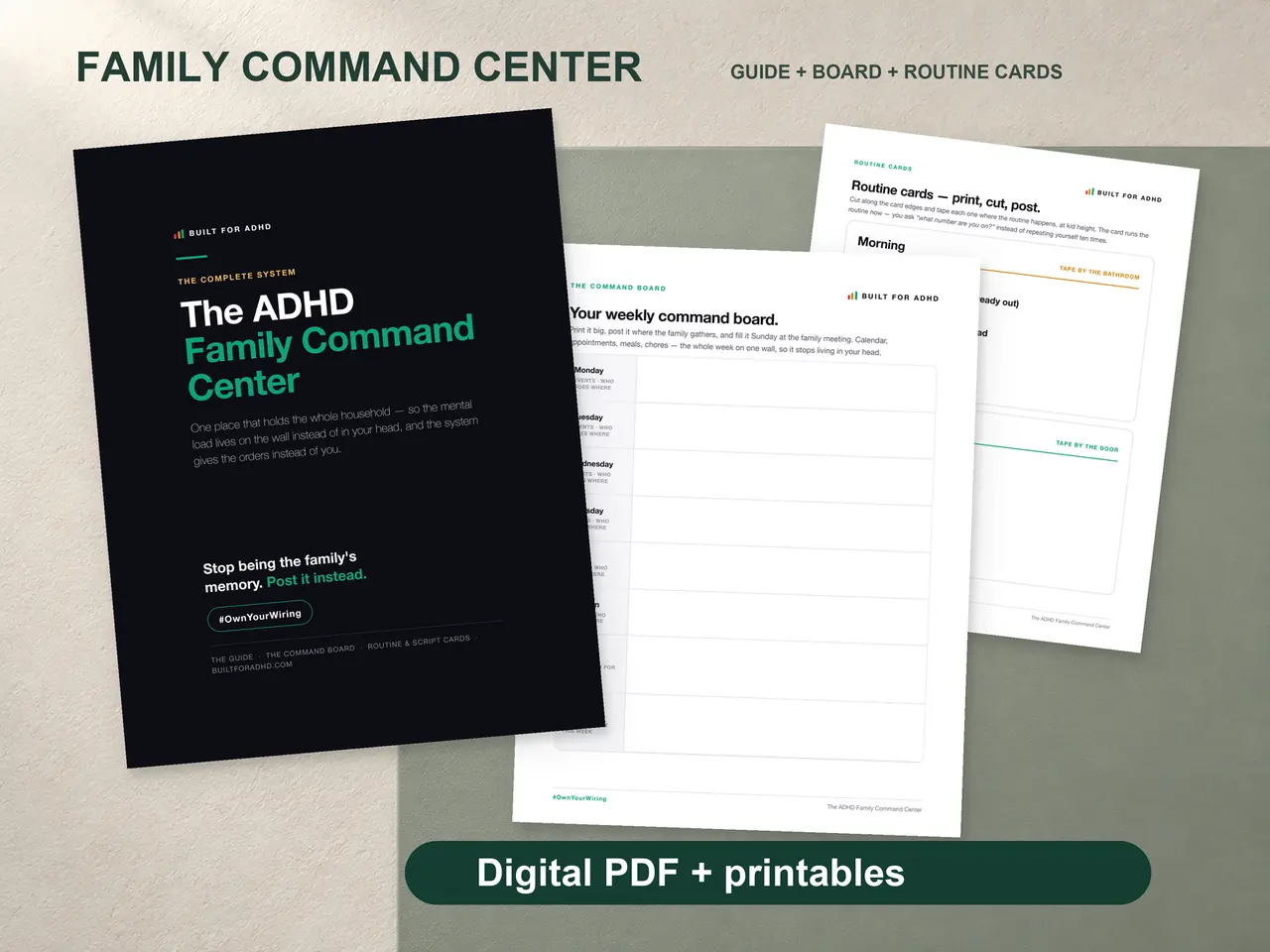
The ADHD Family Command Center is a printable command board built on exactly these principles: one page where the week’s schedule, meals, chores, and appointments all live in the open, with big write-in rows you fill by hand so setup takes minutes and keeping it current is a glance, not a chore. It’s designed with zero-guilt mechanics — no streaks to break, no day you can fall behind, and permission to wipe it and restart from today whenever the week comes apart.
It’s built for households, but the same idea scales to any ADHD life: one visible place, updated in a quick weekly reset, holding the things your brain was never built to carry. If you want the fuller picture of which tools fit which corner of an ADHD life, start with the complete guide to ADHD tools for adults.
You don’t need a better memory. You need somewhere to put the things your memory keeps dropping — where you can see them, without having to remember to look.